I’ve got a new quilt pattern out! It’s called Zester, and it’s in this year’s QuiltCon magazine.

Zester is based on Sunday sketch #250, which features large drunkard’s path blocks alternating with nine-patch blocks made up of half-square triangles.

I modified the design to add some negative space along the top and one side, and introduced a bold palette.

I used Art Gallery Fabrics’ Pure Solids in this quilt, because I wanted that exact yellow – Empire Yellow, my new favourite – and a black (Caviar) to match. Their solids definitely have a lighter hand than the Konas I usually use, and they feel a bit more slippery, but they sew like a dream and don’t fray terribly.
Because it uses only two types of blocks, Zester comes together really quickly. You can chain-piece all the curves, then chain-piece all the HSTs, and before you know it, you’ll have a quilt top!
Zester was quilted by Valerie Cooper from Sweet Gum Quilting. With Valerie’s advice, I settled on yellow thread and straight-line quilting, which I’m really happy with. I love the contrast of the yellow thread on the black fabric! (I also love being able to trust Valerie with the quilting, rather than stressing about doing it myself!)
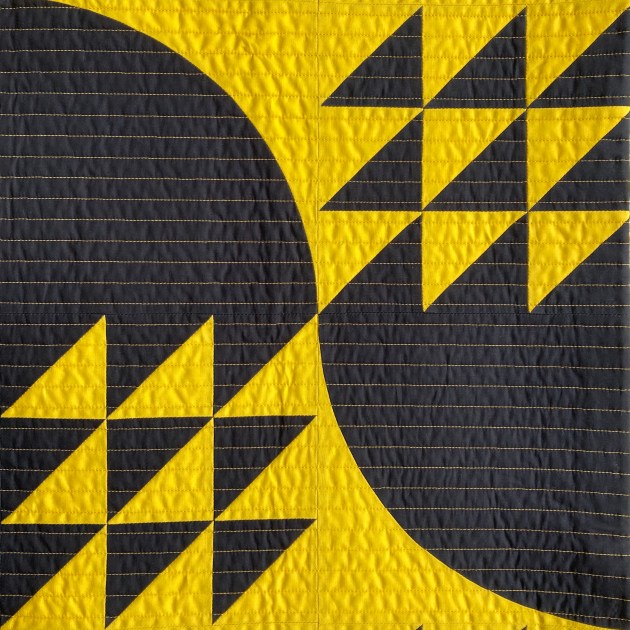
I picked the name Zester because the HSTs remind me of the really sharp bits on a cheese grater or micro-plane for lemon zesting. We have a wasabi grater and those teeth are sharp! But ‘Zester’ felt like a nicer name than ‘Grater’ haha.
I don’t publish quilt patterns in magazines much anymore, but I still submit designs for consideration in QuiltCon magazine every year. QuiltCon is definitely a focal point for modern quilters, and I get a lot of inspiration seeing others’ work each year (from afar – I’ve never been to the show in person!). I’m happy to be able to contribute to the magazine once again, alongside loads of incredible designers and makers.

Digital copies of the 2022 QuiltCon magazine are on sale now. Print copies go on sale on 22 February to coincide with the show in Phoenix. You can also buy individual digital patterns, so if you fancy just making Zester – or my award-winning quilt Fanfold from QuiltCon 2021 – you can find the pattern on the Quilting Daily website.