
Tagged: half-rectangle triangles
Sunday sketch #62
Part of what kept me interested in last week’s sketch is the odd perspective — on the left, the top of the zig-zags is in full view; on the right, it’s the bottom. That sort of unnatural, confusing perspective makes me look at the design again and again.
I haven’t played with perspective much yet, so this might be an area I delve into a little more. This week’s sketch is based on a quick doodle that I made of an apartment building façade in Melbourne awhile back; I found it on the back of a receipt when cleaning out my wallet recently.
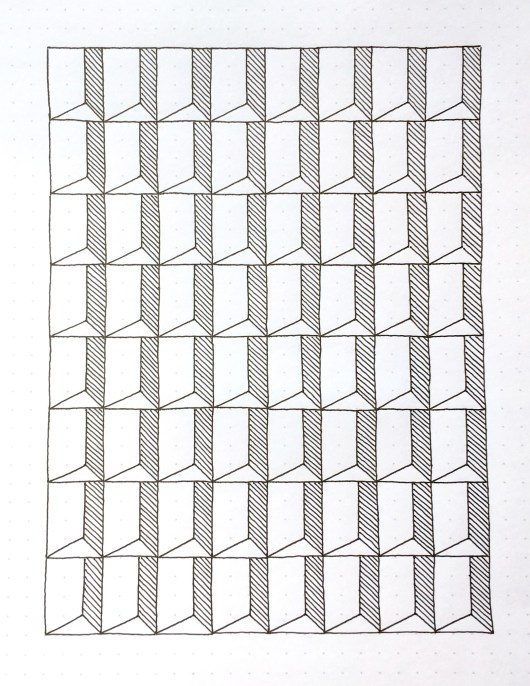
I like how rotating the sketch gives an entirely new look — a new perspective — to the design:

Or even…

If you were brave enough to try a Y-seam, this design could be made into a quilt pattern by combining a triangle and two right trapezoids. Otherwise, you could just use two rectangles, one half-square triangle and one 2:1 half-rectangle triangle per block.
Sunday sketch #58
In the past few weeks, skinny rectangles have morphed into wider rectangles, and the vistas outside those rectangular windows have changed from angles to rectangles and back again. By recombining (or developing?) those elements, I’ve created a new design based on the idea of peeking through one layer to see the next one.

Spin the design so the stripes are vertical, and suddenly the rectangle becomes a diamond.

Construction of these designs would be even simpler (and quicker) than the previous Sunday sketches — mostly stripes with a few half-square triangles (for the top design) and half-rectangle triangles (for the bottom design).
Sunday sketch #51
It’s funny how things come full circle. Lately, in my day job, I’ve been writing about recent discoveries in neuroscience research. It’s a great reminder of two things: the human brain is amazing, and researchers are making ground-breaking discoveries about how it works.
So, synapses firing and neurons connecting led to this week’s branched design.

But the design also reflects a feeling of disruption and distress. I received news this week that a dear family member had suffered a massive stroke. Thankfully he was treated by one of the country’s best specialists, and is showing signs of recovery. It will take time, but I’m trying to hang on to those recent realisations: the brain has an amazing capacity to recover from damage, and researchers – including doctors who work with patients – are making great progress in the field of brain research.
This pattern is all angles – half-square triangles and half-rectangle triangles. It might be easier to paper-piece the skinnier parallelograms. There’s no need to follow this exact layout – you could make a bunch of pieces and just mix them around until you created the desired effect. Disorder and chaos are the goal.
