
Category: Sunday sketch
Sunday sketch #217
When I sit down to sketch (on paper or in EQ8), unless I have something specific in mind, I’ll often start by playing with old favourites – like a star, or some triangles, or maybe even some curves. It’s like a warm-up, to get my brain thinking about shapes and colours.
This week’s series of sketches came from a star block. But I’m not going to show you the original star block I came up with. Why not? Because it’s boring!
One of the advantages of using Electric Quilt 8 for designing quilts is how easily you can manipulate single blocks. Often I’ll design a block that’s a bit meh, but rotating it, flipping it, or colouring it differently can create something way more interesting. Those sorts of manipulations are much more time-consuming (and paper-consuming!) to do with my gel pen and dot pad.
So I’ll walk you through a bunch of designs that came out of the original boring star block. The boring star block was created from 4 copies of a single mini-block, and it’s this mini-block that I’ve manipulated to create a bunch of new designs.
Here’s the first one. The block is laid out in a 6 x 6 grid, with the blocks all facing the same direction. The two-colour palette (not counting white) helps you to differentiate the single blocks.

Still facing the same direction, but now the pink blocks are in a reverse colourway – the pink and white are switched. It’s a small change but it definitely gives the two designs a slightly different feel.
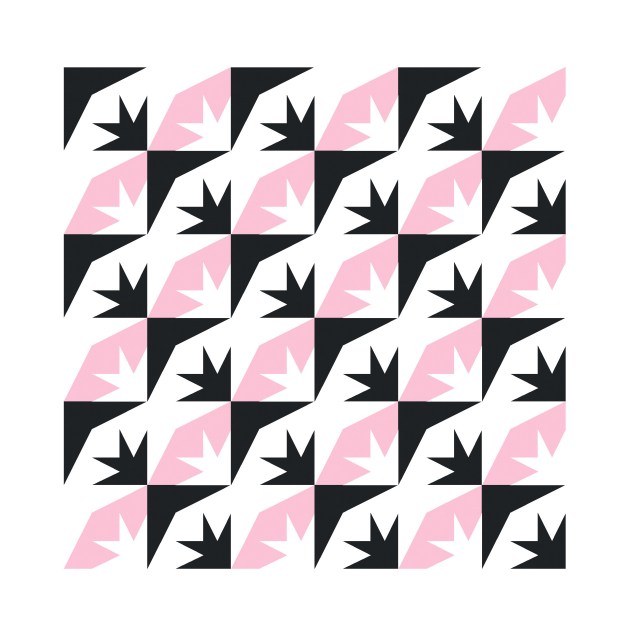
Switching back to a single colour (black) subtly changes the design again. This one makes me think of sprigs of vegetation out in the desert.
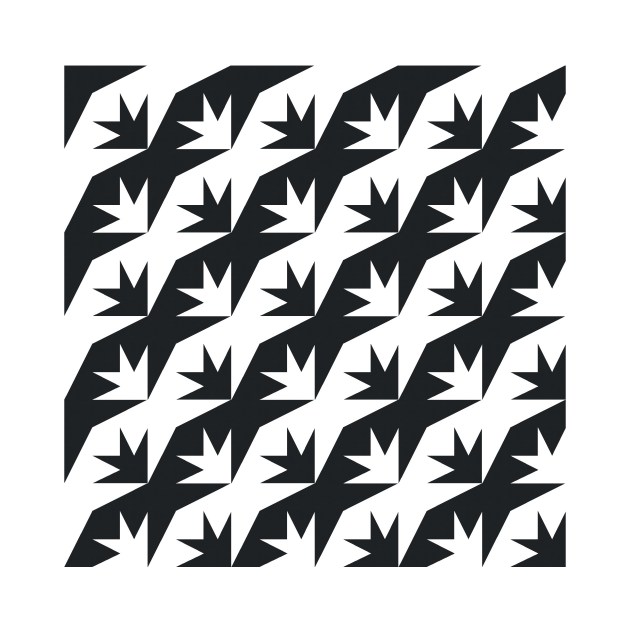
Rotating the blocks introduces a new variation. In the design below, the blocks are rotated 90 degrees with respect to their neighbours. The alternating colours help to create some new shapes and movement.

Adding in a third colour (and a border, just for fun) helps to distinguish those spiky internal shapes from the angled border shapes. The blue and pink shapes now feel like two interconnected webs, controlling those spiky black shapes (which have 8 ‘legs’!).
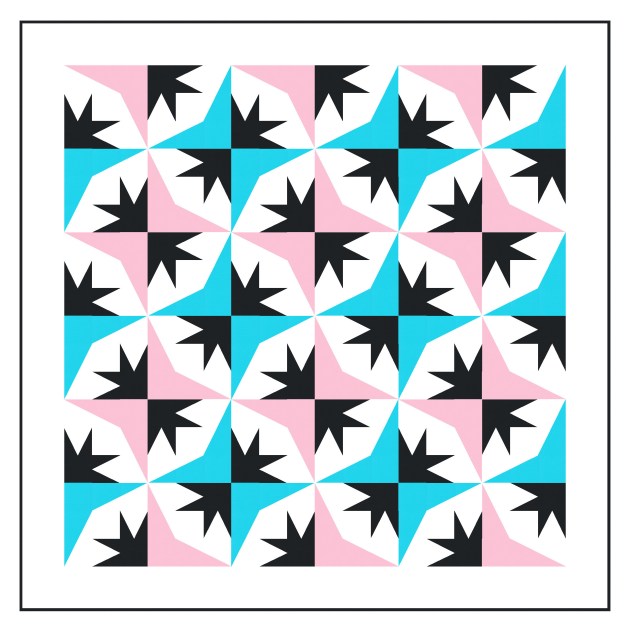
Or the black shapes can come to the foreground, by colouring in the squares that have thus far remained hidden. This also streamlines the blue and pink border shapes, which actually helps to refine its movement (to my mind, anyway).
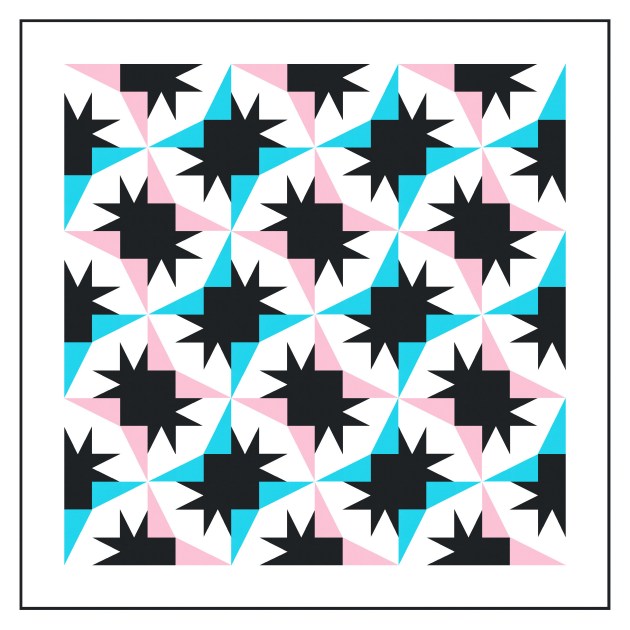
We can thicken up the blue and pink by switching out the border shapes for the spiky-background shapes instead. We can still see the diagonal movement of the colours, but we get to see more of the colours too.
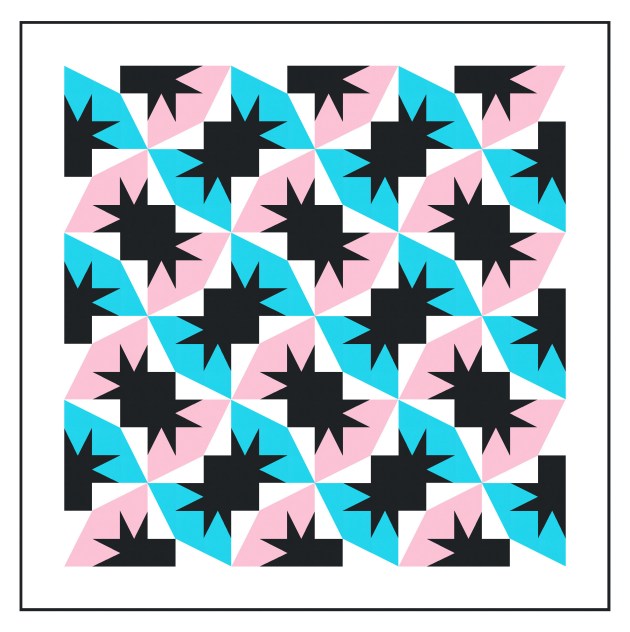
You can get a better idea of where those squares came from (and how they contribute to the actual construction of a quilt from this design) if we colour them differently. I think this design might be my favourite of this series.

Or switch blue to white, and add a coloured border to make the pink feel like it’s a background rather than a foreground colour.
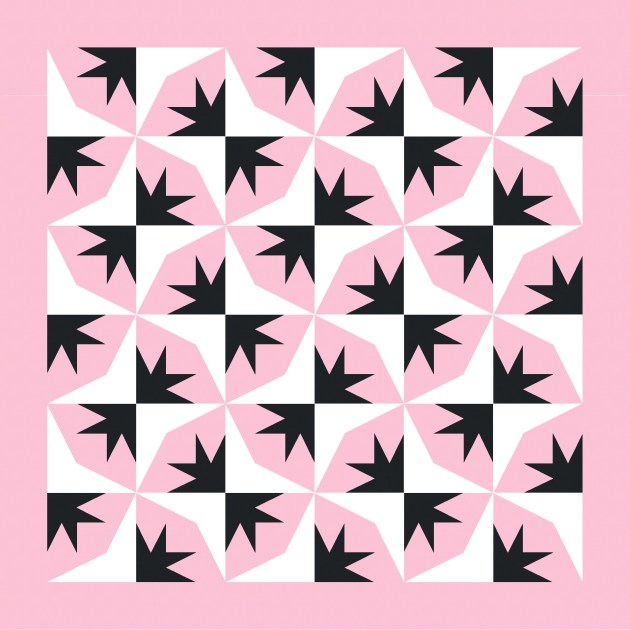
You could embrace white as a background colour, and use chunky rinds of colour to separate the black spikes.

Or take the focus off the black spikes altogether.

But I kinda like the spikes, so here they’re the focus again. This pared-back design doesn’t need any half-rectangle triangles like the other designs – they could be replaced with solid rectangles here. Much quicker and easier! I think this version would look great in a scrappy palette or a limited palette with scrappy fabrics.

Using a single colour can help to show the construction of a single block. There’s so much going on in this version that I think it needs a super-limited palette to not be too overwhelming (for me, anyway).

And, last but not least, a totally different version that just goes to show the versatility (and serendipity) you can create by changing only block rotation and colour placement.

This is just the tip of the iceberg; I have so many more variations of this design that I haven’t shared here. I just wanted to show how easy it is to make large changes to an overall design by tweaking little bits along the way.
So, each block is constructed using two squares, two half-rectangle triangles, one half-square triangle, and two triangle-in-a-square units. Depending on your colour placement though, you might not need some of these units.
Sunday sketch #216
It’s been ages since I’ve used Excel to create a quilt design! Sunday sketch #194 was the last one I shared with you.
This week’s design is a fairly simple one inspired by a cable-knit sweater that my husband noticed on a TV show (French spy drama ‘The Bureau’ – so good!). I liked how the strands twisted together then separated to create new twists, and so on and so forth. Because I knew the design would be all straight lines, Excel seemed like the fastest way to get the idea from my head onto the screen. After a bit of trial and error, I created this design with parallel twists. I used four colours, so it’s easier to see how each strand moves from one side of the design to the other.

Those horizontal areas of criss-crossed lines, where the strands stretch between two twists, add an interesting bit of negative space. In this design, green is always paired with yellow, and red is always paired with blue.
But then I realised that instead of crossing over in the middle like that, the strands could just twist around each other again. This creates a staggered but more consistent design. And note how each colour is paired with two others now: yellow with green and red; green with yellow and blue; red with blue and yellow; and blue with red and green. Of course, parallel lines never meet, so red is never paired with green, nor yellow with blue.

It’s a bit like a chain-link fence too, I guess (with a few too many turns per twist).
This is one of very few Sunday sketches where I haven’t figured out how to make the design into a quilt pattern. Of course, you could just chop up lots of rectangles and squares and piece them together. But I wanted a construction method where each coloured rectangle could be kept intact, as a single piece of fabric. I’m not sure there’s a way to do that without requiring partial seams or Y-seams. I’ll keep thinking about it!
Sunday sketch #215
I love this week’s design – super-simple, but super-cute too. Sometimes the most basic designs have the biggest visual impact!
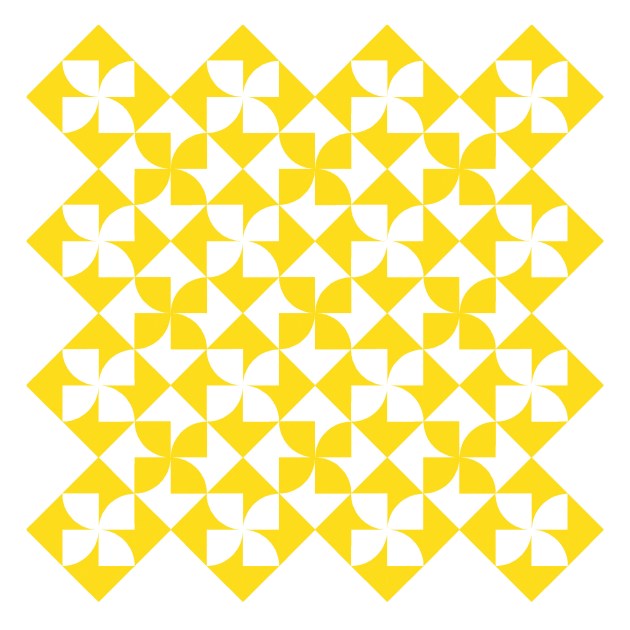
A limited palette (just yellow and white) makes it easier to see those curves winding their way across the design, connecting each block. They’re also visible in the reverse colourway. Honestly, I could make all the quilts in this yellow. I love it!

Two main elements pop out when you look at the design: the pinwheels and the background checkerboard. That still offers up lots of opportunity for different colour placement, even with a limited palette. Here I’ve only used two colours (yellow and pink) plus white.
Keeping the checkerboard consistent and changing some of the pinwheels…
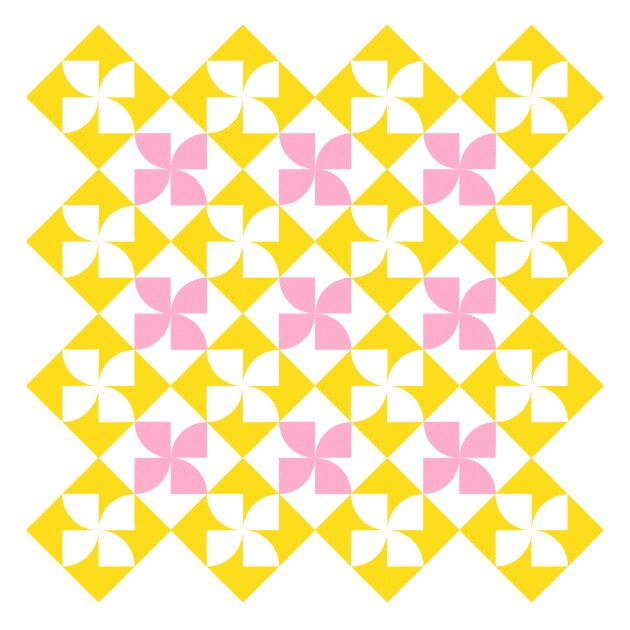
Or keeping the pinwheels consistent and changing some of the checkerboard…

Or changing both the checkerboard and the pinwheels (and introducing one more colour)…

Saturating the design more, but keeping a few pinwheels white…

Or even fewer white…
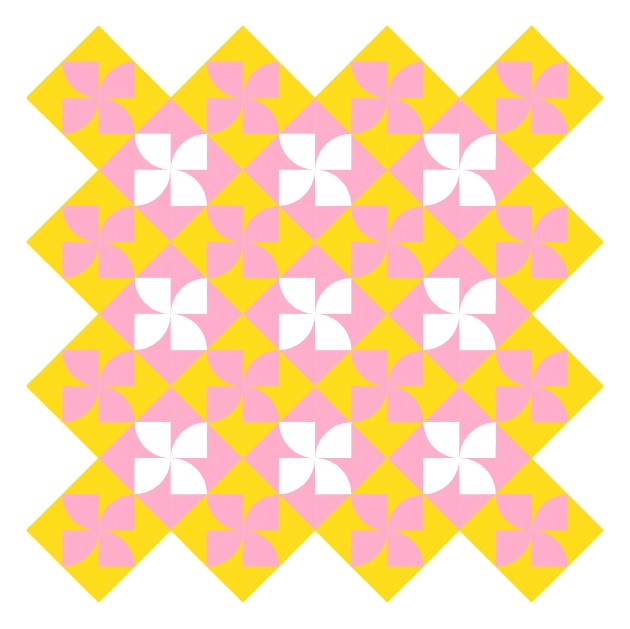
Or none at all…

Replacing the yellow in the previous version gives you a monochrome version again, but slightly different than the first one. The outermost blocks are pinwheels rather than checkerboards, so the whole design now has a square edge. This emphasises the internal horizontal and vertical lines, too.
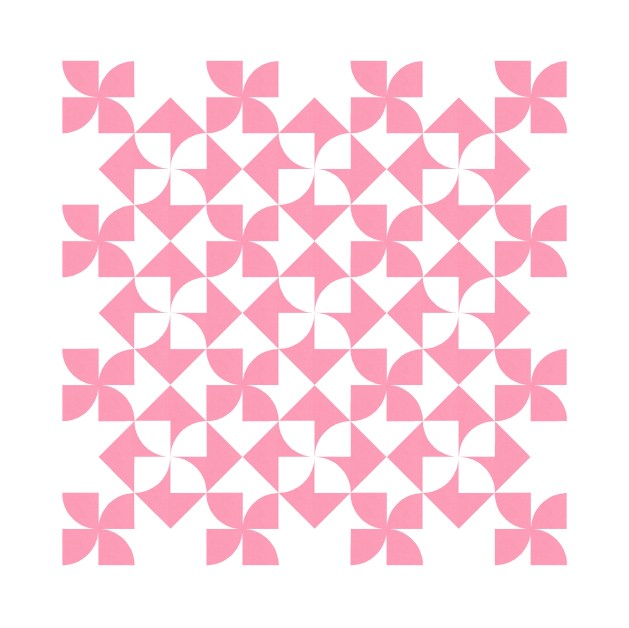
And, finally, a little bit of whimsy to end on. I was going to show what a section of the previous version looks like against a coloured background, but decided to keep these extra curves in. I like how they’re a little reminder of the internal curves.
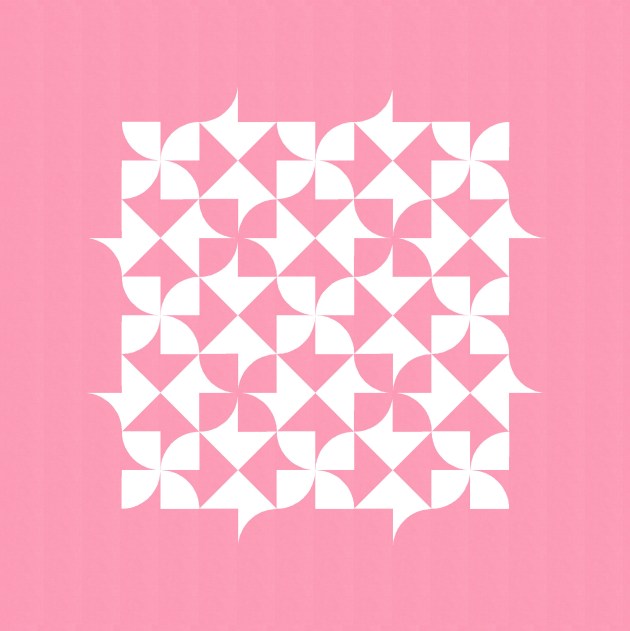
Another reason why those little curves stayed in is because of how I designed the block in this Sunday sketch… and cos I was too lazy to change it when I realised there was an easier construction method.
Originally, each block was made from two drunkard’s path units and two half-square triangles (with each pair in opposite corners). When drawing in EQ8, I didn’t bother separating the drunkard’s path unit from the HST, to make it easier/quicker to colour in. But that meant that some HSTs are still attached to curves, so I couldn’t get that straight edge I was after. But I’m actually glad – those curves are a lovely little design feature!
Anyway, in hindsight, it would probably be easier to alternate two block types: one made from four drunkard’s path units (the pinwheel), and the other made from a quarter-square triangle (to create the checkerboard). If you chain-pieced a bunch of curves, I reckon a quilt made from this design would come together in no time.
