
Category: Sunday sketch
Sunday sketch #236
New Year, new Sunday sketch! Happy 2021!
Onwards and upwards – a theme that fits well with this week’s sketch. I created a block of 2 diamonds, which have sharp chevrons – those pointy arrow shapes – at opposite ends. Flipping and rotating the blocks then creates movement between the diamonds and the chevrons, depending on how you colour them.
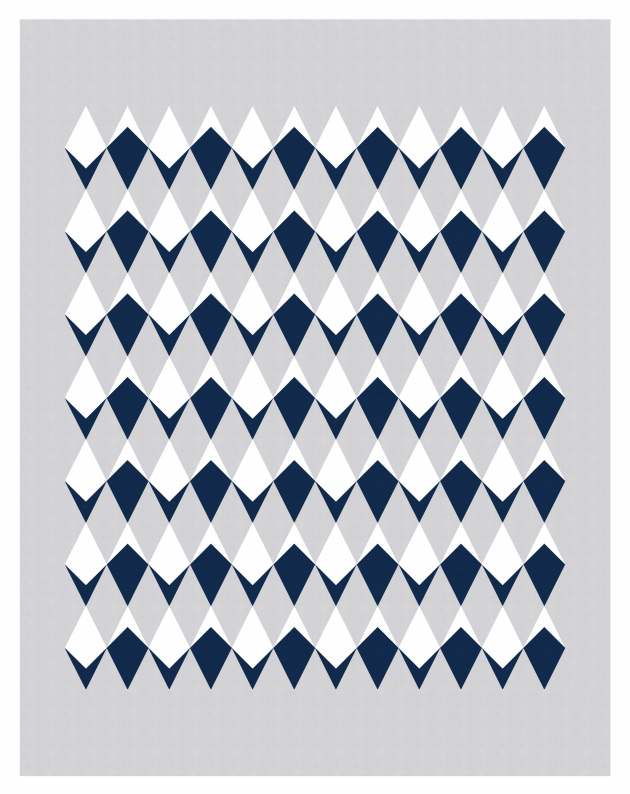
I had a hard time deciding on which was my favourite, but I like how the angles create hidden mountains in this first design.
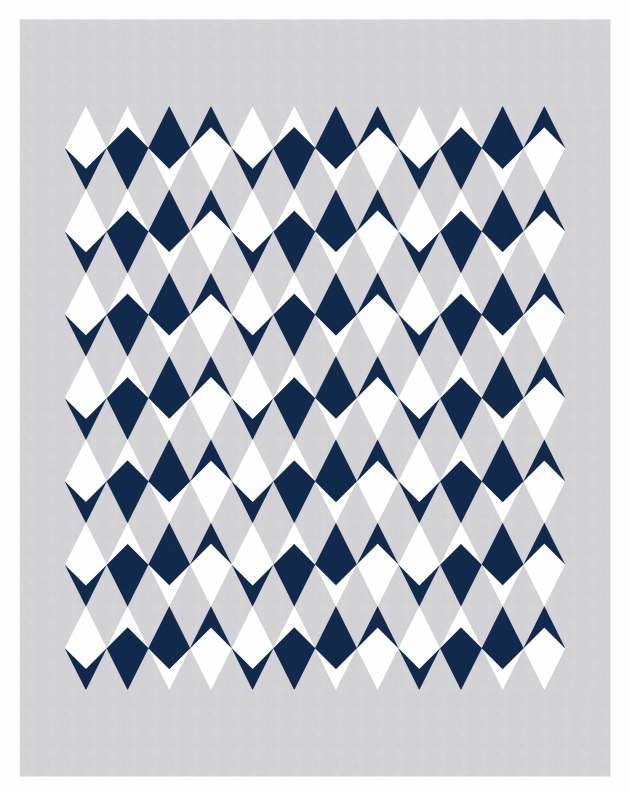
This next design was my other favourite – it’s a bit more chaotic (although also following certain rules and order).
The designs can also be rotated so the diamonds lie horizontally rather than vertically. Suddenly the vertical zig-zag created by the border between light and dark shapes is more obvious.

The design can be simplified further by focusing just on the fine arrows. I like this version; it’s more delicate, and it allows other secondary shapes and movement to emerge.

Speaking of chaos, the blocks can also be rotated. Having said that, there’s clear order in this design: the blue arrows occasionally converge in a foursome, as do the larger white kite shapes.
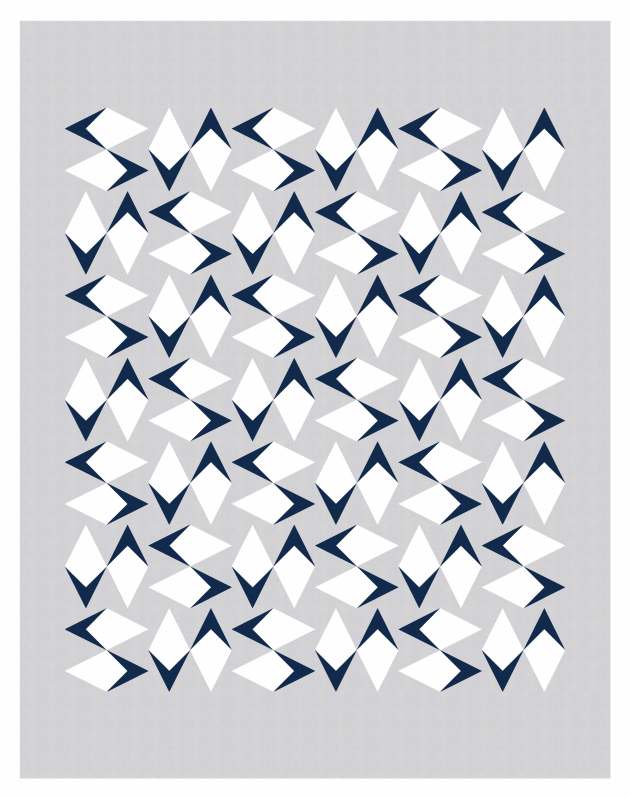
The background of each block can also be coloured, introducing a bit more energy and movement.
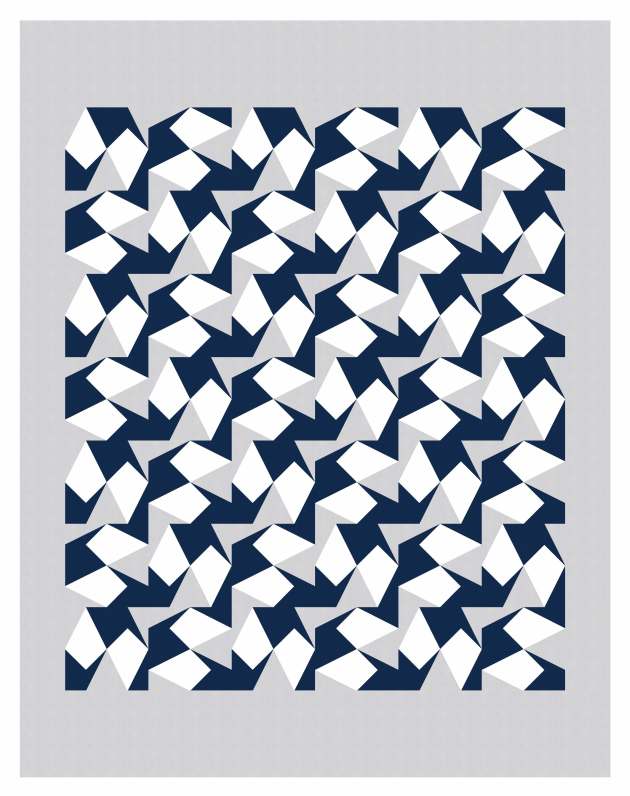
And, of course, the design can use more than 2 colours. Here I’ve added green to highlight some of the diamonds. I first coloured all the diamonds on the diagonal…
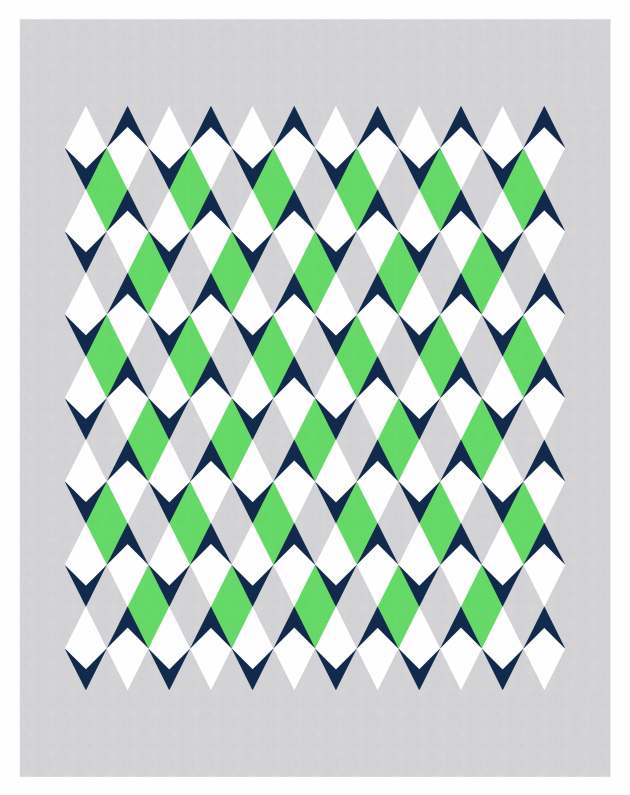
…and then tried colouring diamonds vertically. I’m not sure which I prefer!

These designs are all based on a regular arrangement of diamonds. You could use a template to cut the diamond shapes (and piece them in diagonal columns), or just make each diamond from two triangles (and piece them in rows). The arrows/chevrons would probably be easiest to do well using foundation paper piecing (for accuracy).
Sunday sketch #235
This is my last Sunday sketch for 2020… and the fact that I opted for muted colours is maybe a reflection of the type of year it’s been…!
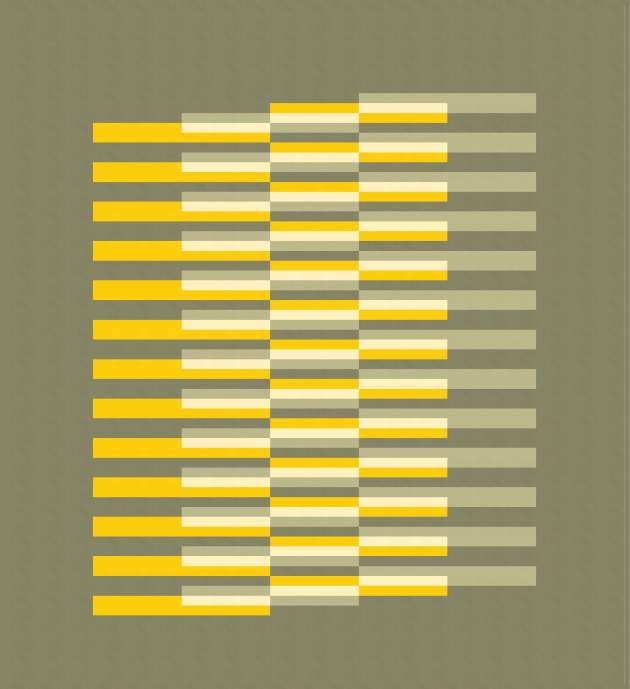
I started by sketching some overlapping stripes, then moved from my dot pad to EQ8 to take it further. Whenever you get overlapping shapes, there’s an opportunity to introduce transparency by playing with colour. But sometimes I think I take it too far… it can get a bit overworked and come off as forced. So I’m constantly trying to balance design aesthetics with the ‘too far’ factor. Not sure which side of that fence I landed on today, but I wasn’t in the mood to explore further, so here we are.
I did try some different colours, some of which are in my usual palette. Here, I opted to avoid the transparency effect by using black to mark the overlap between the red and khaki rectangles.

And here’s the black doing the same job for a red and pink version.

Translating these designs into a quilt pattern would be easy-peasy… it’s all just stripes (long rectangles). The hardest part would be making sure all the edges lined up properly. I’d probably tackle that by piecing the design in 5 columns, then adding the large border pieces.
Update (30 December 2020): A friend pointed out that this design is similar to the Fruity Stripe fabrics from Melody Miller’s Clementine range for Ruby Star Society (manufactured by Moda Fabrics). There are definite similarities! The fabric’s stripes are angled, whereas mine are arranged horizontally. And both the width and the length of the overlap varies in the fabric, whereas they are consistent in my design. But both designs use the overlap as an opportunity to play with transparency. Not surprisingly, Melody’s colour choices are infinitely better than mine 🙂
Sunday sketch #234
I mentioned recently that I was reworking Sunday sketch #171. Here’s where I ended up.

When I posted the original – more than a year ago, in October 2019 – I didn’t really have an idea of how the design could be made into an actual quilt. That’s pretty unusual; I normally have a fair idea of how I could translate the design into a pattern. So I always wanted to go back and refine the idea so it was (relatively) easy to make.
I ended up thinning those diagonal shapes, and making the area where they overlap into a square rather than an elongated hexagon. That simplifies things immensely. But the main concept hasn’t changed at all, and all the same elements are still there.
There are two sets of squares on point; the ones created by the overlapping ‘arms’, and the ones that float in the centre where four arms meet. In the design above, I’ve coloured the groups in orange and blue, respectively. In the design below, they’re in the same colour (dark blue).
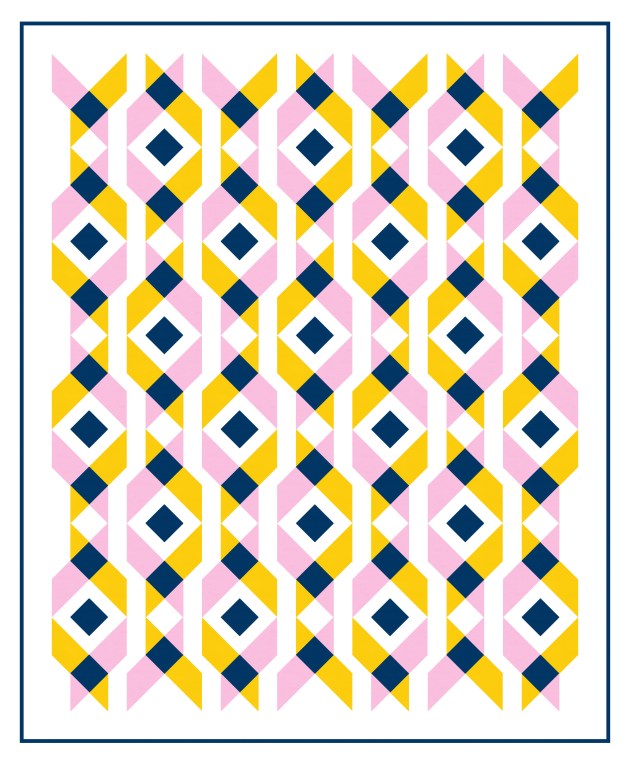
The design works well with a bunch of colours, rather than just a few.

I think it also works when you take away an element, like those floating squares. Here’s the same colourway on a light background, with the reverse, too: the same colours on the dark version, with the dark squares replaced by light grey ones. I like them both.
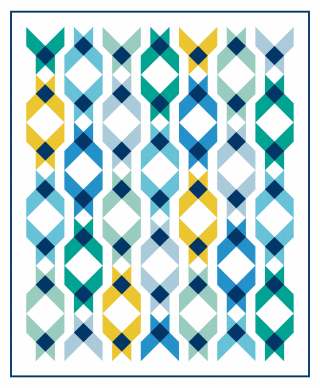

I also introduced a new element by colouring in the shape around those floating squares. This one’s not my favourite, but I’m including it to show how different the overall design can look with just one minor change. To my eye, this addition really bulks out each coloured shape, and creates the impression of larger square shapes across the design. It grows on me the more I look at it!
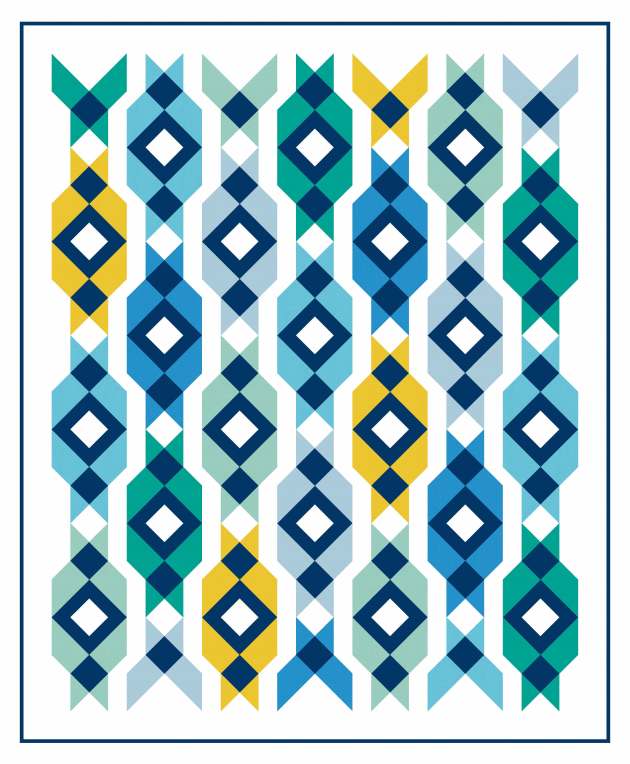
This design would still be a bit finicky to make. It would require slightly oddly shaped blocks to be set on point, then pieced together in columns. The blocks themselves are mostly squares, half-square triangles and triangles though.
