
Category: Sunday sketch
Sunday sketch #326
So, here’s a funny story… I designed this week’s Sunday sketch a few years ago, and loved it so much (SO MUCH!) that I held back on posting it so I could make it into a quilt first. Often I’ll get excited about a design and fall down a rabbit hole of fabric selecting and online ordering… and then I lose interest (it’s the paradox of choice). But with this one, I actually made it!
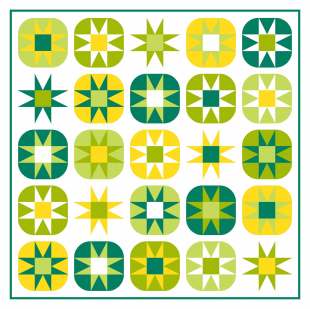
Here’s the sketch (check out the acid yellow!)…
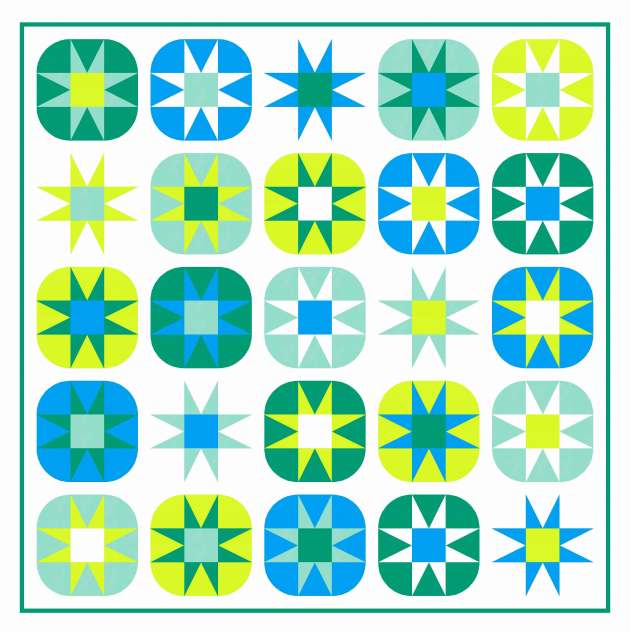
And here’s the actual quilt!

It’s a little hard to tell in that pic, but I bound the quilt in the acid yellow. Thanks to Valerie of Sweet Gum Quilting for the horizontal 1/2″ straight-line quilting, which I love.
So anyway, after I bound the quilt, I packed it away so I could take a proper photo eventually… and then forgot all about it. Oops. Which is kinda crazy, cos I still LOVE this design. It’s so simple, yet it works so well with a huge range of palettes.
With a dark background…
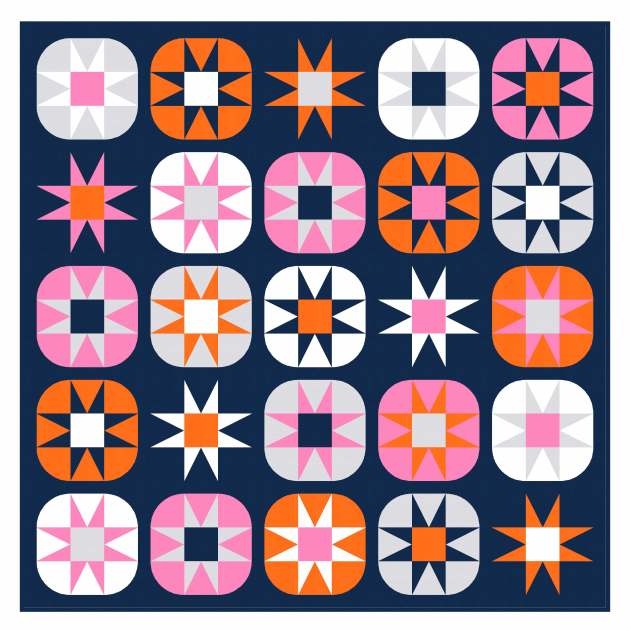
…and a light one.
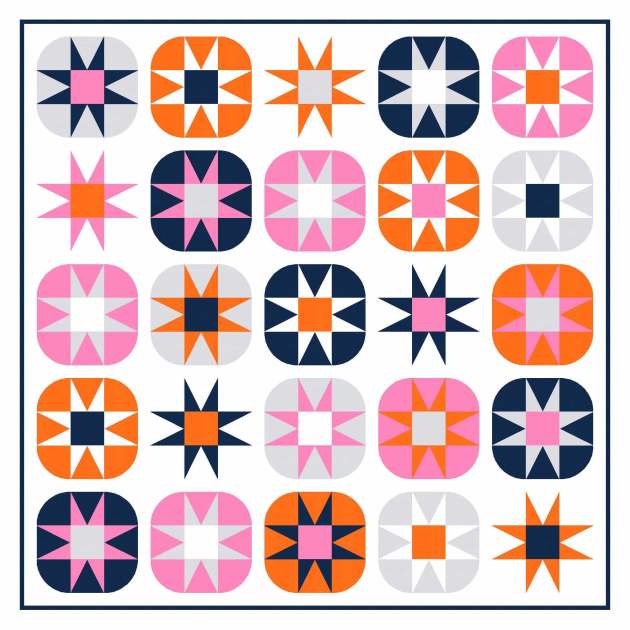
This is a 5 x 5 block layout with a 5-colour palette, and each block contains three elements (the middle square, the star arms, and the background squircle). That combination means that each colour can be used once per row and per column in each of the three elements. Although if you look closely enough, you’ll see that I had to break that rule in a few places.
Including white in the 5-colour palette means that a few stars don’t have a background squircle. I like how that opens up the design a bit and adds some negative space for the eye to rest. (The sashing between the blocks helps with that too.)

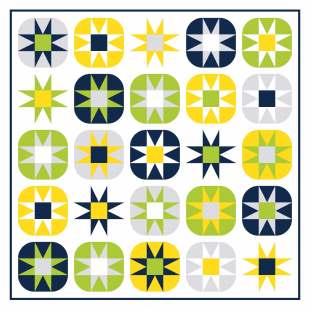


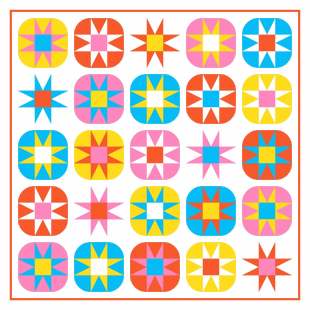
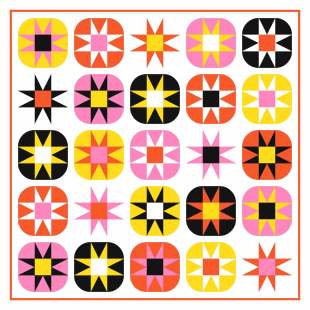

You can see that despite all the possible block permutations (3 elements x 5 colours), there are still a few blocks that are repeated in the previous versions. I tried again with the colour placement to avoid repetition, but it’s not easy! These next two versions feel a smidge ‘heavier’ to me, but maybe the larger number of unique blocks just makes the design seem busier?
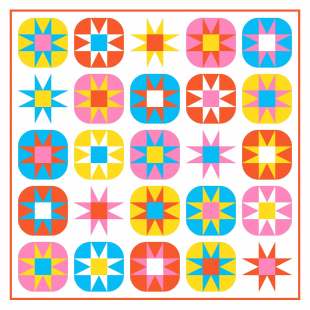

Of course, you could avoid the difficulty of colour placement by using fewer colours and going with just two blocks in an alternating layout.


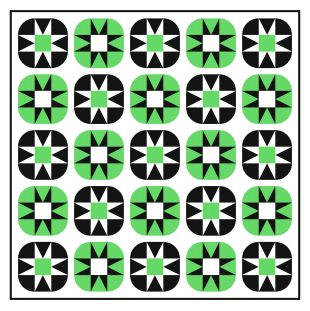
I also like alternating the ‘full’ star blocks with the ‘bare’ star blocks, which lightens the design a bit more.
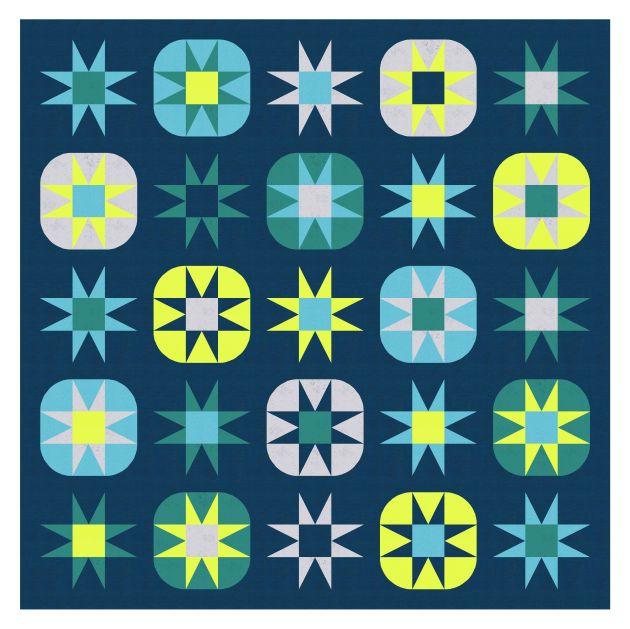
I know I’ve only used solid colours in these variations, but I think this design is one that would work really well with prints, particularly a coordinating range of fabrics.
This week’s sketch could be made into a quilt using quarter-circle (or drunkard’s path) units, triangle-in-a-square units (or half-rectangle triangles), squares, and sashing. I know a lot of people don’t like using sashing, but I like how it opens up a quilt design and lets the blocks breathe a little. OK, that sounds weird, but basically quilts feel less crowded to me when they have sashing.
Anyway, I’m not sure I’ve ever re-made the same quilt design before, but I’m very tempted to make another one of these quilts. It was awhile ago that I made it, but I’m pretty sure it came together quickly, as there are only a few basic shapes you need to make. As usual for me, the longest part was deciding on the colour palette.
Sunday sketch #325
This design is a little like last week’s – check out those bow-ties hiding in the middle – and even a bit like Sunday sketch #314. It’s got the same vertical lines and those large half-square triangles creating diagonal lines.
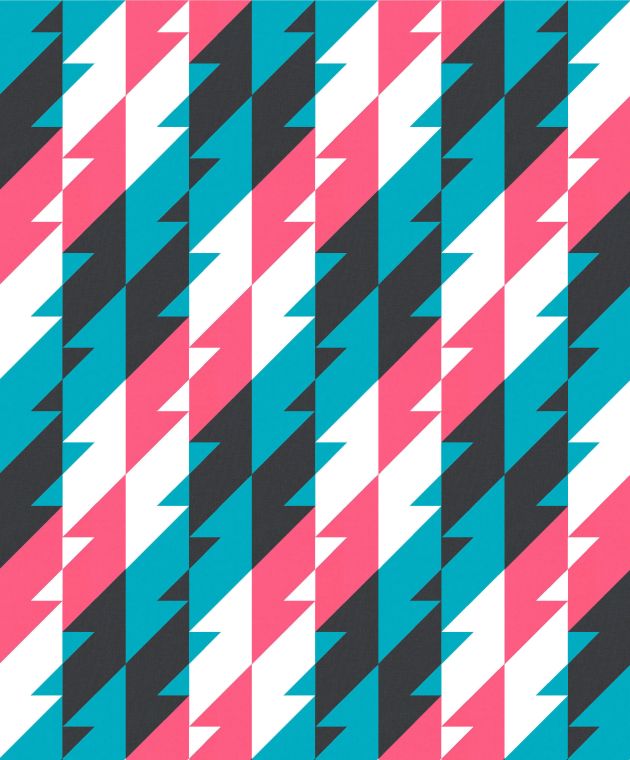
I’ve coloured the shapes in a plaid-ish way, but that still leaves lots of room for variation. Changing up the colours also affects what secondary shapes emerge – although I see large diamonds in most of these designs.
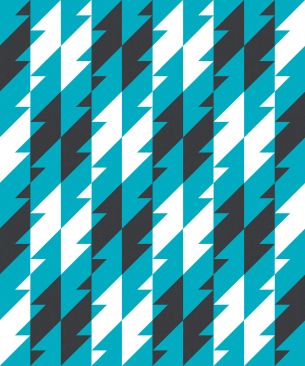

This next version demonstrates the Bezold effect – the name of which I didn’t know until quilter Carolina Oneto commented on a recent Instagram post of mine. I guess it’s an effect I use often!

And here’s a different colourway. I realise as I look at this one that there’s a slight mistake in my colouring – can you see it? I didn’t colour the hot orange shapes in the same way as the others; I’ve missed filling in the small HSTs at the very tips of the shapes. I made the same mistake in the first version, too. Ah well!

This week’s designs could be made into quilts using large and small HSTs, plus small squares (next to the small HSTs). As there’s a limited palette and repeated shapes, it would suit chain-piecing (as well as methods that make more than one HST at a time).
Sunday sketch #324
Quite a simple design this week, although there’s a lot going on when you take a closer look.

This is a block-based design of square blocks in a standard 6 x 6 layout. (It might look like a 4 x 4 layout because the outermost blocks aren’t fully coloured in).
Each square block has two ‘snowball’ corners: one small (in dark blue) and one large (in white). Their sizes are designed so the diagonal lines flow from block to block across the whole quilt. Apart from creating movement, it gives the impression of larger shapes within the design (triangles, squares, diamonds…).
Here’s an even more minimalist version.

The same block / layout can be coloured differently to highlight, for example, just those small dark triangles. This version doesn’t feel overly interesting to me, but I love this palette (which I created fairly randomly in ElectricQuilt8 using the Kona cotton solids colour libraries). I’ll have to use it again.

I originally designed this week’s block on point. This layout reminds me a bit of Sunday sketch #301 (although there are plenty of differences once you take a closer look).
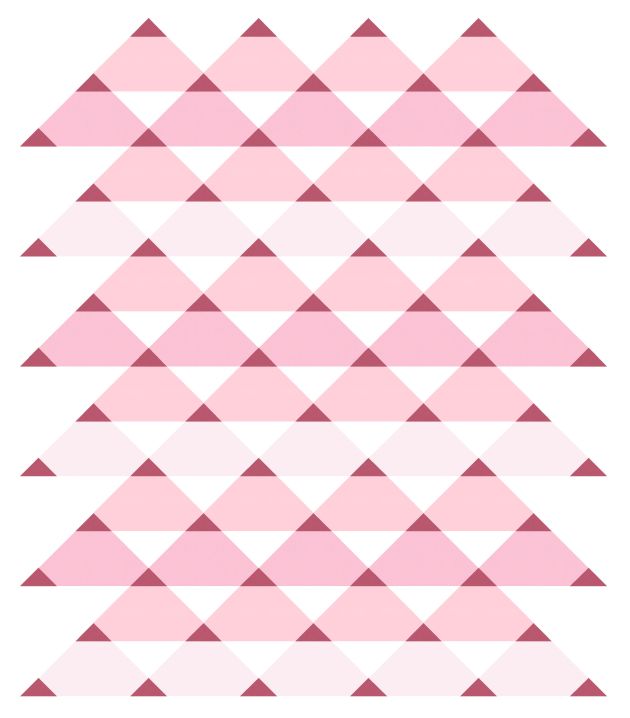
I really like the visual effect – the repetition of the dark triangles, the horizontal lines, the apparent overlap between adjacent larger triangles… but for some reason, this design still feels like it falls short somehow. Something’s missing for me, although I haven’t put my finger on what it is yet. That doesn’t matter… it’ll hang around in the back of my head until I figure it out one day.
In the next version, I’ve played with the background and foreground colours a bit. I love how using the background colour as the middle part of the block makes the top and bottom row look like parts of the design are floating.

This week’s design could be made with squares and more squares. Doing the snowball corners (I’m not sure if that’s the actual name for when you overlay a small square onto the corner of a big square, sew a diagonal seam, trim, and fold back to reveal the new corner?) would create a bit of wastage, but you could save up the cut-off corners for another project. The alternative would be to make multiple small and large HSTs, then piece them into a square using rectangles as well. That approach would mean more seams within the blocks… which means more cutting, sewing and pressing. It might also use more fabric too? (Those seams add up.)
I based this week’s design on the sweater worn by Noreen Vanderslice on season 2 of Fargo. As soon as I saw it, I needed to recreate the design as a quilt. That was my starting point, and then I kept playing until I reached versions I was happy with. It’s probably no exaggeration to say that I think about quilting all the time, and I’m inspired by lots of different things. But this week’s designs are definitely less ‘inspired by’ and more ‘copied from’ and then ‘derived from’. The distinction between inspiration and derivation is not always clear, but in this case it’s pretty obvious (to me, at least).
Also, this doesn’t feel super-original to me as a quilt design. I don’t recall seeing it, but I wouldn’t be surprised if it’s been done before. I even used a similar diagonal-snowball approach in Sunday sketch #160, which was published as the ‘Flight Pattern’ quilt pattern in the 2020 QuiltCon magazine. If you know of a quilt design like this, let me know and I’ll update this post!
