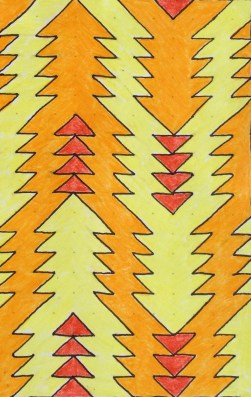
Sunday sketch #11

A common theme to my designs is the repetition of simple shapes. Here, an isosceles triangle lying at an angle within a square.

geometriquilt_ss11-1

The design could be coloured to reveal the alternating bow-ties or each group of 4 triangles arranged in a square formation (which are easiest to spot in the top left or bottom right of the frame).

The same shape arranged randomly produces a completely different effect.

geometriquilt_ss11-2

I’m not sure which one I prefer! I’m a big fan of regularity and consistency, but I also like the ‘ordered chaos’ that arises when a single unit is arranged in unexpected ways.

Each unit could be constructed from an isosceles triangle, 2 half-rectangle triangles (for the sides) and a half-square triangle (for the base). But in the interests of precision (second only to my love of consistency), I think I’d go for paper piecing.


Sunday sketch #10

Something simple this week, with lots of negative space to relax the eye.

Geometriquilt: Sunday sketch #10

The angled edges of the stripes add some interesting movement to the overall design. And I like those 4 little white squares peeking out from the middle.

Sunday sketch #9

Triangles seem so much more versatile than squares and rectangles. I’ve been playing around with half-square triangles in repetitive patterns that evoke trees* and somewhat Aztec-like designs.

Geometriquilt: Sunday sketch #9

Adding shading helps to differentiate each element. (Note how easy it is to lengthen the overall design by adding one more layer of HSTs per ‘tree’.)

Geometriquilt: Sunday sketch #9

The shading also creates movement by bringing some of the downward-facing ‘trees’ into the foreground (*perhaps I should be calling these stalactites and stalagmites instead?).

Geometriquilt: Sunday sketch #9


Adding colour changes the look and feel again. (Why does this totally make me think of Dr Seuss?)


Greens and reds would obviously make this a very Christmas-y quilt pattern, perfect for the holidays.

The pattern would be relatively simple to construct using long columns of HSTs and solid strips. You could even save some seams by piecing two columns at a time using flying geese.