
Sunday sketch #42

This design reminds me a little of Sunday sketch #21 : crosses, with perspective*, on a grid, but not quite filling the page. A little like cross-stitch. I like the white eight-pointed star peeking out from between the blocks in the bottom right quadrant.

Geometriquilt: Sunday sketch #42

There are lots of ways to make this design into a quilt… squares on point, using Y-seams (argh!), or lots of little half-square triangles (meaning each ‘X’ would be split into 16 units). But I think the best way would be to make 4 ‘double’ half-square triangles for each ‘X’ block. Make HSTs as normal (i.e. from the dark and light fabrics together, and the two intermediate fabrics together), then add 2 squares of the background fabric to diagonal corners. Sew a line across the small squares, parallel to the first HST seam, and cut off the excess. Ta da! Double HSTs.

* this reminds me of the Graceland graveyard scene in Spinal Tap.
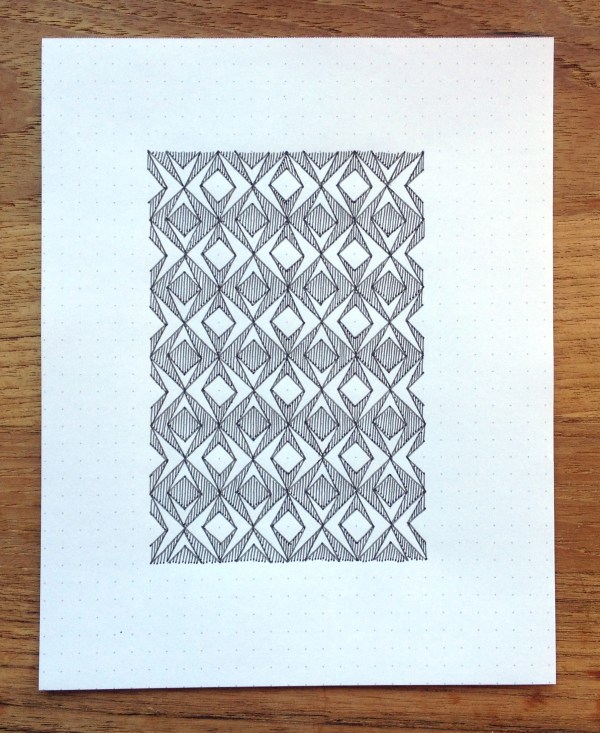
Sunday sketch #41

The density of this design (or maybe my tight hashing lines) almost makes it feel like an optical illusion. The repeating unit (a square on point) alternates between black-on-white and white-on-black in each row.

Geometriquilt: Sunday sketch #41

Normally I’d give some hints as to how the design could be made into a quilt pattern – e.g. whether it uses half-square triangles, rectangles or curves. In this case, I think paper piecing would be the best way to manage all those angles and precise points.

Sunday sketch #40

Following on from last week’s theme of layered triangles with a pop of colour:

Geometriquilt_SS40-1

Once again, the red triangles are placed purposefully, with their sides all aligning. The pattern is symmetrical; turning it 180 degrees will end up with the same design.

The logical next step in this series of sketches was to flip the triangles, so you see their flat bases rather than their pointy heads:

Geometriquilt_SS40-2

I think this design would’ve been better with the red triangles in each column touching tips – without that white space in the middle. Lesson learned.

Both designs could be made using half-square triangles and rectangles; you could also save some seams in the top design by using flying geese as well.