
Category: Sunday sketch
Sunday sketch #271
I call myself a modern quilter, but not all of my quilts (or my quilt designs) are modern. Some of them definitely lean more traditional. Don’t get me started on how to even define ‘modern’ and ‘traditional’ quilts – I honestly don’t know, and I don’t think there’s a clear line that separates them. But sometimes a design just feels less like one and more like the other. It might be the layout, or the blocks, or the colour scheme, or the fabrics.
This week’s designs feel more traditional to me, probably for a few reasons. I picked a muted colour scheme, for one. And the designs are based on a sawtooth star, which dates back at least to the late 1800s. And I’ve gone for a regular, repetitive layout, instead of introducing the negative space or asymmetry that you might expect in a modern quilt.
But hey, enough of my yakkin’. Let’s get started!

OK, so I introduced a little bit of negative space, just to make it seem like this design is on point (it’s not). This is a 5 x 5 layout, with some borders added, and the 4 corner blocks removed. Some of the colours extend from one block to the next, which helps to tie the blocks together.
Here’s the same design with the corner blocks added back in, plus a version with slightly different colouring.


The colouring can also be pared back to highlight less of the foreground and more of the background. This first version feels like lacework letting the light through. And switching the colour of a few of the smaller elements from black to white gives an entirely new version with a whole other feel.


Paring back to just one colour requires filling in different shapes to distinguish the blocks. Now it’s like baubles and stars intertwined. This might make a good Christmas quilt in a different colourway!
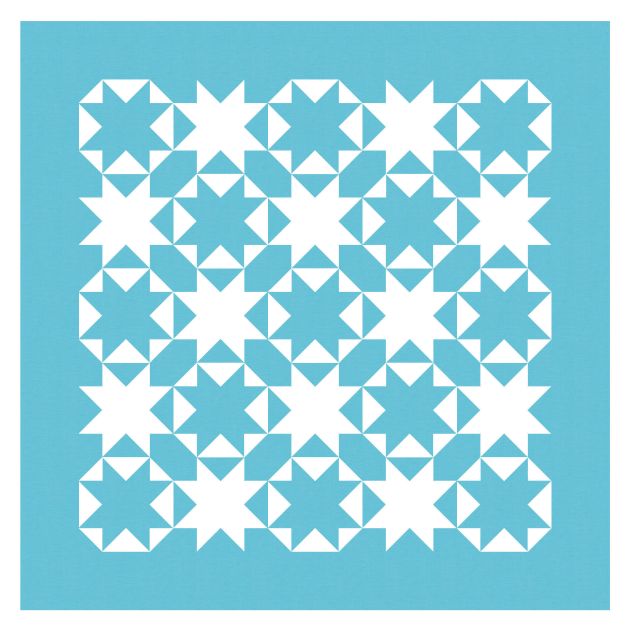
Sticking with the two-colour design, we can highlight all the stars in white. The interstitial shapes become square-in-a-square units – some blue on white, and some white on blue. If this design didn’t feel traditional before, it does now!
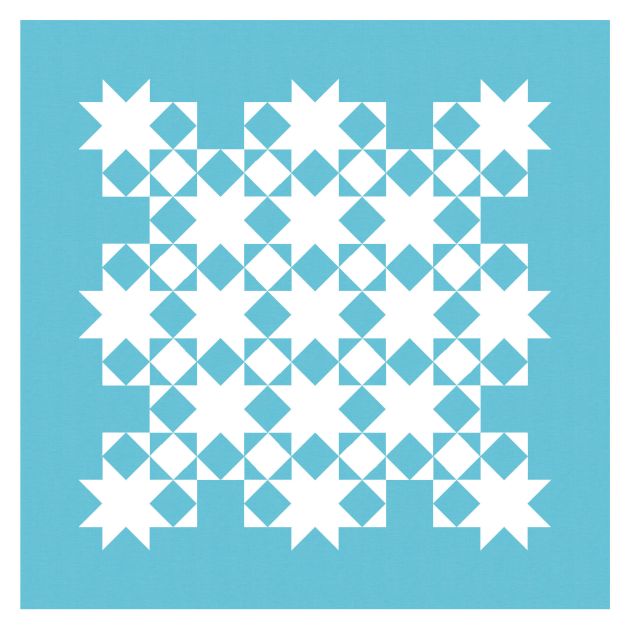
I like the idea of paring back the design even further, so those square-in-a-square units become more prominent. The version on the left is just the same one as above, without the stars around the edges. In the version on the right, the middle squares of 4 of the white sawtooth stars have been coloured blue, blending them into the background. Suddenly it feels like the whole design is squares on point!


There are so many other ways these designs could be coloured to change the overall look and feel. And so many ways to make the design into an actual quilt: squares and square-in-a-square units; half-square triangles, flying geese and squares; or square-in-a-square units, half-snowball units and squares.
Sunday sketch #270
More skinny strips this week, but straight this time.
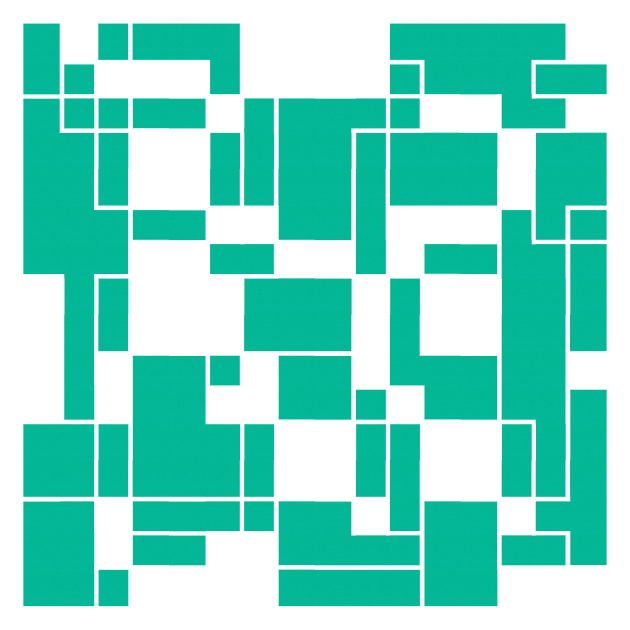
Believe it or not, this design is made from a single block in a 4×4 layout. And each block is a 4×4 arrangement of squares that are separated by thin sashing. Depending on how the background and sashing are coloured (or not), different parts come to the foreground or move to the background. Here’s the reverse colourway.

I actually started with black sashing and two colours. I worked through the shapes, colouring as I went, making sure that adjacent shapes never had the same colour. In some places I had to move the sashing or change the shapes to get the desired effect. (Oops, I can see one spot where two white shapes are touching sides.)
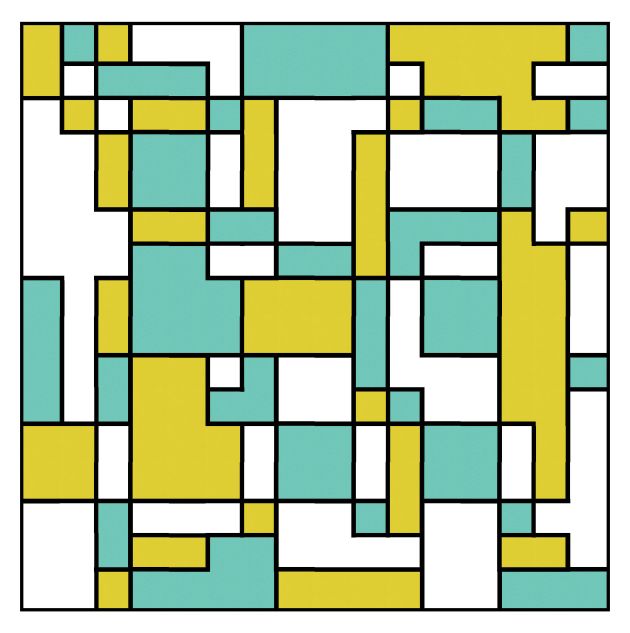
The black lines are a bit Mondrian-ish, of course, which is why I changed them up a bit.
This design could be made into a quilt using normal piecing of squares, rectangles and thin strips. And the layout possibilities are endless!
Sunday sketch #269
I’ve talked before about how my design skills match my sewing skills. I tend to design things that I could make myself. Before I’d sewn curves, I didn’t design quilts with curves. Until I could sew a partial seam confidently, I rarely designed quilts that needed them. I’ve never sewn a Y-seam (I know!), and I don’t think I’ve ever designed a quilt that uses them. When my sewing skills develop, so too do my design skills.
But occasionally I’ll play around with EQ8 and end up with a design that I know is beyond my capabilities as a quilter. It might be too complicated, or technical, or just impossible to piece in a straightforward way. I tend not to post these designs, because they never excite me as much as designs I know I could make. Maybe it’s because I don’t work on those designs as much, or iterate them to the point where they might excite me… as soon as I think “I don’t know how I’d make this”, I lose interest. But I save them (I save everything!), cos who knows what might happen in the future?
Well… let me tell you! You might take a class with Jenny Haynes of Papper, Sax, Sten on skinny inset strips, and realise that designs you’ve previously binned in the Too Hard Basket suddenly become absolutely achievable. Here’s one such design.

I’ve done a few series of sketches featuring thin black borders and outlines (see Sunday sketches #203, #204 and #205, and #225, #226 and #227). But in most cases, they’re straight lines (relatively easy to piece) or circular curves that are wide enough to piece (say 1/2″ to 1″ wide).
In this design, the lines are much thinner (1/8″) and curvy and overlapping and I knew just from looking at them that I could/would never make a quilt like this. The potential for inaccuracy and subpar results would annoy me too much. But I really like the design – it’s very Art Nouveau, and reminds me a little of artwork from William Morris (without the flowers) or Charles Rennie Mackintosh.
Here are a few more versions.
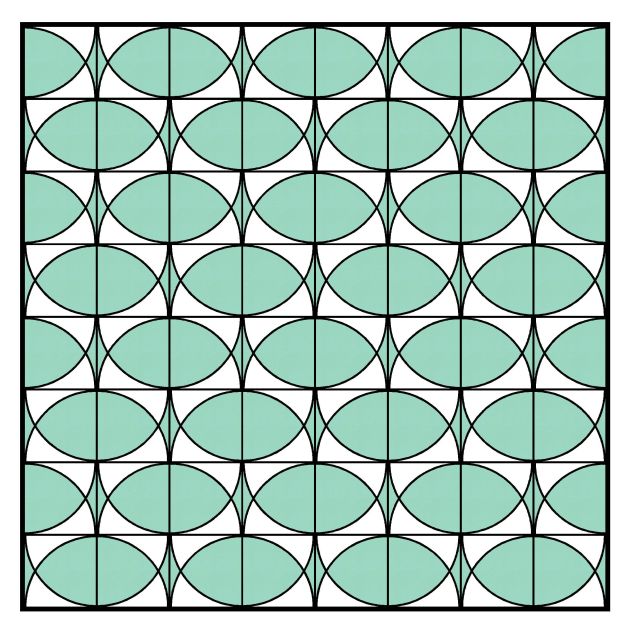
The previous designs are an 8×8 arrangement of a single block that’s alternately rotated by 180 degrees. There’s also vertical and horizontal sashing (also 1/8″ wide) between the blocks. The next design is all that but without the horizontal sashing.
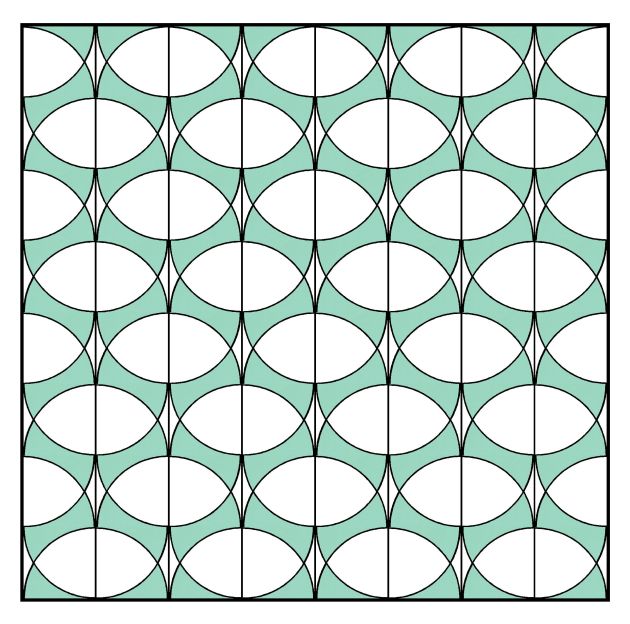
With so many elements, there are lots of ways to arrange the blocks and use colour to highlight different shapes. Here they are without the sashing.
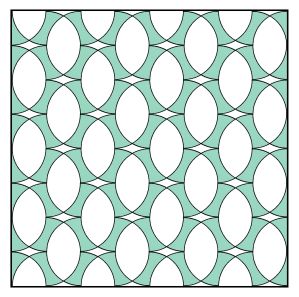
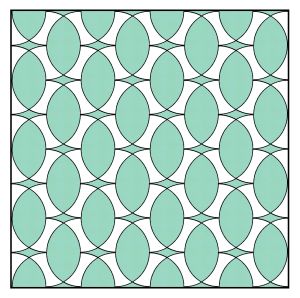
You can also add colours. I tried this next design in peach, but it looks a little… umm… intestinal haha. All those fleshy bendy bits!

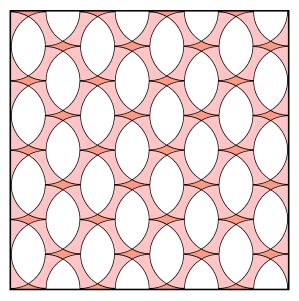
And back to the version with sashing, featuring 3 colours (plus black)…

…or a different arrangement of colours…
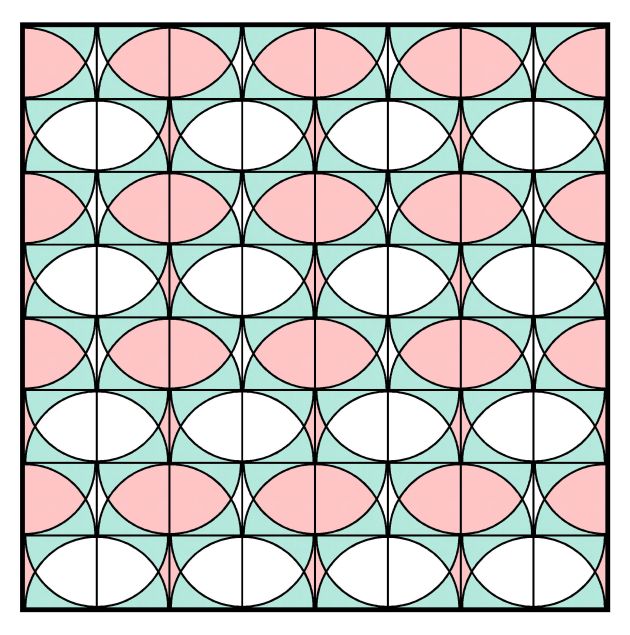
And that layout with only vertical sashing…

…so, there are lots of options.
And after taking Jenny’s online class, skinny curves like this now seem totally manageable. You can see a pic on my Instagram of the first skinny inset strip that I sewed during the workshop. How good is that?! It was much less complicated than I was expecting, and really quick and easy. (I’m not being paid to say this haha, I just really enjoyed the class and am excited at the idea of incorporating skinny inset strips into future designs.)
So now that I’ve expanded my sewing skills a smidge, I’ll feel more confident incorporating skinny inset curves into my designs. Yay!
