
Category: Sunday sketch
Sunday sketch #385
The last two quilts I’ve made have featured mostly curves, so I’m on a bit of a curve kick at the moment.

I began with a basic four-petal flower block, set on point. I’ve used this shape before (see Sunday sketch #366), but not as much as I thought I had. It feels really retro and happy, so a good starting point!
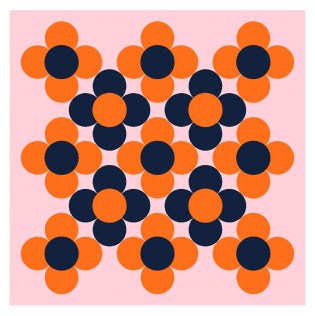
Each of the petals is made up of four quarter-circles or drunkard’s path units, so a natural iteration is to use a different colour in one of those. That introduces some new lines that create secondary shapes (squares) between the flowers. (I also changed the shade of pink that I used – you can see the difference in the background colours of these two versions).

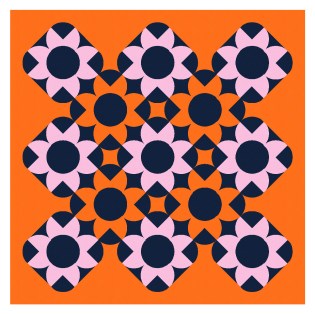
After that, I played with colour placement a bit more. I also added curved corners to the blocks, and used different colours for the block background and the quilt background. Depending on what colours are used where, different shapes get pushed to the background or pulled to the foreground.

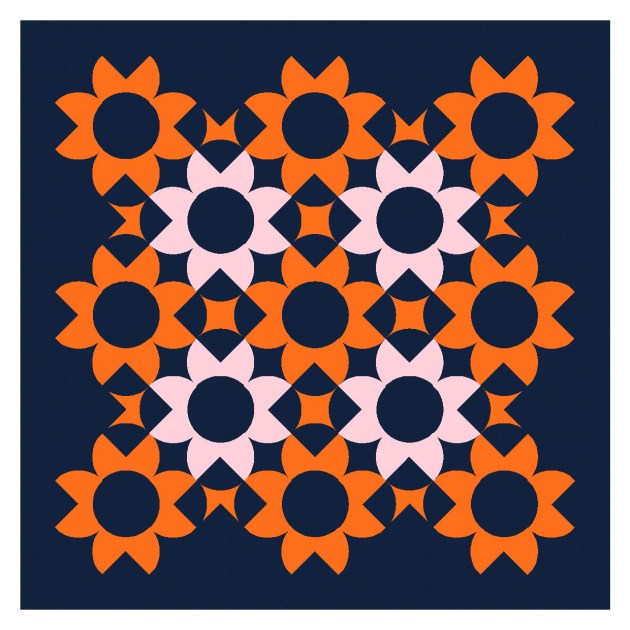
I’ll show you more designs along those lines next week. For now, here’s another version that makes the most of those concave curve-based squares (and partial pointy shapes) between the flower blocks. I’ll play with those more next week too.
This week’s design is a lot like Sunday sketch #271 – so much so that I’m surprised I didn’t do a curvy version back then. Both designs have a (pseudo) sawtooth star as the central motif and make a feature of those interstitial squares.
These designs could all be made using quarter-circles or drunkard’s path units. Lots and lots of them! Oh, and because the blocks are set on point, you’d also need corner and setting triangles.
Sunday sketch #384
If you’ve followed my Sunday sketches for awhile, you’ll know that I love playing with colour palette and placement to make multiple versions of the same block. This week’s design uses two blocks, but that just creates more opportunities!
In the first version I’m showing you, which is the last iteration of the underlying design, I’ve just used colour to hide parts of the block (by blending them into the background). This particular colour placement suggests that the blocks have two layers, each of which can be peeled back to reveal the other one on its own. (This is my attempt at ‘modernising’ what’s otherwise a relatively traditional design.)

The designs that led to that first one are a bit different, though. I started by alternating two block types in a standard layout (even though the diagonal lines in the next few versions might suggest an on-point layout). Even with two relatively simple block designs, there are loads of ways to use colour placement to achieve a different look. Sometimes that means colouring some shapes the same as the background, effectively removing them from the design.


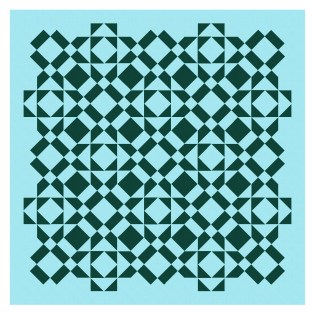

After playing with those versions for awhile, I switched to an on-point layout, which changes all those diagonals to vertical or horizontal lines. The same two block types are in there, but it almost looks like a design you could achieve using just one block type and some creative sashing.

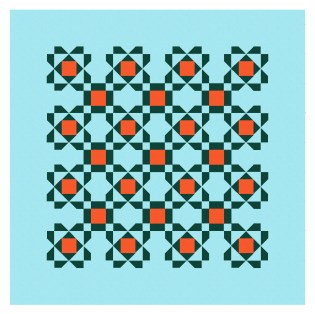

I often like to colour only some of the outer blocks to create interesting edges to my designs. (I really like the movement in the first design below, which I think might be easier to see when there’s no red to distract the eye.)

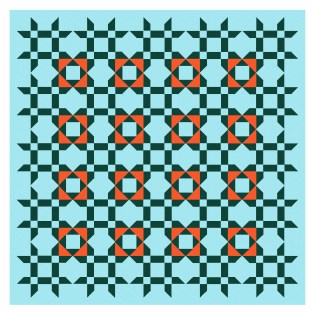
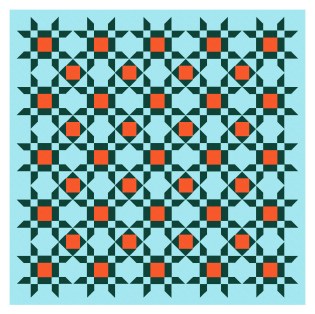

Of course, I kept iterating these designs and adding or subtracting new shapes (which were always there, just not always coloured in). This next version, the penultimate one, is the first version where I coloured in those smaller red squares (which are actually the four corners of that particular block; the other block doesn’t have any red in it).
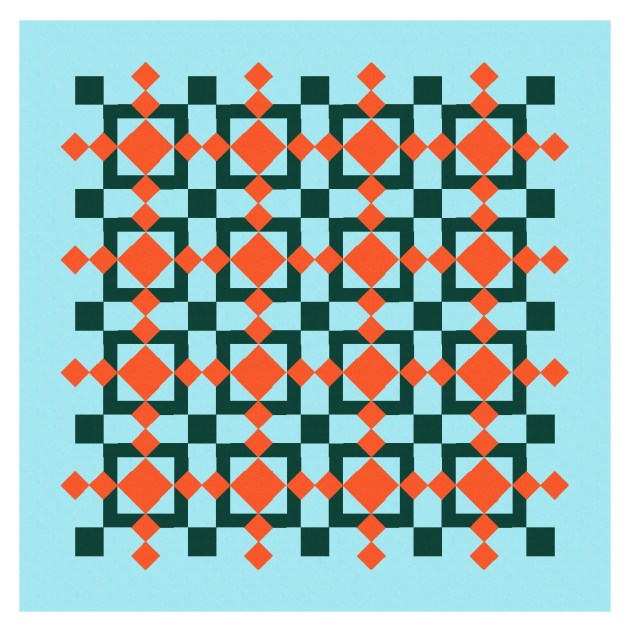
This colour placement suggests two discrete layers: a lacework of red squares overlaying the black ones. I liked the idea of paring back both layers in different areas, to reveal each one on its own (at least for a few blocks). That’s a concept I’d like to explore more in future.
Anyway, so the first and last sketches in this week’s post feel a bit different from the rest of the designs – I probably could’ve stretched them out to fill two blog posts! – but at least you can see how they’re all connected.
This week’s designs could be made into quilts using squares, square-within-a-square units, flying geese, rectangles and half-square triangles.
Sunday sketch #383
It’s been aaaages since I used Excel to create a Sunday sketch – I think the last one was Sunday sketch #335, which I posted almost a year ago. But I had an idea recently that I knew would be too hard to do in EQ8 (not impossible to do; just too time-consuming/annoying for me at my level of expertise), and because it’s all lines and squares, Excel is a perfect alternative.
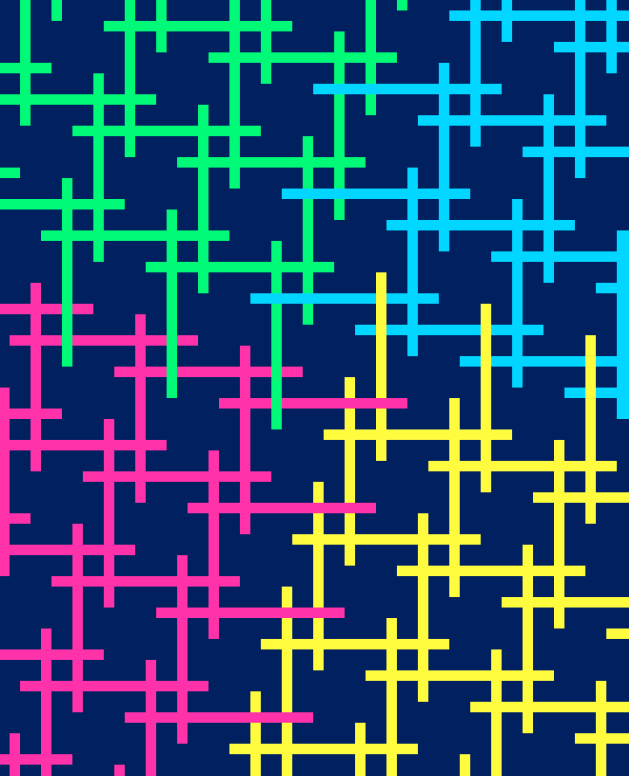
The inspiration behind this week’s sketches was a similar motif that I saw on a bedspread in a photo for a real estate listing (inspiration is everywhere!). The original design was much more complicated; the arms extending from each hashtag joined up to create new shapes. But I didn’t want that. I just wanted to see how it would look to connect the arms of adjacent hashtags.
I started off small (and with a limited palette), just to explore the motif and its layout. Obviously, joining the bottom-right arm of one block to the top-left arm of the next one will create a stepped layout, which eventually resembles a slightly off-kilter square. All those intersecting lines create some shapes to colour in, too.
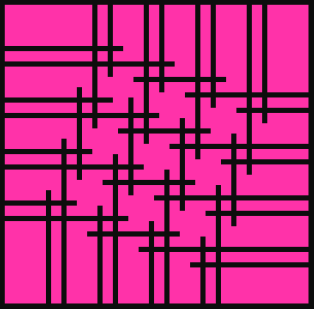


I liked the idea of extending those arms off to the side of the quilt. I’m not sure I’d make this design in real life; I’m not great at sewing (or keeping) long lines that straight. (I’ve never used starch, but maybe I should?)
So instead I tried packing the design from edge to edge with the hashtags, and playing instead with colour palette and placement. Excel doesn’t have a huge selection of pre-set colours, although you can input RGB colours if you want. I’m too lazy for that, so I just picked some bright, neon-y shades.


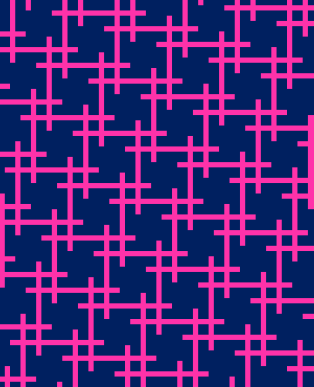
(I even like how those four look together!)
I’m not sure of the easiest way to construct this design, particularly for those versions where lines cross over or under lines of other colours. I guess there would be a lot of careful seam matching to obscure the joins between adjacent blocks. Otherwise, it’s just all squares and rectangles.
I know that the hash (#) symbol has been used in other quilt patterns, so I dug around to try and find some. If you like this motif and you want to use it in a quilt, check out these patterns:
- the #Hashtag quilt block and quilt pattern from Sew Can She
- the Ella quilt pattern from Kitchen Table Quilting
- the Hashtag paper-pieced quilt block pattern from Patch and Dot
