
Category: Sunday sketch
Sunday sketch #14
I don’t usually work with a lot of colour in my sketches. I find it a bit distracting (and difficult) to think about what colour(s) to use and where to put them. If I’m happy with a design, I’m always a bit worried that adding colour will be taking it one step too far. The right palette and great placement can enhance a pattern; the wrong palette and poor placement can just as easily ruin it.
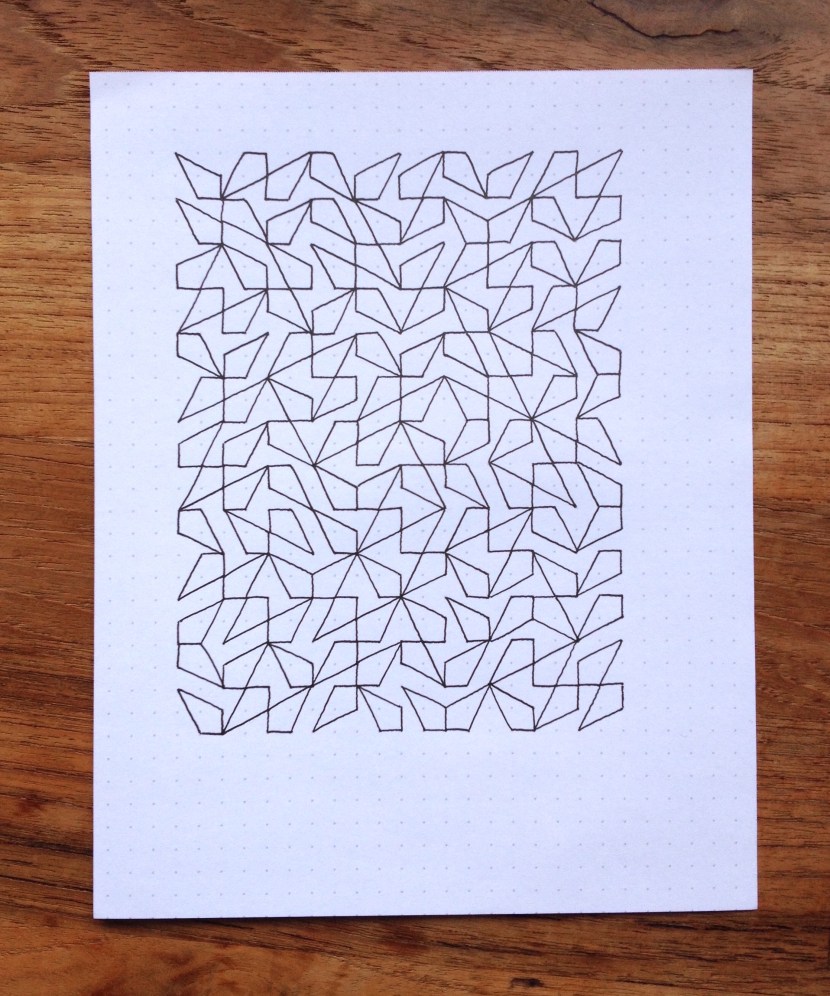
Having said that, I recently sketched a pattern that I’ve had in my head awhile and that needs a bit of colour to define the units and bring out the actual design.

Now I’m not suggesting that this pattern should be made in black, blue and red – those are just the gel pen colours I had available. But to achieve the look I wanted, I think 4 colours (including white (I know, I know, it’s not a colour…)) are necessary; 3 could work if you had the patience to plan them out carefully (I didn’t).
My intention with this design was to make sure there were no adjacent pieces of the same colour within each rectangular block. Of course, you could make this pattern with even fewer fabrics or colours if you wanted to, or use more colours at one end and fewer at the other for a gradated look. The possibilities – as always – are endless.
Sunday sketch #13
I’ve been playing with Adobe Illustrator a bit lately. As I explained to a friend recently, I learn about 5 new things every time I use it… and promptly forget about 3 of the things I learned last time. It’s complicated! Still, I’m making progress.
I found* the perfect inspiration for some Illustrator practice this week: a fantastic minimalist print by Melinda Wood Designs, which she sells through her Etsy shop:

(*thanks to Quilt by Starlight, who pinned it to one of her many awesome Pinterest boards).
I love the simplicity and boldness of Melinda’s design, not to mention its geometry. I immediately wanted to use those intersecting triangles to create something in Illustrator. After figuring out how to make equilateral triangles and how to fill individual parts of shapes, I came up with the following repetitive design…

I wasn’t sure about those empty hexagons, so I tried filling them with smaller triangle frames:

Hmm, maybe too busy.
I decided to simplify the design by concentrating on those triangular frames to create a secondary pattern of 6-pointed stars. But how the %&$#@ could I do that in Illustrator? It took me awhile, but I figured it out.
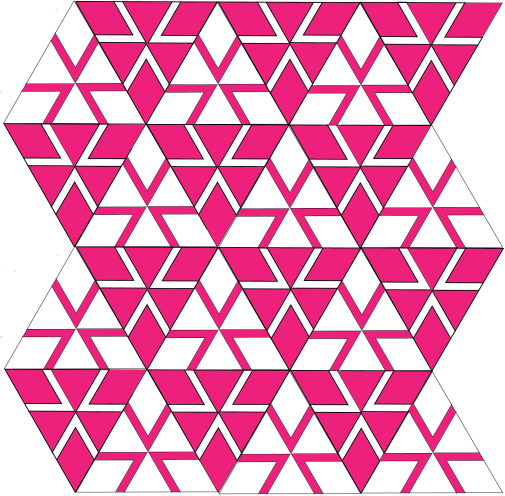
And finally, all in one colour with contrasting frames. This one reminds me of Islamic geometric patterns.

Don’t look too closely, or you’ll see how rough my Illustrator skills are!
Adding in a second colour helps to differentiate those 6-pointed stars.
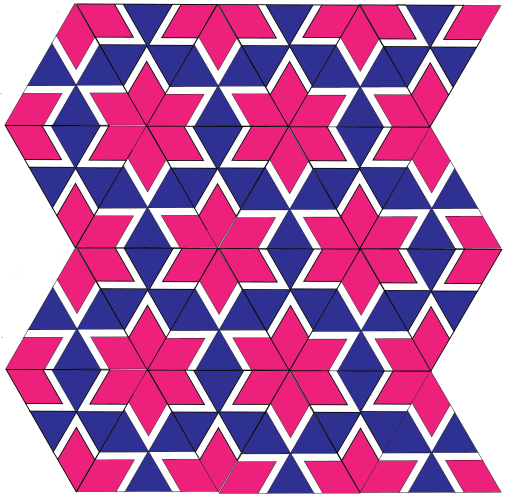
I’m not sure how best to construct a quilt from these patterns – probably either foundation paper piecing or traditional piecing using diamond and triangle templates. There’d be points where 6+ fabric pieces would be coming together, which would require some nifty seamwork and/or a super-hot iron to avoid lumps.
Thanks to Melinda for kindly allowing me to refer to her artwork in this post. I’m not affiliated with her store in any way – I’m just a new fan of her work, which you can also see on Instagram.
Sunday sketch #12
Last week I wrote about using single units in an ordered or random arrangement. It’s amazing how many designs you can get out of one shape. Last week it was a triangle; this week it’s a kite. I always seem to start with the random arrangement first.
Within each 2-by-2 square on my Rhodia pad, the sharp end of the kite can point in any one of 4 directions: north-east, north-west, south-east or south-west. That creates a lot of potential combinations for this simple repeating shape. Some pretty interesting secondary patterns can emerge as well – can you see those wide-headed, narrow-tailed arrows in the middle design below?
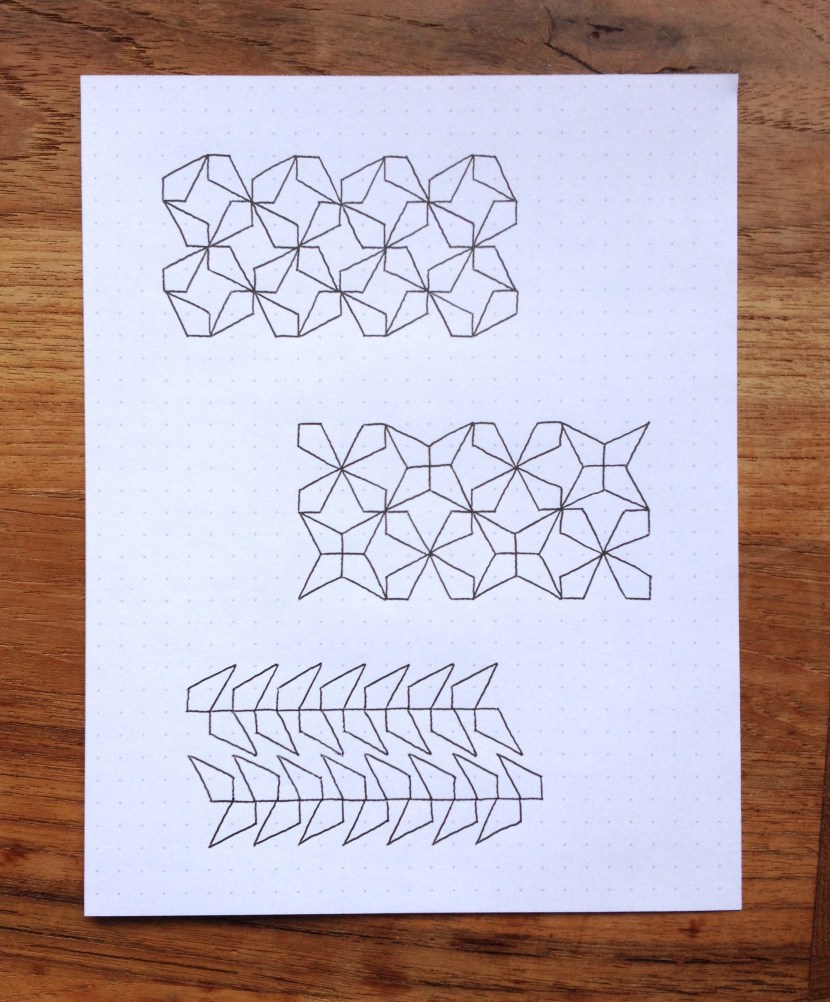
The third design, above, reminds me of the sawtooth leaves of some Banksia species.
Even more possibilities…
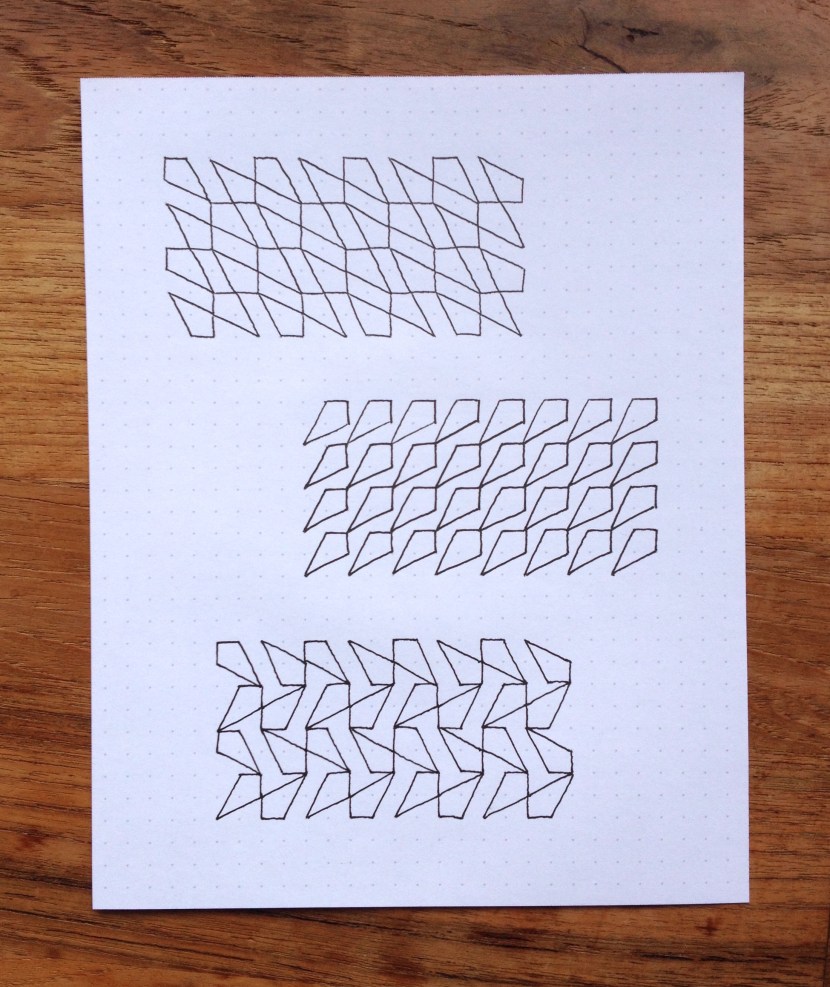
I’m tempted to design some kind of sampler quilt with rows or blocks of these different repetitive patterns. The kite unit could be made in a number of ways; I’d probably opt for paper piecing for precision.
