
Tagged: triangle in a square
Sunday sketch #342
This week’s sketch is a direct progression of Sunday sketch #341. Instead of half-circles, I’ve used flying geese, and instead of larger circles in the inside of those black squares, I’ve introduced more squares. The colouring’s much the same, and there’s still a ton of movement, with lots of secondary shapes created by all those horizontal, vertical and diagonal lines.

The good thing about introducing flying geese is that their angles match those already in use in the design – so the sides of the geese are parallel to other lines in the design. Same with the central white squares. That helps to keep the whole design feeling coherent and less cluttered.
Here it is in a standard layout (with the blocks not on point).
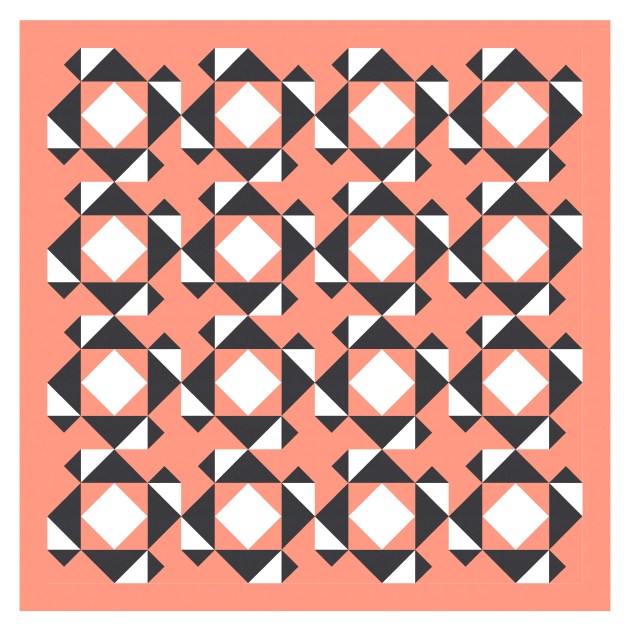
I also tried replacing the flying geese with another shape – a triangle-in-a-square unit – but… nah. I don’t think it works well at all.

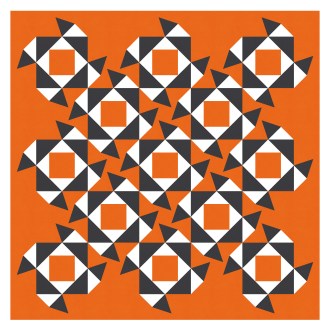
I’m not entirely sure why I don’t love these variations very much… they just feel a bit too busy and chaotic for me. The triangle-in-a-square units just add too many new angles that aren’t repeated elsewhere in the design, and it all feels very pointy and sharp. No thanks. But hey, I’m happy to share them anyway, because that’s what the Sunday sketches are all about: exploring design ideas, playing with shapes, and inspiring you to do the same.
These designs could be made using squares, half-square triangles, flying geese and rectangles. The standard layout above is an 8 x 8 grid, so 64 blocks total. Although you wouldn’t have to construct blocks before constructing the whole quilt – you could just make all the individual units and then piece them together in rows or columns. All the colouring is the same in all blocks, so you could chain-piece your way through them in no time.
Sunday sketch #326
So, here’s a funny story… I designed this week’s Sunday sketch a few years ago, and loved it so much (SO MUCH!) that I held back on posting it so I could make it into a quilt first. Often I’ll get excited about a design and fall down a rabbit hole of fabric selecting and online ordering… and then I lose interest (it’s the paradox of choice). But with this one, I actually made it!
Here’s the sketch (check out the acid yellow!)…
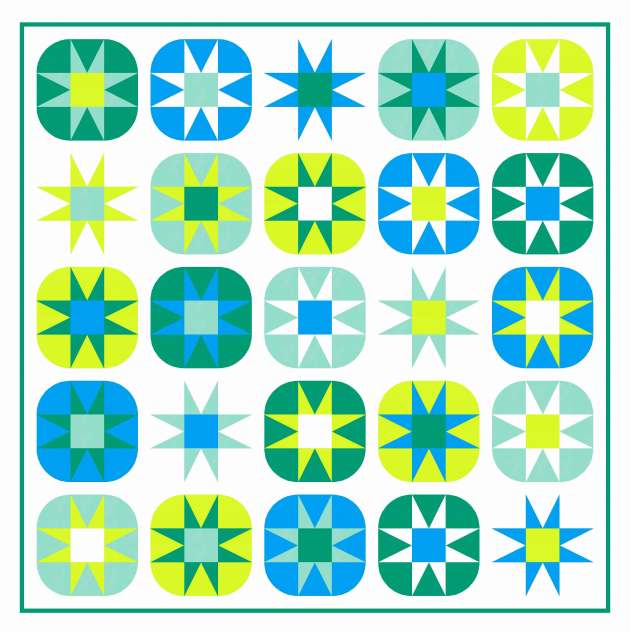
And here’s the actual quilt!

It’s a little hard to tell in that pic, but I bound the quilt in the acid yellow. Thanks to Valerie of Sweet Gum Quilting for the horizontal 1/2″ straight-line quilting, which I love.
So anyway, after I bound the quilt, I packed it away so I could take a proper photo eventually… and then forgot all about it. Oops. Which is kinda crazy, cos I still LOVE this design. It’s so simple, yet it works so well with a huge range of palettes.
With a dark background…
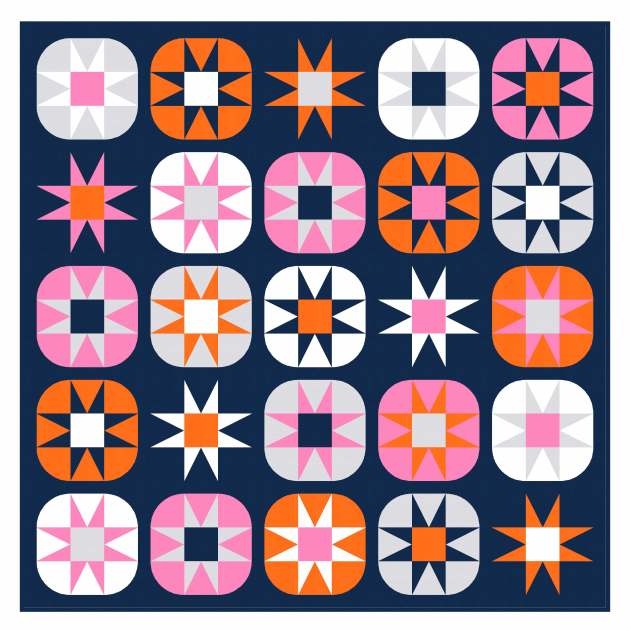
…and a light one.
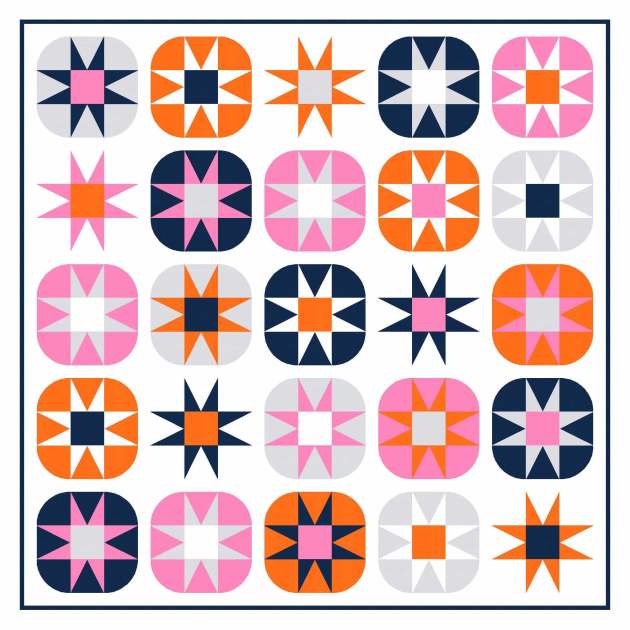
This is a 5 x 5 block layout with a 5-colour palette, and each block contains three elements (the middle square, the star arms, and the background squircle). That combination means that each colour can be used once per row and per column in each of the three elements. Although if you look closely enough, you’ll see that I had to break that rule in a few places.
Including white in the 5-colour palette means that a few stars don’t have a background squircle. I like how that opens up the design a bit and adds some negative space for the eye to rest. (The sashing between the blocks helps with that too.)

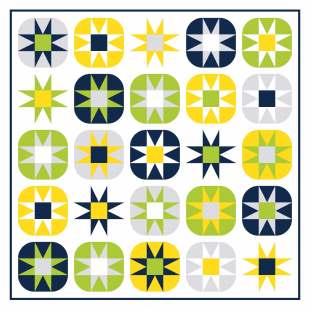

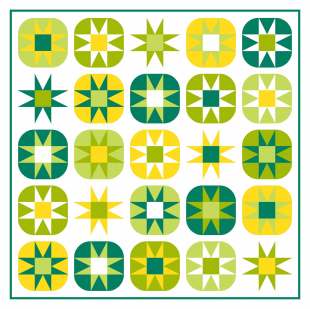

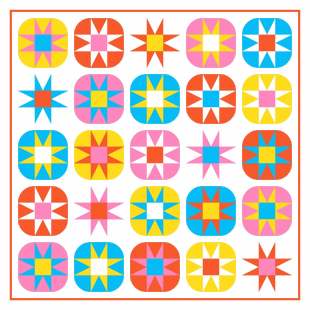
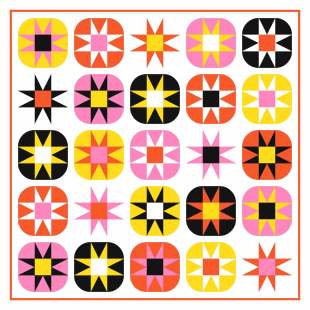

You can see that despite all the possible block permutations (3 elements x 5 colours), there are still a few blocks that are repeated in the previous versions. I tried again with the colour placement to avoid repetition, but it’s not easy! These next two versions feel a smidge ‘heavier’ to me, but maybe the larger number of unique blocks just makes the design seem busier?
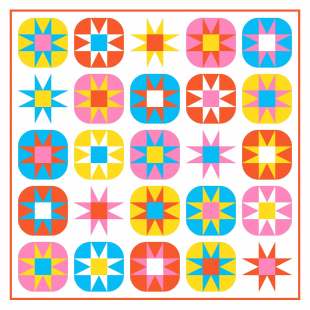

Of course, you could avoid the difficulty of colour placement by using fewer colours and going with just two blocks in an alternating layout.


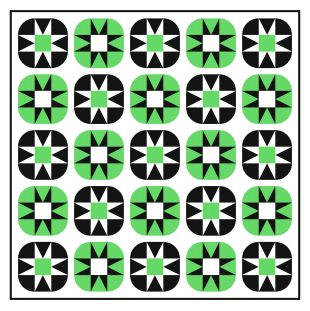
I also like alternating the ‘full’ star blocks with the ‘bare’ star blocks, which lightens the design a bit more.
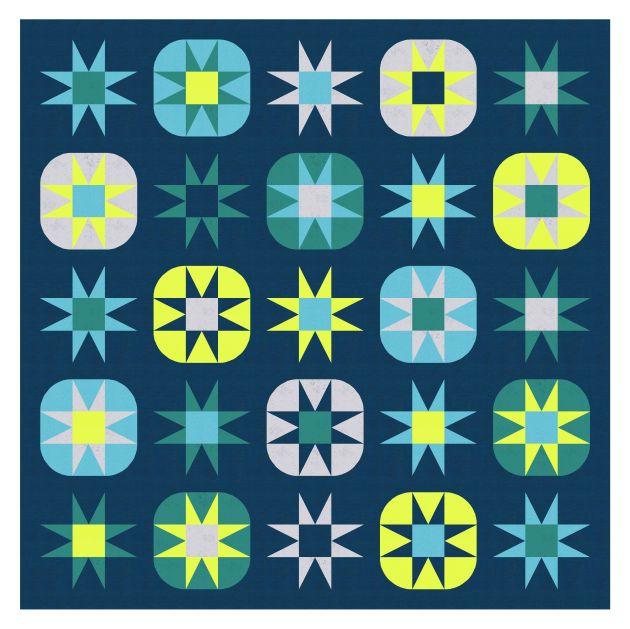
I know I’ve only used solid colours in these variations, but I think this design is one that would work really well with prints, particularly a coordinating range of fabrics.
This week’s sketch could be made into a quilt using quarter-circle (or drunkard’s path) units, triangle-in-a-square units (or half-rectangle triangles), squares, and sashing. I know a lot of people don’t like using sashing, but I like how it opens up a quilt design and lets the blocks breathe a little. OK, that sounds weird, but basically quilts feel less crowded to me when they have sashing.
Anyway, I’m not sure I’ve ever re-made the same quilt design before, but I’m very tempted to make another one of these quilts. It was awhile ago that I made it, but I’m pretty sure it came together quickly, as there are only a few basic shapes you need to make. As usual for me, the longest part was deciding on the colour palette.
Sunday sketch #318
I love creating block-based designs where lines from adjacent blocks combine to create new shapes. I guess that’s how secondary shapes emerge, but sometimes alternating block colouring can create secondary patterns too.
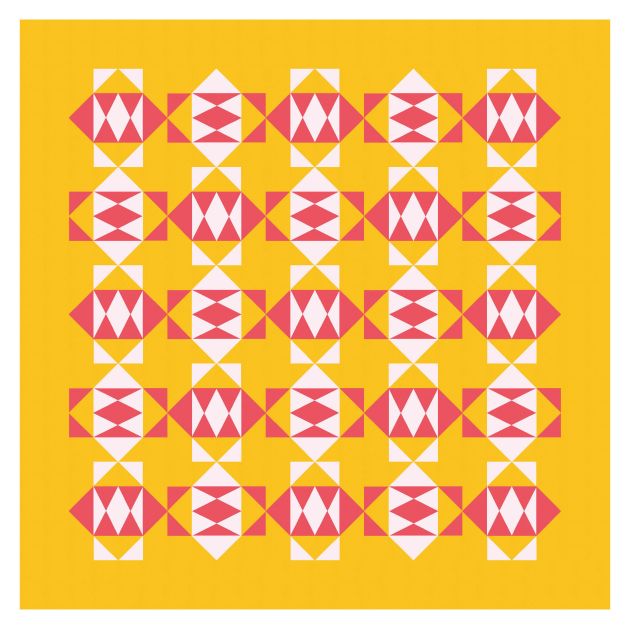
In the first version of this week’s sketch, alternating the colour placement in adjacent blocks creates a diagonal plaid effect. The colouring means that the features connected horizontally are that dark peachy-pink, while the same connected features running vertically are in light pink.
Changing the colour placement a bit eliminates the plaid effect. In the next version, both the block colouring and placement are the same (blocks are identical but every second one is rotated 90 degrees). Now light pink corners are touching dark pink sides, and vice versa.

There are enough different elements in this design that you can pick out single shapes to highlight.
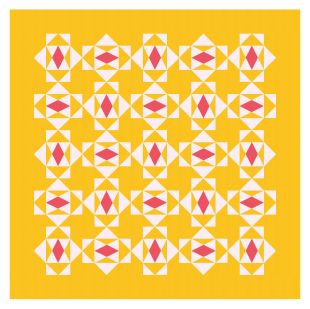
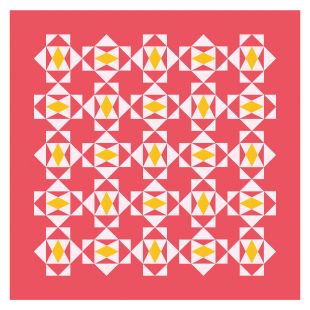
Or several shapes.

Or avoid focusing on any particular shapes, and just colour all the blocks in the same two tones. That simple colouring helps to highlight those diagonal lines, too.

These designs could be made into quilts quite easily using flying geese units, squares, and triangle-in-a-square blocks.
