
Tagged: half-square triangles
Sunday sketch #384
If you’ve followed my Sunday sketches for awhile, you’ll know that I love playing with colour palette and placement to make multiple versions of the same block. This week’s design uses two blocks, but that just creates more opportunities!
In the first version I’m showing you, which is the last iteration of the underlying design, I’ve just used colour to hide parts of the block (by blending them into the background). This particular colour placement suggests that the blocks have two layers, each of which can be peeled back to reveal the other one on its own. (This is my attempt at ‘modernising’ what’s otherwise a relatively traditional design.)

The designs that led to that first one are a bit different, though. I started by alternating two block types in a standard layout (even though the diagonal lines in the next few versions might suggest an on-point layout). Even with two relatively simple block designs, there are loads of ways to use colour placement to achieve a different look. Sometimes that means colouring some shapes the same as the background, effectively removing them from the design.


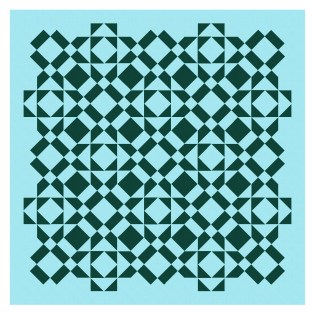

After playing with those versions for awhile, I switched to an on-point layout, which changes all those diagonals to vertical or horizontal lines. The same two block types are in there, but it almost looks like a design you could achieve using just one block type and some creative sashing.

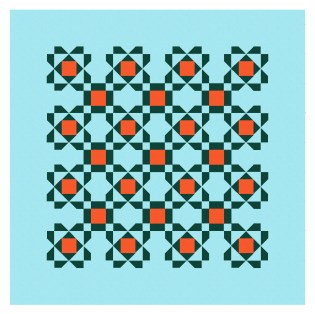

I often like to colour only some of the outer blocks to create interesting edges to my designs. (I really like the movement in the first design below, which I think might be easier to see when there’s no red to distract the eye.)

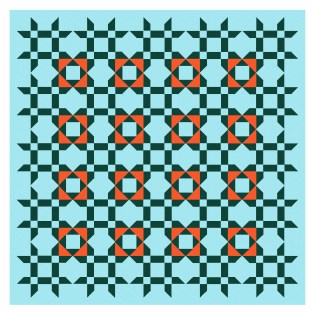
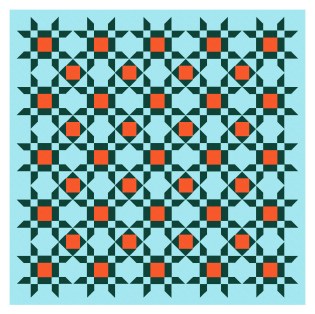

Of course, I kept iterating these designs and adding or subtracting new shapes (which were always there, just not always coloured in). This next version, the penultimate one, is the first version where I coloured in those smaller red squares (which are actually the four corners of that particular block; the other block doesn’t have any red in it).
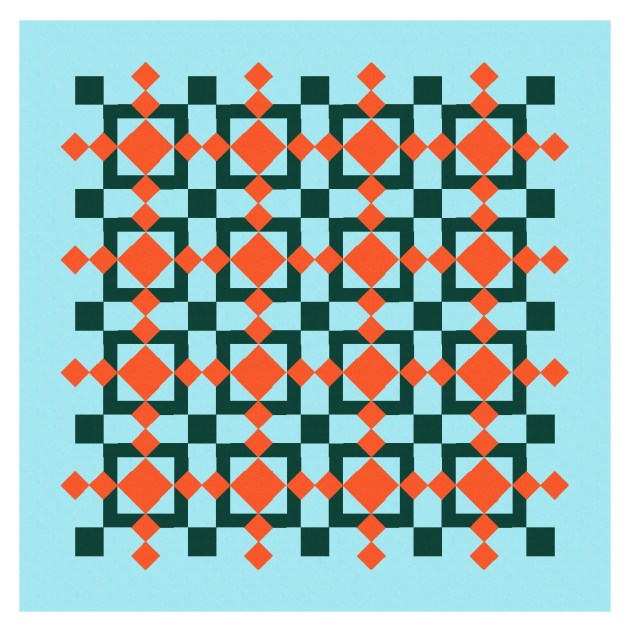
This colour placement suggests two discrete layers: a lacework of red squares overlaying the black ones. I liked the idea of paring back both layers in different areas, to reveal each one on its own (at least for a few blocks). That’s a concept I’d like to explore more in future.
Anyway, so the first and last sketches in this week’s post feel a bit different from the rest of the designs – I probably could’ve stretched them out to fill two blog posts! – but at least you can see how they’re all connected.
This week’s designs could be made into quilts using squares, square-within-a-square units, flying geese, rectangles and half-square triangles.
Sunday sketch #377
This week’s sketch features rail-fence-like blocks with square-in-a-square units as the main element. The middle row or column of each block (depending on its orientation) is differentiated from the adjacent columns/rows by switching the colouring of the squares and background. This creates floating rectangular shapes within the design.
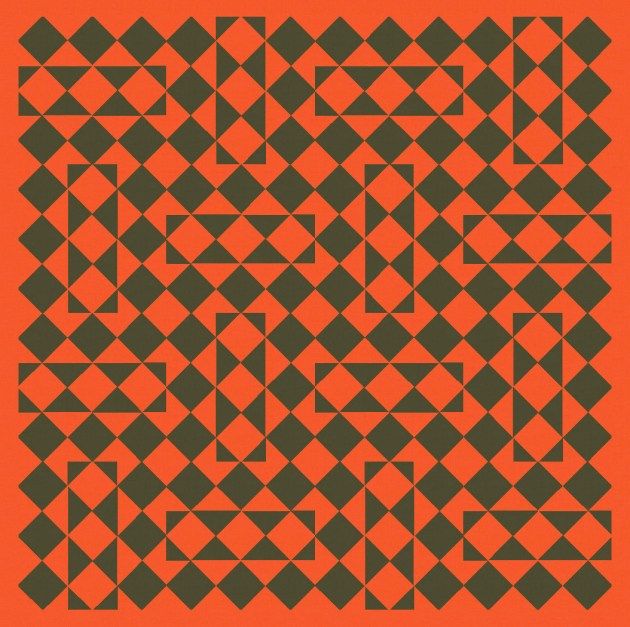
Here it is in red and white and in the reverse colourway.


I often like trying a design with a different block layout; in this case, setting the blocks on point. Now instead of running horizontally and vertically, those floating rectangles are sitting diagonally. And the background (or foreground?) grid is now a checkerboard.

Rather than having some of the floating rectangles only half-appearing (on the edges of the design), I’ve removed those ones so that the design has only complete rectangles.
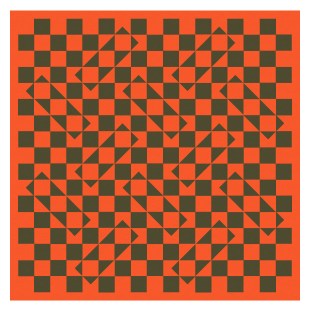

I think from afar, this design can look like a bit of a jumble, until you look more closely and see that there’s some regularity to those floating shapes.
Removing some of the rectangles gives the eye a (little) bit of room to rest, and makes the remaining rectangles more of a feature. This might be something I’d do if I were submitting this design to a modern quilt show.
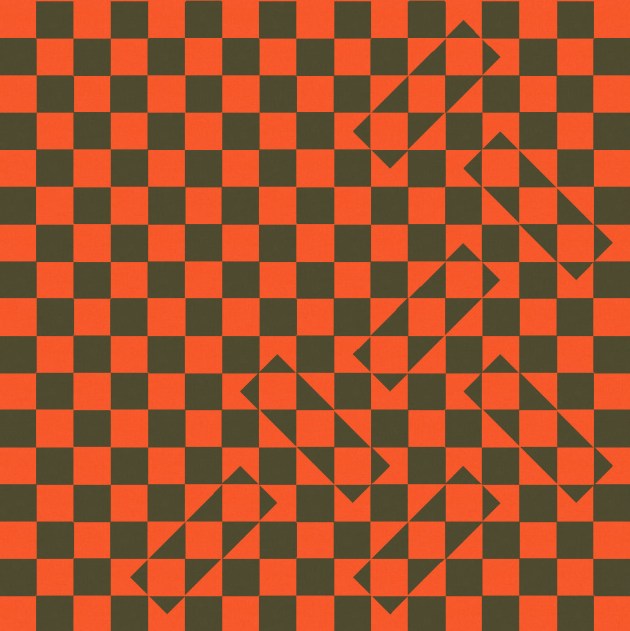
As the background (or foreground?) checkerboard pattern can be a bit overwhelming, I also tried removing some of it. This gives the eye much more room to rest. Ahhhhh.
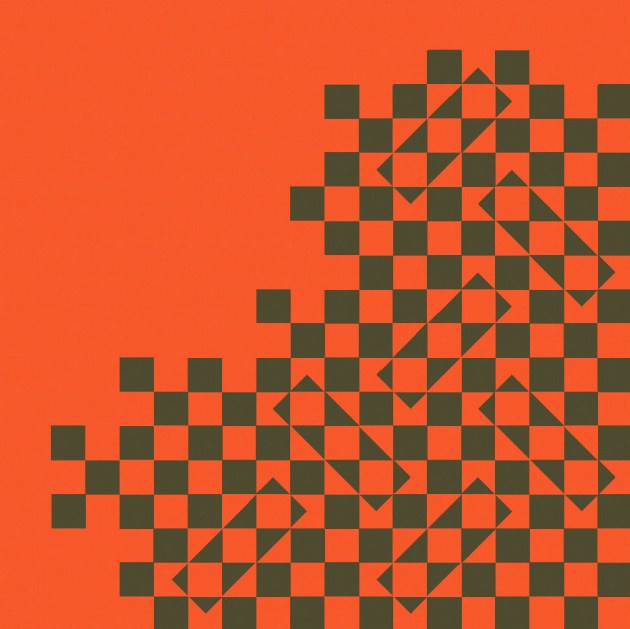
This week’s sketch(es) could be made using squares, half-square triangles and quarter-square triangles. Despite describing the main block as including square-in-a-square units, I wouldn’t actually use those units to create this design; simple squares and HSTs/QSTs would be enough.
Sunday sketch #373
I designed the week’s sketch only a couple of months ago, but I’ve already forgotten what prompted it. The blockiness* and transparency remind me a little of Sunday sketch #246. (*possibly not a real word.)
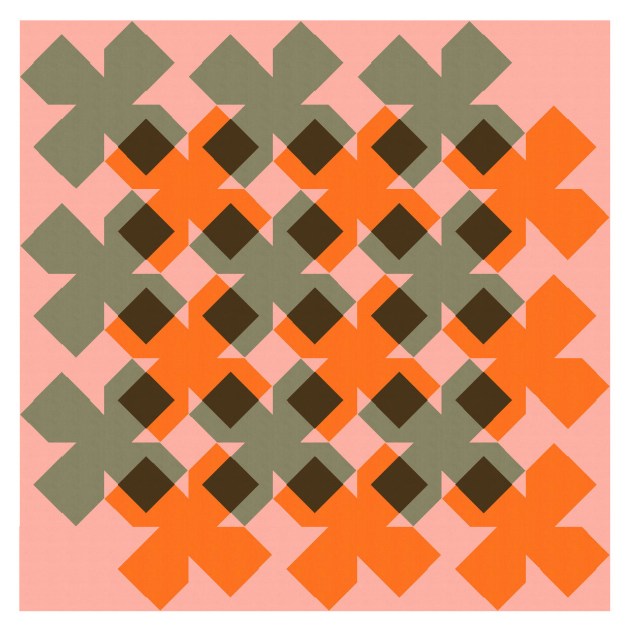
I think maybe I just liked the colour palette. It kinda gives me the ick but I’m also really drawn to it. I feel like the dark brown squares (where the reddish orange and khaki green overlap) work really well.
I expanded the border a little to let the design breathe a bit; that first version’s very crowded and in-your-face.
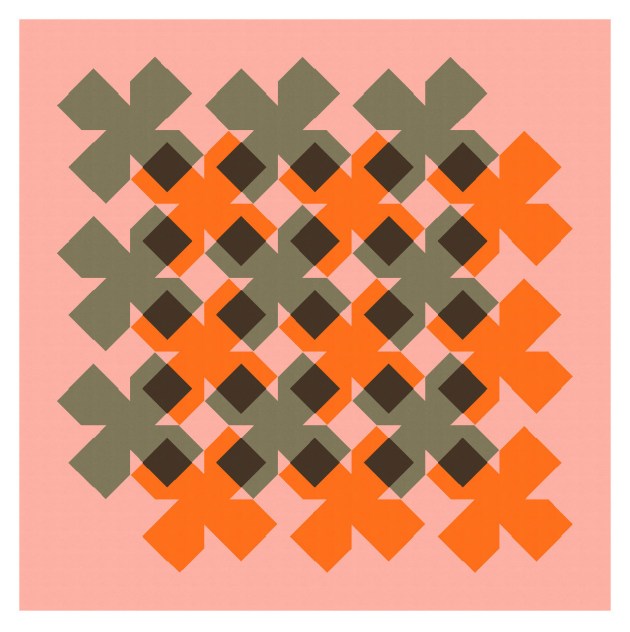
I tried to refine the design a little by curving the edges of the ‘flower’ shapes, which introduces lovely new secondary shapes (the orange-peel units in dark brown). The curves of the flower shapes are maybe not quite right – there’s a point at the tip of each petal where two curves meet that’s a bit sharp for me. But I love those orange peels!
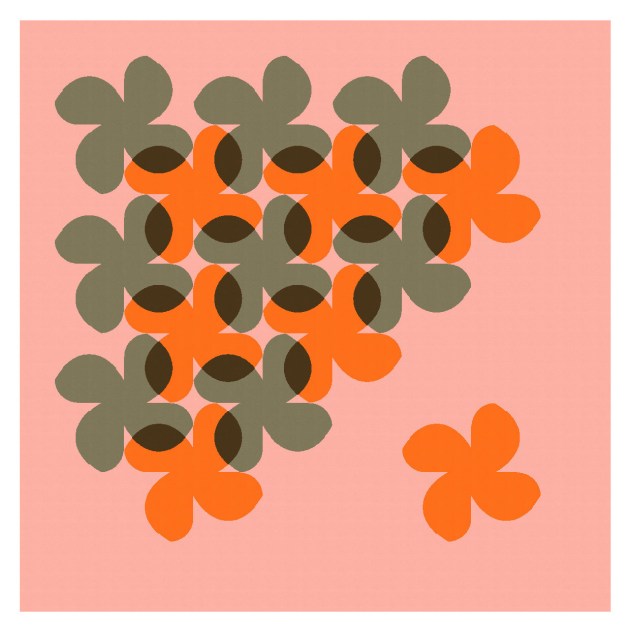
The first version of this week’s design could be made using squares, rectangles and half-square triangles set on point. The last version could be made using drunkard’s path units (or quarter-circles), rectangles and orange peels.
I’m mulling over ideas of what to make for submission to QuiltCon 2024 (submissions open on September 1 and close on October 31), but I don’t think this is a contender – the design needs more work. The palette though – that’s definitely on the shortlist! I just need to think up a four-colour design…. 🙂
