
Tagged: half-square triangles
Sunday sketch #295
The last day of QuiltCon is today, so you’ve no doubt seen lots of modern quilty goodness online. I’ve got three quilts in this year’s show, one of which is also a pattern in the QuiltCon magazine. I’m bummed not to see them hanging in person, but I’m not quite ready to hop on a plane just yet. Maybe next year?
Anyway, I was feeling like this week’s Sunday sketch wasn’t too modern, but having checked the Modern Quilt Guild’s definition of modern quilting, I guess it fits. It’s got “the use of bold colors and prints, high contrast and graphic areas of solid color”, although no “improvisational piecing, minimalism, expansive negative space, [or] alternate grid work”. The heavy use of half-square triangles (HSTs) feels more traditional to me, despite the bright solids, but apparently “the updating of classic quilt designs is also often seen in modern quilting”. So I reckon I’m covered haha!
I created these fishy shapes using HSTs, then embedded one (in colour) within another (in dark blue). I rotated the blocks to create lots of fishy movement, and separated them with thin sashing to avoid the HSTs from adjacent blocks touching (which would create secondary shapes that I didn’t want). Here it is in my usual warm palette:
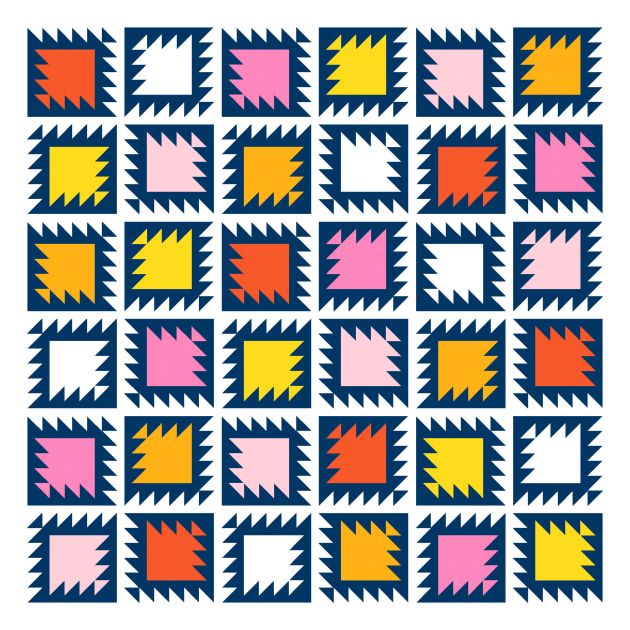
And in a cool palette:

As with any block-based design, this week’s sketch has lots of layout options. In the design on the bottom left, the blocks are arranged to create a spiky trail of HSTs (on either side of the white sashing) zig-zagging up the design from left to right. On the bottom right, I’ve just pointed the blocks all in the same direction. There’s a lot less movement in that version, but it’s nice to have somewhere predictable to rest your eyes.


Paring back the palette is also possible.


Or amp it up by adding more layers of ‘fish’. Here I’ve embedded two more fish-inside-a-fish, to make four fish per block. It’s probably overkill – imagine making all those HSTs! Not to mention how small they’d have to be (unless you wanted a massive quilt).
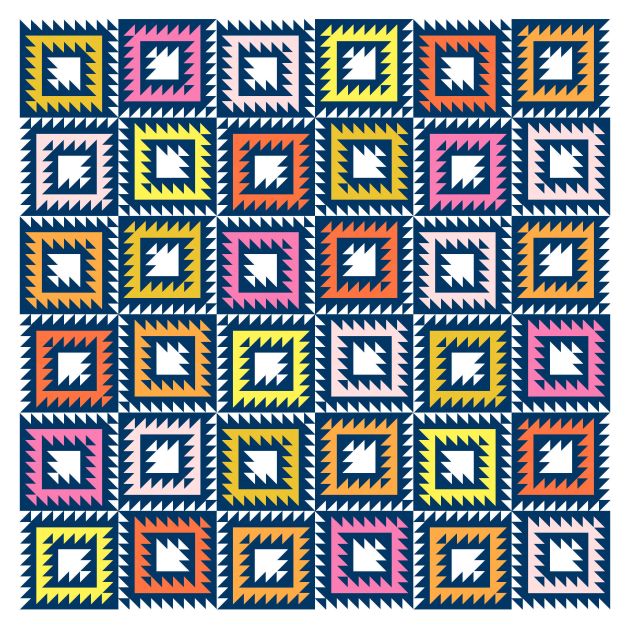
This last variation is so energetic, and I love how the areas where four blocks meet create a kind of ‘ripple’ effect – like you’d get after dropping a pebble into a pond.
This week’s sketch could be made into a quilt using lots – and I mean lots – of HSTs, plus a few strips. You’d definitely want to use a technique for making multiple HSTs at once, like the ‘magic 8’ method. I think the earlier variations could work with prints as the central fabric in each block, but I need to try that to find out. I’d still use solids for the big fish and the sashing, though – things would get way too busy otherwise.
Finished quilt: Sketch
This is Sketch, one of my absolute favourite quilts of all time. It’s a hand-drawn sketch recreated as a quilt, made using freezer-paper piecing with striped fabric.

Sketch is based on a modified version of Sunday sketch #181, which I posted on 15 December 2019. That design, which I drew with a gel pen on a Rhodia dot pad, looked like this:

In the blog post at the time, I wrote:
You can see from the scale of the background dots and my fill lines just how small this design was on the page of my Rhodia dot pad – only a few centimetres across! I love a good triangle, and I just started placing them on the page, following only one rule: each triangle I added had to touch an adjacent triangle, but only at a tip (no back-to-back edges allowed). I stopped when I was happy with the random arrangement.
Those of you who know how much I like symmetry and order can probably see that despite the ‘improv’ nature of this design, it’s still fairly well balanced in terms of positive vs negative space, and the number of shapes in each quadrant. Even when I’m not trying to be ‘ordered’, it happens 🙂
I thought that the design would look great as a large quilt, but I didn’t spend much time thinking about how that might be possible – I guess I just assumed I’d piece large shapes in a solid colour. I never got around to doing it, and moved on to other designs.
I’m not sure when it first happened, but my quilty friend Tamara Stunnell – who I met through the Melbourne Modern Quilt Guild – suggested that I make the sketch into a quilt using striped fabric to represent my sketching lines. Ooohhhh. Brilliant idea. Genius. I knew it would be amazing. But also way too hard. I let it slide.
Then she said it again. And probably again. And each time I’d say “Great idea!”, then change the subject, cos I honestly had no idea how I’d do it. I’d need a striped fabric with the same imperfections as my hand-drawn pen lines. I’d need to create paper-piecing templates for every single triangle, and figure out how to add the thin black outline to every shape (in the exact same width as the lines in the fabric, just like in my sketch). I’d need to make sure the striped fabric lined up on every single piece, so that the lines all followed the same direction across the quilt – just like my pen lines do when I’m sketching on a page. I’d have to make sure that a black stripe never ended up in the corner of a shape, right up against the shape’s black outline, or it would make it look too dark and draw the eye unnaturally towards it. I’d need to figure out how to sew all the shapes together, probably using some partial seams. The points of the triangles would have to meet perfectly. And I’d have to do it all with a large white background, which would show up every stray black thread. Are you kidding me?!?! No way. It’ll never happen!
And then we were in our local quilt shop – GJ’s Discount Fabrics – one day, and there it was: the perfect striped fabric. The black stripe from the Dot and Stripe Delights range from Robert Kaufman. Stripes that look hand-drawn. Fairly regular, not perfect. A few flecks that look like ink here and there. And the stripes are around 1/4″, meaning that the outline of each shape could also be 1/4″ wide. “You should make that quilt,” Tamara said. Arrghhh! She was right, of course. I bought yardage.
So, with no deadline in mind, I started planning the quilt. I revised the sketch, making slight changes to avoid some parts I hadn’t loved in the original. But I kept the design mostly the same. Here’s the updated version:

I counted up all the shapes and made freezer paper templates for paper piecing. I marked on each one which direction the stripes should point, to make sure they were all parallel in the finished quilt (just like they are in the sketch). And then I got to work making all the pieces. Some pieces are unique, while others – like the 2:1 half-rectangle triangle – appear a few times.
Once all the triangle units were done, I put them together into the quilt top. Only one partial seam was required for assembly. I was really happy with how it looked, but hardly took any photos cos I was terrified of mucking up a mostly white quilt!
I sent Sketch to Valerie Cooper of Sweet Gum Quilting for longarm quilting. After talking through various quilting options, we settled on a grid design in white thread to represent the graph paper I use for sketching. Valerie offset the grid so that the vertical and horizontal quilting lines (in white thread) avoided the vertical and horizontal outlines of the triangles (in black fabric).

I finished the quilt with a facing, so it was nice and flat like a sheet of paper. Here are the sketch and the quilt side by side. I honestly couldn’t be happier with how this quilt turned out.


So this quilt represents a few things for me. First and foremost, the importance of supportive friends who know when to nudge you beyond your comfort zone. Also the joy of making for the sake of it, with no purpose in mind other than to tackle a challenge. And finally, the evolution of my design and quilt-making skills. When I first posted this Sunday sketch in 2019, I wasn’t ready (and possibly not able) to make this quilt. But two years later, my skills had improved to the point where it was possible. I love seeing tangible signs of how my quilt-making has developed over the years.
Sketch was juried into QuiltCon 2022, and will hang at the show in Phoenix, Arizona. If you happen to spot it there, send me a pic or tag me on Instagram! I’d love to see it.
Quilt pattern: Zester
I’ve got a new quilt pattern out! It’s called Zester, and it’s in this year’s QuiltCon magazine.

Zester is based on Sunday sketch #250, which features large drunkard’s path blocks alternating with nine-patch blocks made up of half-square triangles.

I modified the design to add some negative space along the top and one side, and introduced a bold palette.

I used Art Gallery Fabrics’ Pure Solids in this quilt, because I wanted that exact yellow – Empire Yellow, my new favourite – and a black (Caviar) to match. Their solids definitely have a lighter hand than the Konas I usually use, and they feel a bit more slippery, but they sew like a dream and don’t fray terribly.
Because it uses only two types of blocks, Zester comes together really quickly. You can chain-piece all the curves, then chain-piece all the HSTs, and before you know it, you’ll have a quilt top!
Zester was quilted by Valerie Cooper from Sweet Gum Quilting. With Valerie’s advice, I settled on yellow thread and straight-line quilting, which I’m really happy with. I love the contrast of the yellow thread on the black fabric! (I also love being able to trust Valerie with the quilting, rather than stressing about doing it myself!)
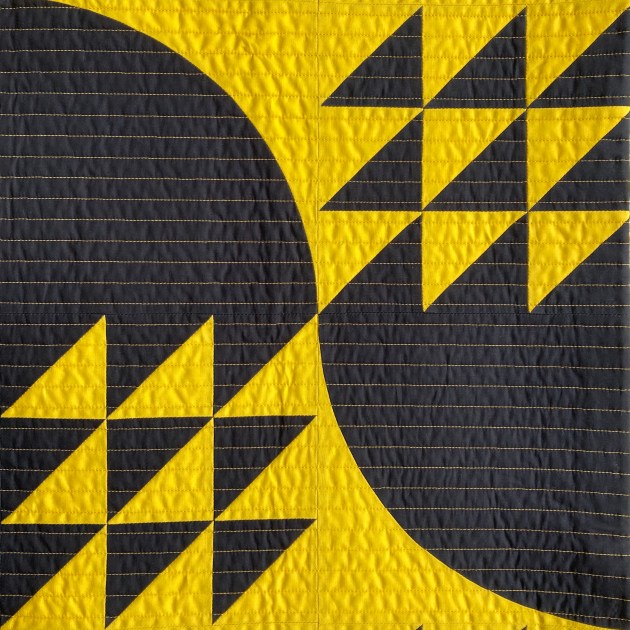
I picked the name Zester because the HSTs remind me of the really sharp bits on a cheese grater or micro-plane for lemon zesting. We have a wasabi grater and those teeth are sharp! But ‘Zester’ felt like a nicer name than ‘Grater’ haha.
I don’t publish quilt patterns in magazines much anymore, but I still submit designs for consideration in QuiltCon magazine every year. QuiltCon is definitely a focal point for modern quilters, and I get a lot of inspiration seeing others’ work each year (from afar – I’ve never been to the show in person!). I’m happy to be able to contribute to the magazine once again, alongside loads of incredible designers and makers.

Digital copies of the 2022 QuiltCon magazine are on sale now. Print copies go on sale on 22 February to coincide with the show in Phoenix. You can also buy individual digital patterns, so if you fancy just making Zester – or my award-winning quilt Fanfold from QuiltCon 2021 – you can find the pattern on the Quilting Daily website.
