Finished quilt: Cherries
I don’t always post about finished quilts, but I’m particularly proud of this one: Cherries. It’s also going to be hanging at QuiltCon 2022 in Phoenix, USA, so I thought it would be good to document its creation for anyone who sees it there and wants to know more.
On Instagram, I follow a UK-based multidisciplinary artist and printmaker named Frea Buckler. In July 2021, Frea posted an image (no longer on Instagram) of a series of screenprints, one of which featured large overlapping hexagons.
I fell in love with the artwork at top right. The colours (that yellow!), the shapes – everything about it just makes me happy.
Coincidentally, the Modern Quilt Guild had just announced the 2022 Hexagon Quilting Challenge for QuiltCon: “Eligible quilts must use a hexagon shape as a primary element in the design.” I knew Frea’s artwork would work really well as a quilt, and I wanted to make it and submit it to the Hexagon challenge. Can you see the four hexagons in her design? Two standing side by side, and two more larger ones created by their outside edges?
I contacted Frea and asked for her permission to recreate her artwork (which she had provisionally called ‘Cherries’) as a quilt, and she graciously agreed. I also bought the print 🙂
I’ve never adapted someone else’s design to make a quilt before; I’ve got enough of my own designs to work with. But I loved the idea of scaling up a small (20 cm square) artwork to quilt size, sourcing just the right solids to match the original paint colours, and creating an entire quilt with only 9 colours and 14 seams.
When the print arrived, I used my Kona Cotton Solids and Devonstone Collection solids colour cards to match – as closely as I could – the colours in the original artwork. Then I had to wait for all the fabric to be delivered (this was during lockdown, when I couldn’t shop in-person, and post was delayed!). Some were perfect matches; others, not so much. But I finally settled on a palette that I was happy with.
I procrastinated a long time making this quilt. I wasn’t entirely sure how to approach it, and I didn’t know if I’d encounter problems with sewing together large pieces with long bias edges. In the end, I just started measuring and cutting and sewing and re-sewing where necessary. It wasn’t as difficult as I was expecting, and it didn’t take me nearly as long (which is good, since I’d left it til the last minute!). The final quilt measures around 49″ square.
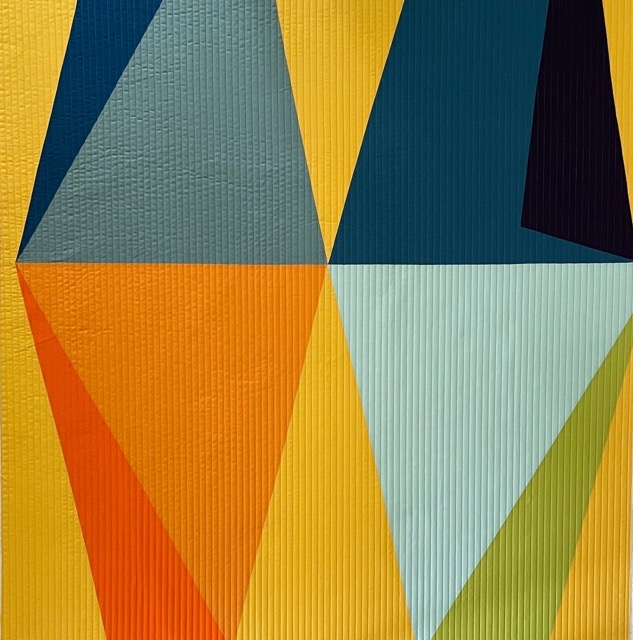
Cherries was quilted by Valerie Cooper of Sweet Gum Quilting. Because I’d left it so late, we settled on vertical straight lines with yellow thread. I think the quilt could’ve also looked great with more geometric quilting within each colour block, but I didn’t leave Valerie nearly enough time for that. She quilted it quickly, and I did a facing and took photos with what felt like only minutes to spare before the QuiltCon submission deadline.

I received confirmation in December that Cherries had been juried into QuiltCon. I’ve seen lots of amazing hexagon quilts on Instagram that are destined for the show, so I’m excited that Cherries will hang with them. If you’re in Phoenix and you see this quilt, feel free to send me a pic! I’d love to see it.
I’m very grateful to Frea for allowing me to recreate her artwork and for inspiring me to break out of my quilty comfort zone. I’ll definitely be less hesitant to try something new next time.