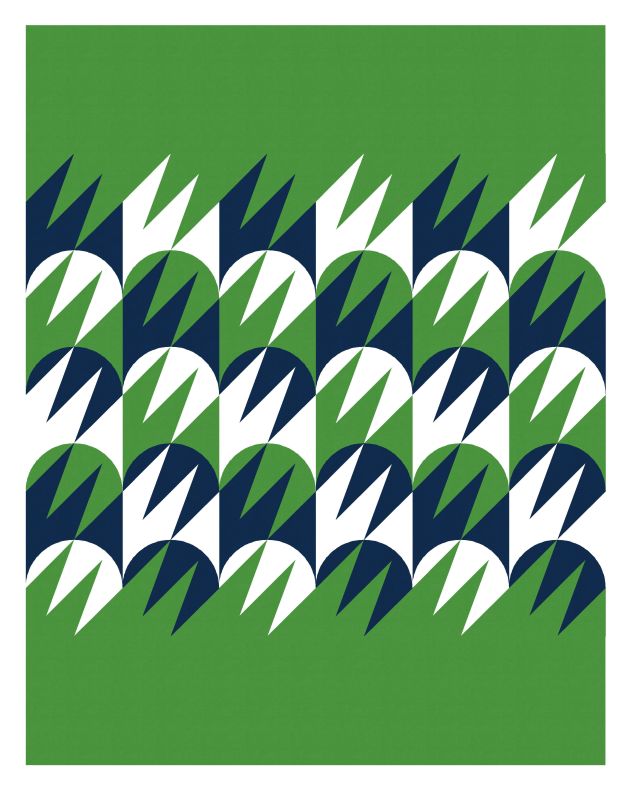
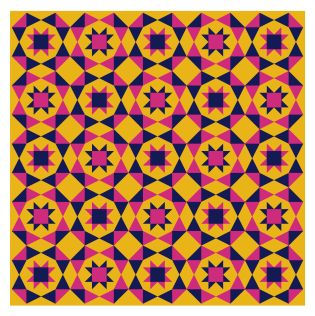
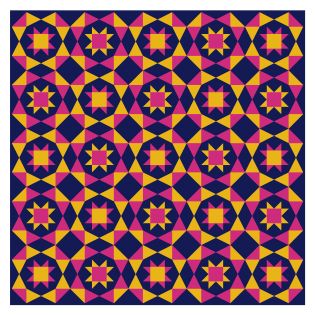
Australia got a new prime minister this week, so it feels like the perfect time for a bright and happy multicoloured design.
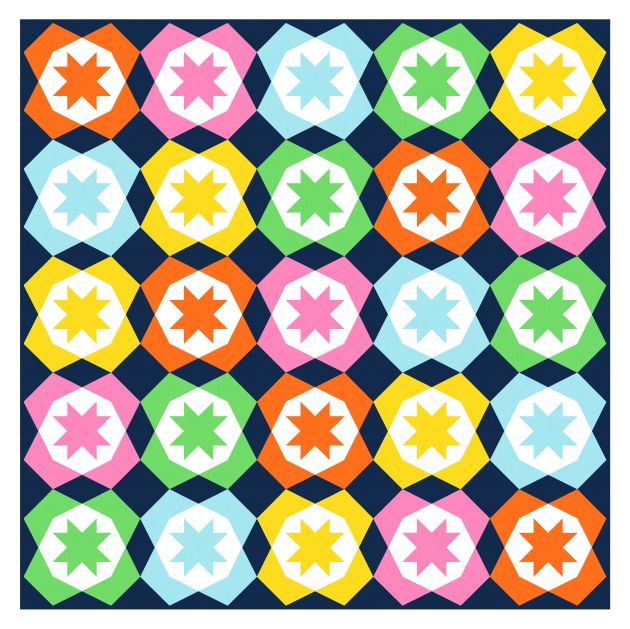
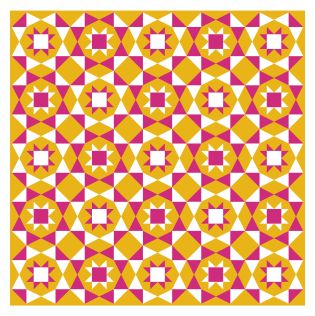
This design is a single block on repeat. Although the block is made up of a few different elements – which I’ll talk about later – I’ve stuck with only a few colours per block. I wanted to emphasise certain shapes, and not let the whole design get over-busy. One way to reduce busy-ness is to use the same colour in certain parts of all blocks – in this case, using white for that internal octagon in each block.
Here’s an even sparser colourway that matches the internal octagon to the background colour (white):
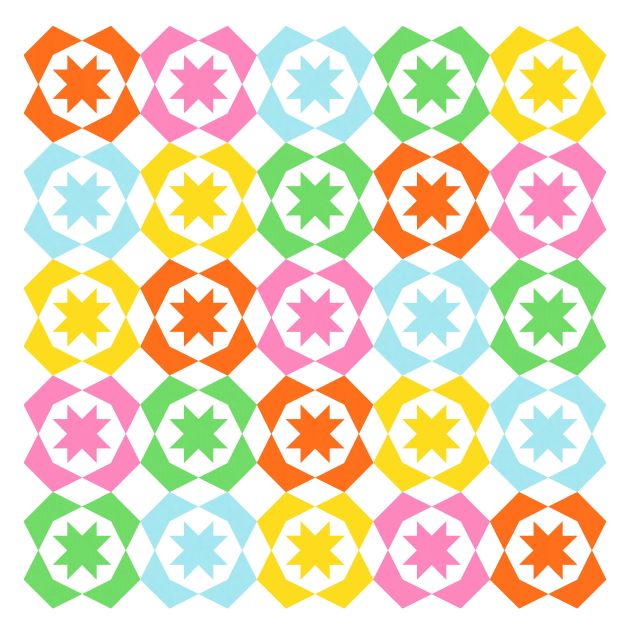
The centre of each block is a square that could fit just about any other type of block, but here I’ve used the sawtooth star – one of my favourites, and a traditional block that I come back to again and again. Sawtooth stars have several elements (the internal square and the outer half-square triangles), and they too can be coloured differently to create another variation of this design.
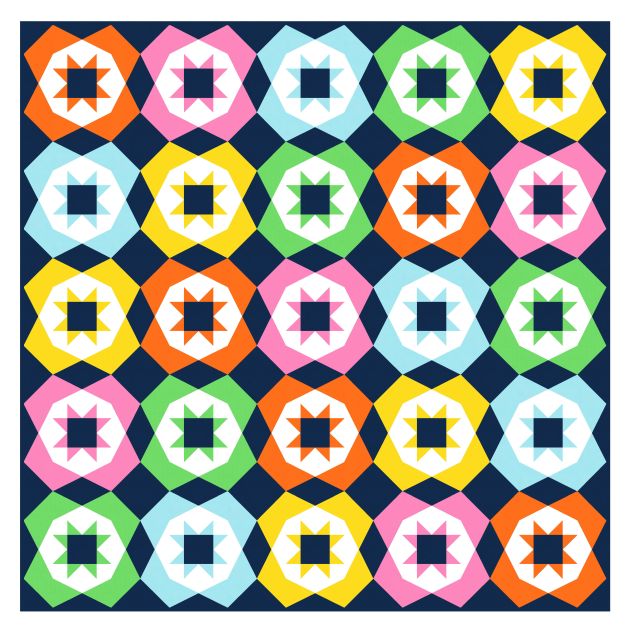
These blocks remind me a little of storm-at-sea blocks, as all the lines around the central square in each block meet the lines in adjacent blocks, creating movement that draws your eye round and round.
I added even more movement by colouring some of the shapes that emerge between adjacent blocks. (And added a border so your eye has somewhere to rest.)
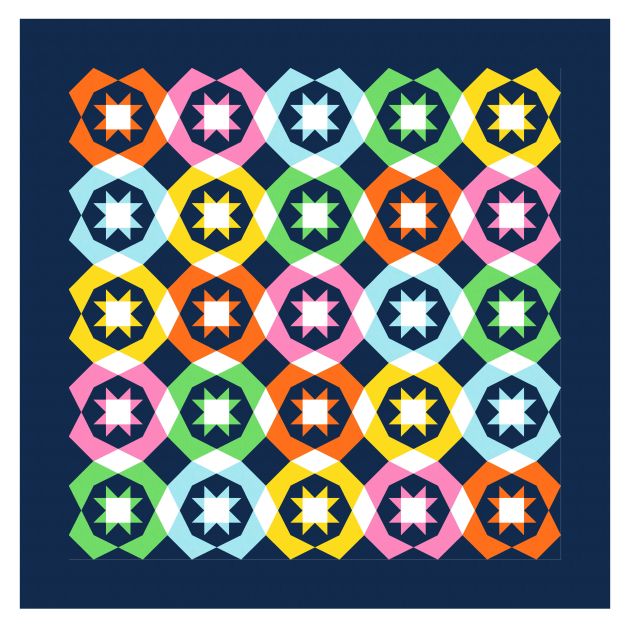
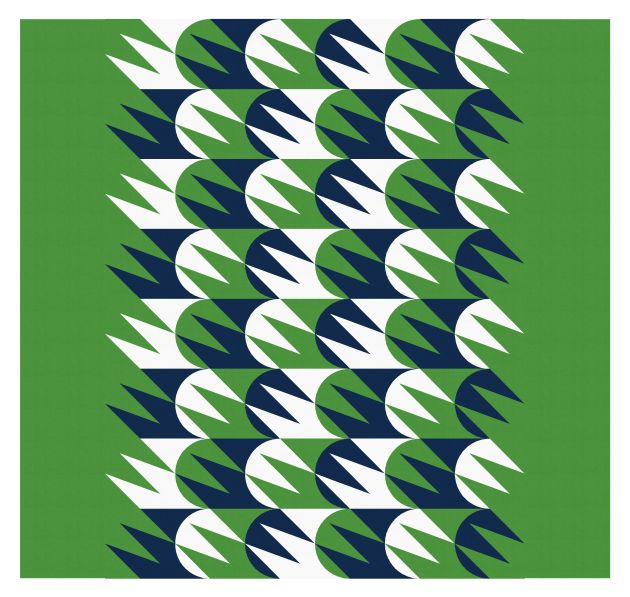
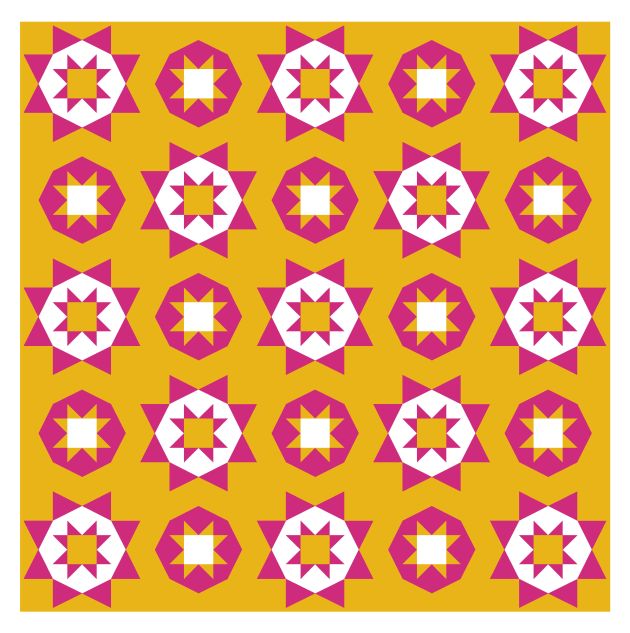
The outer points of the blocks are positioned in such a way that shifting blocks along a bit still lets them touch by their tips. So I can stack them in tilting instead of vertical columns. Some of the movement from the earlier versions is gone, replaced by movement in new directions.
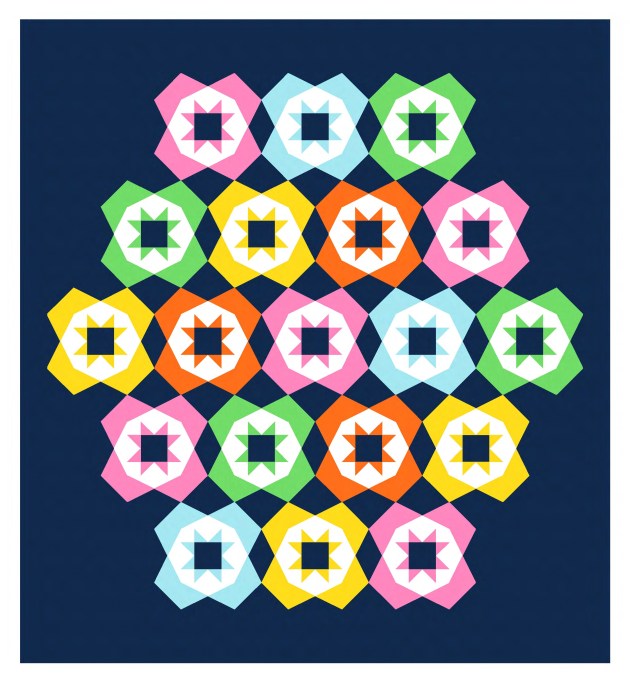
And the blocks in each row can be connected again, as before.
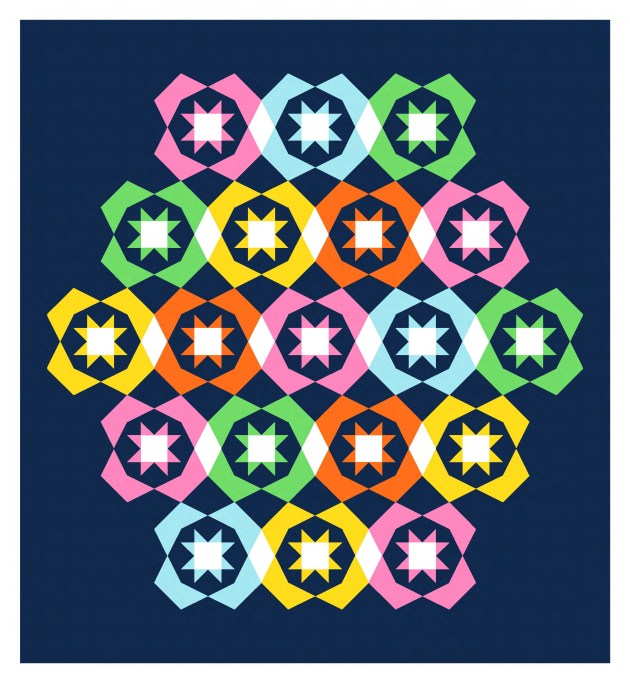
These blocks are created using a bunch of basic units. Each block is a 16-patch, with the central 4 patches merged to create a larger square that fits the sawtooth star. The 4 corner patches are half-square triangles, and the 4 sides (comprising 2 patches each) are triangle-in-a-square blocks (facing each other with their points touching).
Pretty much any block could be squeezed into that inner square – even a mini version of the same block. I like sawtooth stars cos they’re simple and easy to make, but also just cos I love the way they look.
I could’ve kept iterating this design to try and create one with a bit more negative space, but then you’d lose a lot of that movement, I think. And not every design needs to be ‘modern’ in that way… this one feels a bit more ‘contemporary’ than ‘modern’ (although don’t get me started on how to differentiate between the two…). It definitely has traditional leanings, and next week I’ll share variations that take the design even more in that direction.