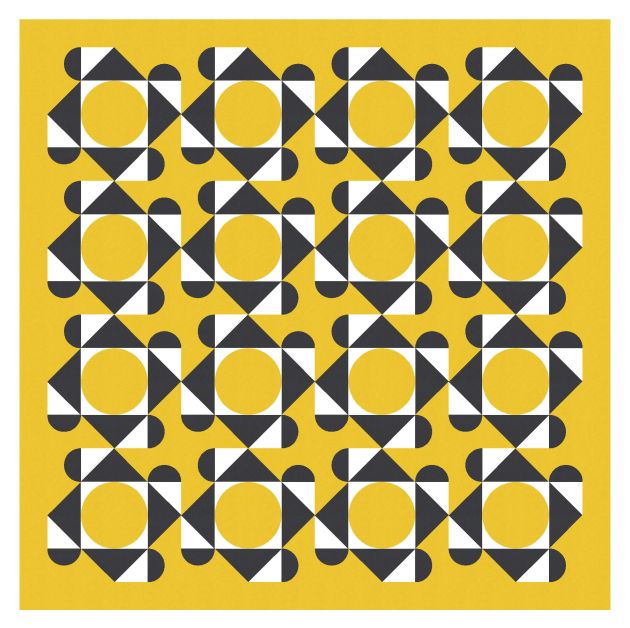
Sunday sketch #333

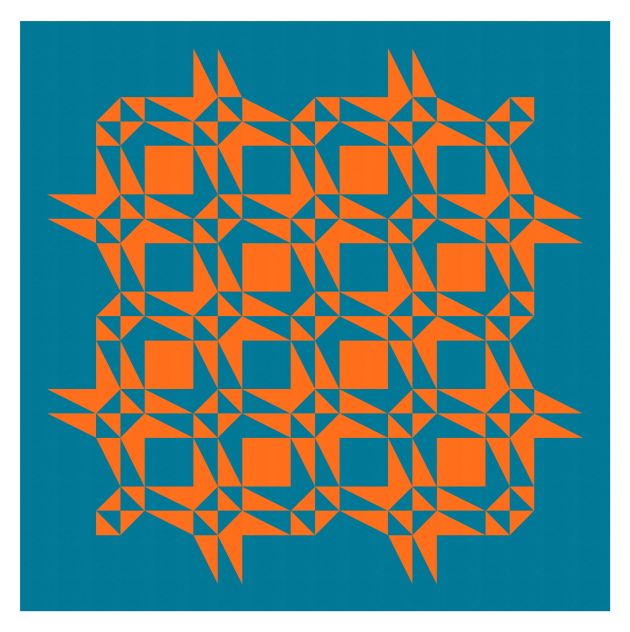
I started this week’s sketch on my dot pad, but I’ll show you where I ended up first.

This palette’s one that I’ve had in my head for awhile – that murky, blue-y green (teal I guess? but darker?), and that bright orange. I love it! Anyway, I didn’t start with that palette either, but I’ll explain how I got there.

I started by playing with triangles of different size. These shapes kinda look like (conical) martini glasses. By shading the components differently, it creates an overlapping effect. I decided to explore the idea more in Electric Quilt 8.

It’s pretty clear from the sketch that the easiest way to recreate the hand-drawn sketch is to break down the triangles into half-square triangles. So that’s what I did. Although I coloured the first version in a palette of four colours (against a white background).

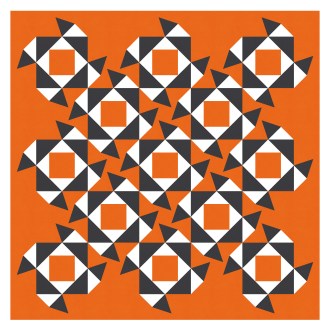
This design feels busier than I’d normally like. I decided that big triangles that weren’t overlapped shouldn’t include the smaller triangle from the adjacent shape, so they’re solid. And just something about this version feels… I dunno, not quite right. I don’t like how the predominant lines are the diagonals connecting the hypotenuses of the larger triangles. And there’s way too much going on with that palette.

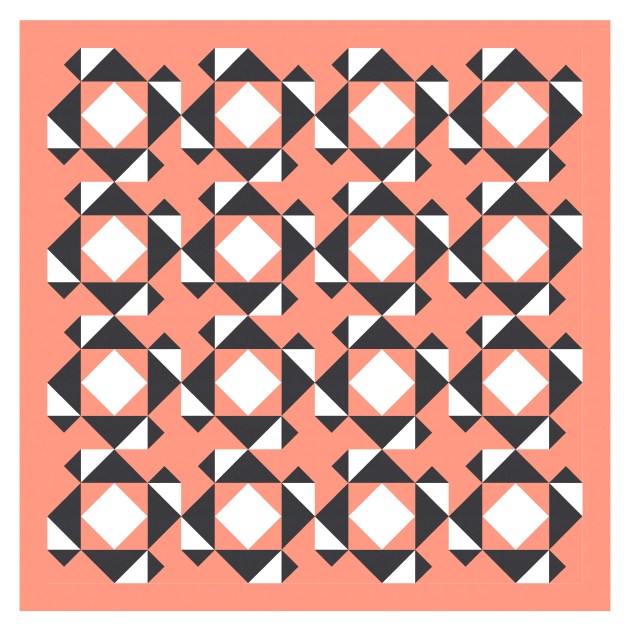
So I made a few tweaks: I set the half-square triangles on point, so the triangle shapes now appear to be in rows and columns. That removes those diagonal lines; they’re now horizontal, which is somehow less imposing. And I reduced the palette by one colour. It’s still pretty busy, but a bit more manageable now.

I often like to set designs against large white borders – almost like an artwork framed by a mat board. But I think this version would actually look better without the borders, so the repetition fills the quilt top. I like this version a lot more…

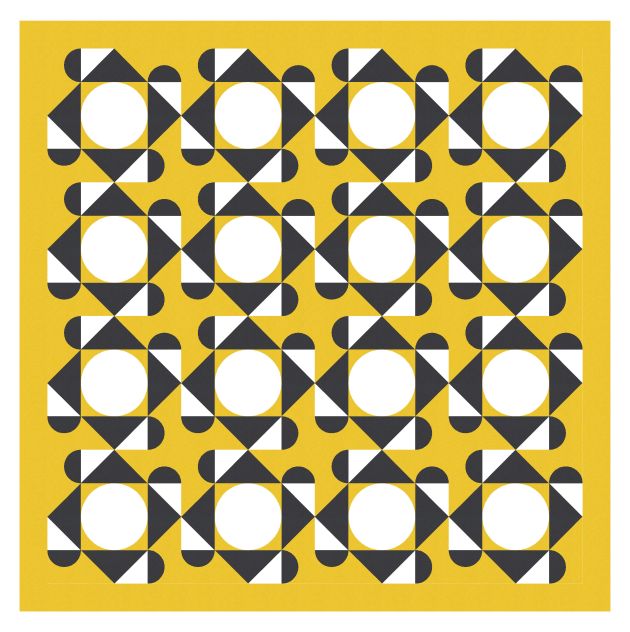
…but it’s still not what I had in mind originally. So I kept tweaking. I reduced the palette once again, to a pair of colours for the triangles against another colour in the background (I’ve used this light grey, blue and black combo before, most recently in Sunday sketches #314 and #315). And I found a fantastic combo with acid yellow – I know this won’t be everyone’s cup of tea, but I love it!

Finally, I started removing triangles to create some negative space and introduce some more interesting movement. I don’t usually plan this; I just pull things out until I like how the design feels.

And then I found this colour combo, which I stuck with.

I liked that version a lot, but the middle of the design felt a bit heavy compared to the rest. I decided to break up the columns of triangles in the middle – adding a bit of negative space. It was also an opportunity to add more large orange triangles. I think that naturally draws the eye from orange triangle to orange triangle, helping to create more movement in the design.

I also added a floating shape at the bottom right. This breaks my rules a bit – every other shape touches at least one other – but I’m allowed 🙂

These sketches could be made into quilts using half-square triangles and squares. You might need a design wall to keep everything organised until you were ready to sew rows or columns together.

This week’s sketch reminds me a lot of Sunday sketch #308. It’s got the same columns of repetitive, overlapping shapes. And the shapes themselves are very similar, with a large component and a small component that touch at a point. These are two of my favourite Sunday sketches (I know I say that all the time)!

Sunday sketch #332

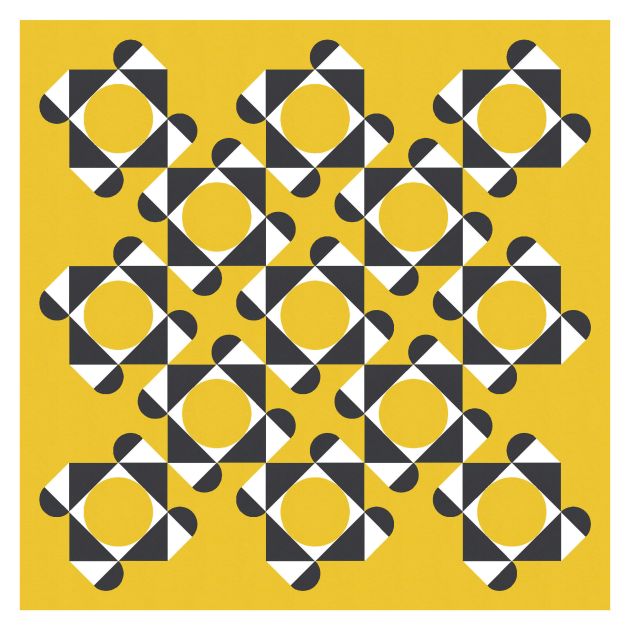
Is it cheating to post a Sunday sketch for the first time after I’ve made a quilt from it? (I guess not really, since I make the rules haha!)

I designed this sketch awhile ago, when planning what three quilts I’d contribute to ‘The Before Times’, an exhibition at the Wangaratta Art Gallery in Victoria, Australia, from 12 November to 18 December 2022.

The exhibition is curated by Tara Glastonbury (@stitchandyarn) and features work from six artists. We were each free to interpret the theme of ‘The Before Times’ in our own way. I thought about geometry and going back to the most basic of shapes: triangles, rectangles and ellipses. I designed each quilt around a single shape, and this week’s sketch is the basis of the ‘square’ quilt (which I’ll post about in more detail later).

I’ve talked before about how imposing constraints on designing can actually be helpful. When you’re allowed to move in any direction, indecision can leave you standing still. But when you can only go in a specific direction, it can be easier to move forward.

Squares are the most basic of shapes in patchwork, and there are a million (or more!) quilt designs that use only squares to great effect. It took me awhile to come up with something interesting that I felt like I hadn’t seen before, then even more time to find a colour palette I liked.

I love how the squares look like those crocheted squares that interlock at their edges.

The actual quilt that I made looks a little different – I added some asymmetrical borders and used a different colour palette. The design works well in a lot of different colourways – basically any four colours that go together but have sufficient contrast so that adjacent colours don’t blend into one another too much.

I always have a bit of fun using the ‘Randomize’ feature in Electric Quilt 8… more often than not, the output is a bit yuck, but occasionally I find a colour combo that I can tweak.

This quilt design can be made into a quilt using big squares and small squares. I actually sewed long strips together then subcut them to make the outer edges of each block (the alternating small squares). The same pairs of colours appear throughout, so that was a much faster way of doing it.

I called the quilt based on this sketch ‘Tetrapacked’, as a nod to the basic shape. I’m not sharing too much about it online yet, because I’ve also submitted it to QuiltCon 2023. So if you want to see it, you can head to the Wangaratta Art Gallery to see ‘The Before Times’ exhibition 🙂


Sunday sketch #331

This week’s Sunday sketch is inspired by art that I saw on Twitter. I follow a few accounts that serve up wonderful art every day – images of paintings or other creations and the people behind them. My favourites are @MenschOhneMusil and @womensart1.

PL Henderson, the art historian who curates the #WOMENSART feed, posted a series of works by Ukrainian-French artist Sonia Delaunay in early October. The image of 1920s-1930s clothing designs caught my eye. Those shapes and colours!

I’m embarrassed to admit that I didn’t know much about Sonia Delaunay or her work. She combined abstract geometric shapes and bold colours in art and fashion. And she was a quilter! Well, she made at least one quilt, a process that apparently prompted her to change the direction of her art practice.

Anyway, it seems fitting that I’d be inspired by one of her designs. If you check out the image of the clothing designs on Twitter, you might spot which dress sparked this idea.

Delaunay’s sketch of a dress design uses a quarter-square triangle for the bodice and two squares flanking a triangle for the skirt. I created the same shapes and linked them in columns with another quarter-square triangle added in-between; that let me ensure that the ‘skirts’ in adjacent columns didn’t interfere with each other.

In the next version, I coloured the ‘skirts’ differently from the bodices and extra quarter-square triangles. You can see that I inverted the shapes in alternating columns.

Because there are so many shapes, there are lots of other possible variations in colour placement. This next one is perhaps a bit heavy in this colourway. But sometimes it’s fun to play, just to see if any new ideas emerge.

I also tried two shades of a single colour, which also looks good, I think. This approach also makes it clearer to see secondary shapes and other apparitions emerge from the design. I feel like there are a few serious dogs (or bears?) wearing shades in this version. (Can you see what I mean, or do I sound like I’ve lost my mind?)

There are a couple of ways this design could be made into a quilt. You could create a bunch of quarter-square triangles and lay them out in columns, separated by columns made of flying geese and squares laid vertically. Or you could set the whole thing on point, and use squares and half-square triangles instead. I think it’d be pretty easy once you got started.

If you want to read more about Sonia Delaunay, check out this profile in the Guardian, published to accompany an exhibition at the Tate Modern in 2015, and a more recent article from this year, in Daily Art Magazine.