Sunday sketch #351

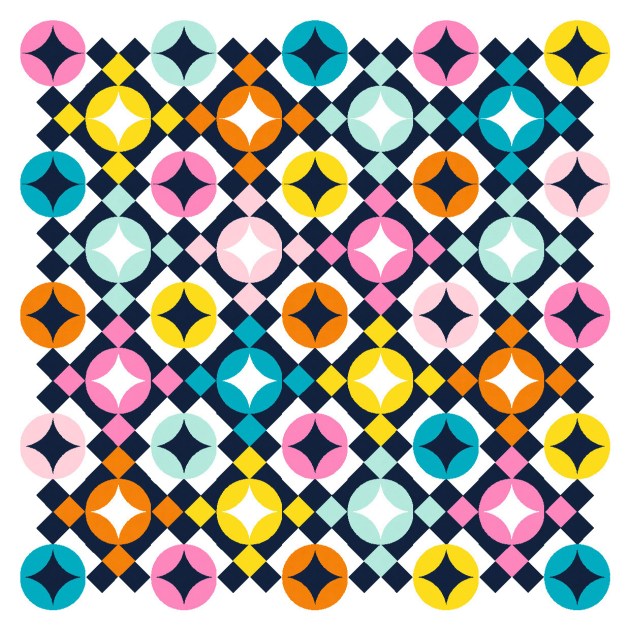
The colour palette this week makes me so happy that I found it really difficult to pare down the list of designs to share. I’ll walk you through the slight variations between each one, and you can decide which one(s) you prefer!

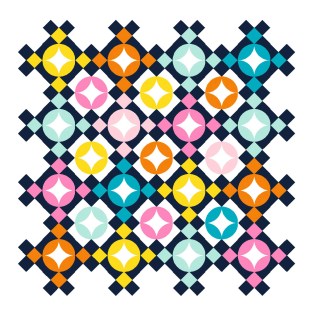
This is a fairly simple block-based design that looks like it’s set on point but isn’t. I’ve never sewn an orange peel block before, but I can do drunkard’s path units (quarter-circles), so I figure it’s just one more step, right?

In this first version, I’ve used colour for the circles and either white or dark blue for the inner four-pointed concave stars.
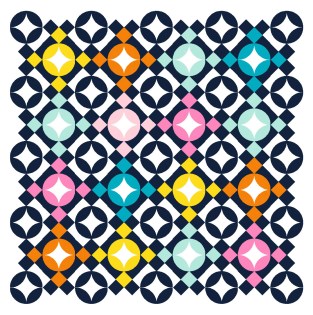
I can mix those colours around though, to produce slight variations that feel heavier or lighter. On the left, the coloured circles that previously had inner dark stars are now dark circles with inner coloured stars. On the right, I’ve stripped colour out from alternate blocks.

Or I can darken those stars in the coloured circles instead.

I often like changing up the outside edges of designs. Instead of colouring those outer circles, I’ve opted here to focus on the stars. I love this effect. Other minor changes in colour placement help to lighten the overall design.
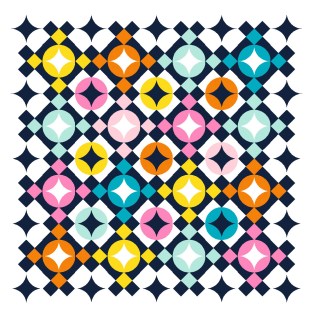
And then I removed the stars from the outer edges, to focus on that blocky checkerboard pattern instead. I like this one too!

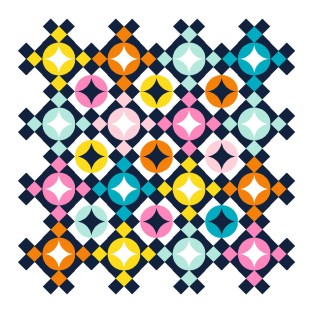
And finally, removing the outermost dark squares smoothes the edges of the blocks, making the design look like square blocks on point (which it actually isn’t). This is probably my least favourite version of the design, but I still like it enough to include!
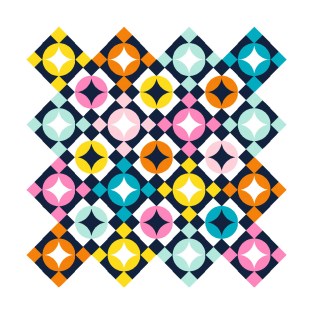
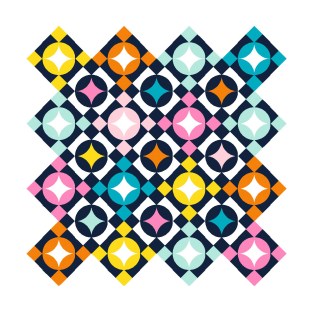
This week’s designs are made using orange peel units, squares and triangles (which could be made from quarter-square triangles too). As always, I think the hardest part would be deciding which version to make, and then settling on a colour palette!


Sunday sketch #350

I didn’t set out to do another basic design using a warm palette this week… but when a design uses multiple colours, I tend to gravitate to the pinks and oranges in Electric Quilt 8. I use the Kona solid colours as my default fabric library, and I guess those colours have the best mix of shades. It’s either that, or cooler blues and greens, and I was feeling warmer this week.

Anyway… I’ve spent a bit of time with quarter-rectangle triangles lately, for a few reasons. One: the release of Latifah Saafir’s HuRTy ruler, which she and I used to create the Paperdrop quilt pattern, is giving me more ideas of how to use half-rectangle triangles and quarter-rectangle triangles. And two: I’ve spent the last week or two seeing pics of Avalanche, one of the four quilts I had hanging at QuiltCon in Atlanta and which is entirely made from quarter-rectangle triangles.

In this week’s design, I’ve just set the blocks on point and coloured some of the triangles in the background colour to introduce some negative space. Otherwise it all feels a bit crowded.

Here’s a multicoloured version. There’s obviously opportunity for transparency here, but I tried not to use it too much; I like the idea of just mixing a bunch of different colours together and letting the contrast create movement in the design.

This last version reminds me a little of Sunday sketch #146 – some zig zagging, lots of angles, and a similar palette.

This week’s designs use quarter-rectangle triangles and some borders. Given the complicated colour placement, it might be easier to use paper piecing (which is how I made Avalanche), although if you were organised enough, you could probably make the QRTs the usual way without too much fuss. I haven’t used the HuRTy ruler to make QRTs yet, but I really want to!


Sunday sketch #349

A quick, cute design this week, and an excuse to talk about colour placement.

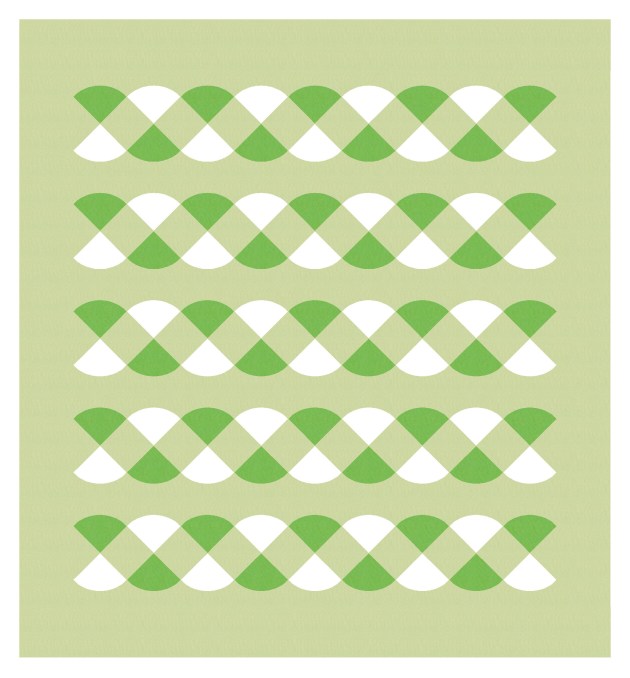
This design is set on point, and just features squares and quarter-circles (or drunkard’s path units). In the version above, the squares are coloured the same as the background, and the curves are in white, yellow, orange (light, medium or dark) or pink.

Even though each row features squares of background colour, they look like they’re two zig-zagging lines twisting round each other – like a double coil of white plus another colour. I’m not sure what optical illusion is at play here; it’s not really a transparency effect, because white plus any of these colours wouldn’t produce that background colour. But somehow the brain just seems to imagine that those squares are connecting the curves on either side to create a long, winding coil.

The design works horizontally too.

And in a more limited palette.

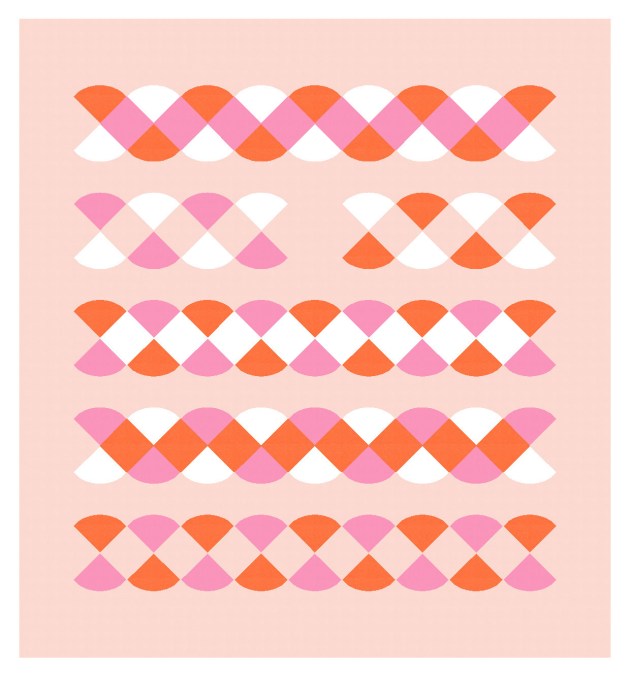
The design doesn’t have the same effect with a different colour placement though. Below I’ve used different placement in each row, and you can see how it changes the whole effect – in some places, the transparency is there but less effective; in other cases, it’s gone completely, leaving quite a clunky design in its wake.

The first row above features a transparency effect: the white and red zig-zags overlap in pink squares, which makes sense. I feel like it’s a bit ‘heavier’ than the second row. The third and fifth rows lose that effect completely, and feel very clunky (and boring) to me. The fourth row retains the zig-saggy feel (for the most part), but using red to colour in the squares where the white and pink ‘overlap’ doesn’t quite work, so feels a bit wrong.

So anyway, if a pattern featured a design like this, I think it would be important to tell people how the overall effect might change with different fabric placement. Something that looks great on paper might end up looking very dodgy in fabric if you weren’t careful.

Of course, the same design can be coloured completely differently, to avoid any of these problems 🙂

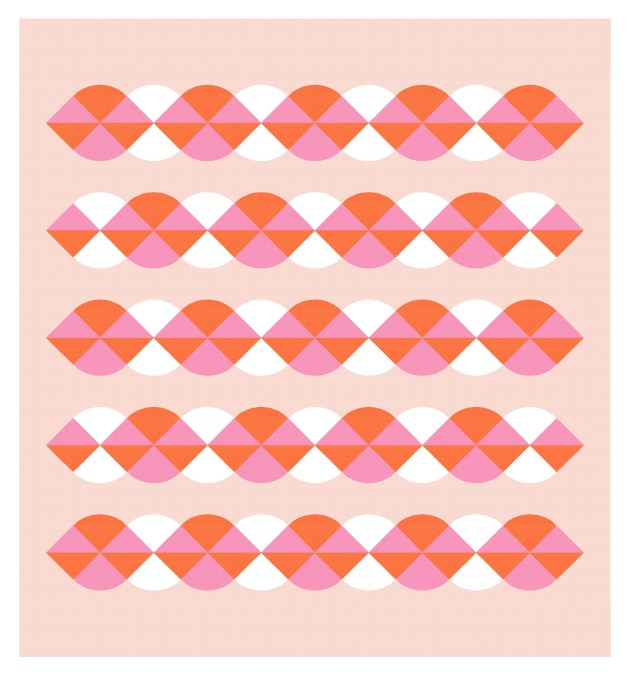
These designs could be made into quilts by arranging squares and quarter-circles (or drunkard’s path units) on point. The last version uses half-square triangles instead of squares. All fairly straightforward!