Sunday sketch #354

The similarities between this week’s sketch and last week’s should be clear; basically the only difference is that the elongated diamonds (and their internal circles) are now bisected horizontally. That change provides an opportunity to colour things a little differently and to introduce a bit more movement.

I’m using a palette I’ve used before, but I think it works well here. Dark blue, hot orange, a peachy pink, with white. I think this colourway works with this design because it has a good range of values: dark, medium-dark, medium-light, and light.

Here’s the first version with the white and peach swapped:

Like last week’s sketch, there’s downward movement (the lines created by the tops and bottoms of the elongated diamond shapes), upward movement (created by adjacent blocks stepping up across the page), horizontal movement (as your eye tracks across the lines bisecting the circles), and vertical movement (ascending/descending each column).

There are lots of different layout and colouring options. In this next version, I’ve only coloured half of each diamond, with the other half taking the background colour. All the same movement is there, with an added meander from circle to circle: up, down, up, down, across the page.

This is such a fun design, and I feel like it’s quite different from last week’s design despite the small tweak.

This week’s design could be made using half-rectangle triangles and half-circles (which might be a smidge easier to make than whole inset circles).

The right colour choice would make all the difference, particularly with the overall movement; choosing different colours could make certain elements stand out more (or less). It would take a bit of experimentation to get it right, I think.


Sunday sketch #353

This colour scheme is a bit new for me, but I feel like it works with the retro feel of this week’s sketch. That background colour’s a bit olive-y, a bit chartreuse-y. I like it!

The overall design is very reminiscent of Sunday sketch #306, which I repurposed in a different colourway and layout to make Triangulate. It’s got the elongated diamond shapes, some internal shapes, and an alternating grid of three colours. But there are a few differences: the elongated shapes in this design use half-rectangle triangles rather than half-square triangles, so the angle is a little different. The angle’s also in the opposite direction, so the rows descend down the page from left to right (whereas they go up in Triangulate). And instead of those internal pairs of flying geese, I’ve used circles here.

Here’s a different colourway. I love that bright green with a dark blue and white.

This is a relatively simple design, with only a few elements, but there’s still a lot of movement. The diamonds head downward, whereas the circles lead upwards. Then there are the vertical columns too.

This week’s sketch could be made using circles and 2:1 half-rectangle triangles. I’ve never pieced whole circles within a square before, but I know there are plenty of tutorials online on how to sew inset circles. Of course, the same shape could be made from four quarter-circles, but why deal with extra seams when you don’t have to?

I kept playing with this design, so I’ll share some more iterations in the next few weeks.


Sunday sketch #352

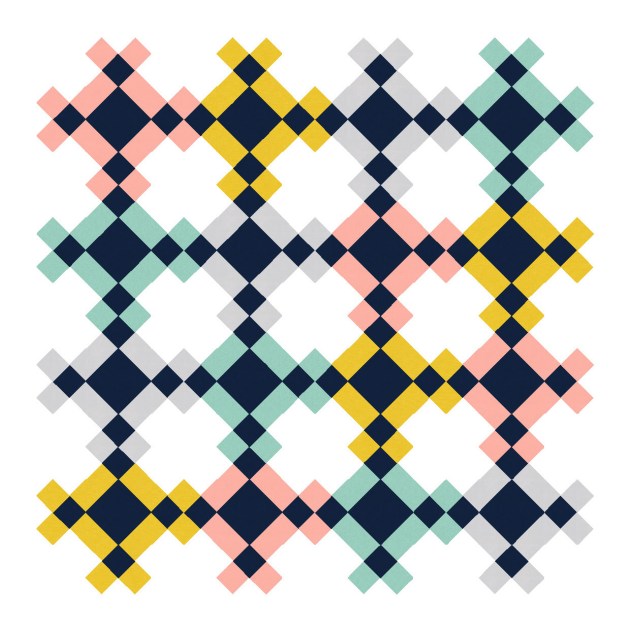
This week’s design is an iteration of last week’s; I’ve basically just removed the curves and added large squares in their place. Oh, and I lightened the whole design by swapping the colouring of the light and dark elements.

One issue with this sketch is that the elements that look like blocks – basically a large coloured square with four smaller units at the corners – overlap with each other at those corners, which makes colouring in a little difficult. Apart from the very first ‘block’ at the top left (I’m putting ‘block’ in quotes because technically, the way I designed this sketch, they’re not blocks), every other block is ‘missing’ at least one of its elements in its own colour; the adjacent block(s) overlap with their own colour(s). I don’t think it’s super-obvious here, and I’ve tried to follow the rule that the ‘block’ to the left/top takes precedence in terms of colouring, but… I don’t love the fact that this is a feature of this design. It just means an extra step of thinking when it comes to colour, which I try to avoid 🙂 I also think it would be a pain to try and explain in a pattern, for example. (Which makes me realise that even though I haven’t decided whether or not to publish my own patterns, I do tend to think about these things whenever I’m designing a sketch.)

Anyway. Those internal spaces feel a little ’empty’ to me, so I tried filling them with more squares. I feel like the dark squares are too dark, but the coloured squares make the overall design feel a little too jumbly (is that a word?).

Maybe another shape would fit in there? The curves worked last week because they don’t introduce any straight lines to compete with the squares, and squares work this week because… well, they’re just more squares, and the new lines they create are parallel to the existing lines. So I’m not sure what else could work in there.

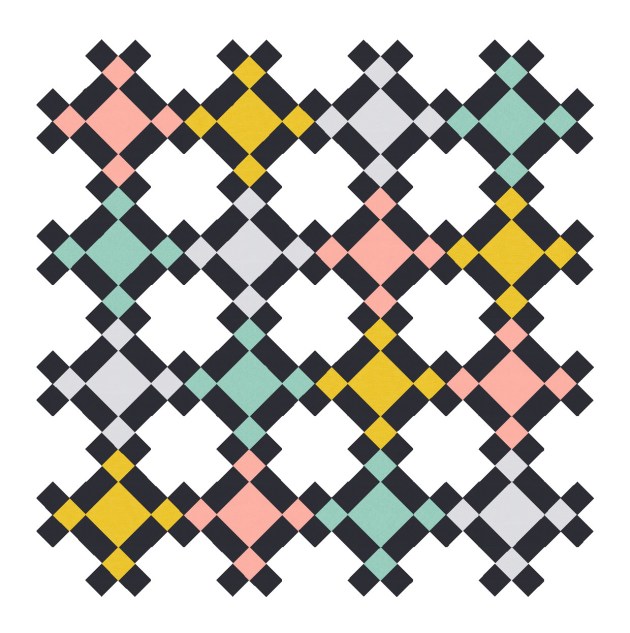
Anyway, here are a few versions where I’ve swapped the light and dark elements back to their original placement from last week. Instead of the inner squares being dark, they’re in colour, and the large bars framing each of the coloured squares are black. (Actually I used charcoal here, to lighten the whole design just a smidge.)

Again, those internal spaces feel a little empty to me. Here are two versions with the dark and colour squares instead.

This week’s sketch, like last week’s, was originally designed using two different blocks in a standard layout, not the same block on point (despite how it looks). But obviously, once I’ve removed the curves from last week’s design, this version could be made much more easily using a single block that’s set on point. In that case, you’d be using a modified nine-patch block, and all you’d need are squares and rectangles, with some triangles for the empty spaces along the edges and at the corners.

This is one of those designs where I was fairly sure it must’ve been done before – I mean, it’s just a modified nine-patch. I did a quick search on Pinterest and Google and didn’t find anything exactly the same, but that’s by no means exhaustive. I’d be surprised if there isn’t something similar out there in quilt land. If you know of a pattern like this week’s sketch, let me know and I’ll update this blog post!