
Sunday sketch #28

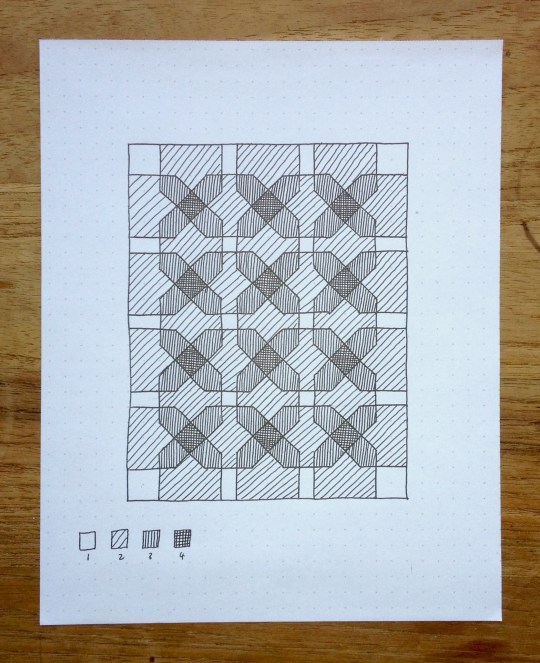
Overlapping octagons make some lovely secondary shapes…

geometriquilt_ss28-2

Three different shades highlight where the octagons overlap once, twice or three times.
geometriquilt_ss28-1

This design could be made as-is using squares, rectangles and half-square triangles. Or you could turn it 90 degrees and make it on point using mostly squares and rectangles and a few quarter-square triangles. Following the shading shown here, you’d need only 4 colours.

This design would be perfect for playing with transparency – combining fabric and colours to create the effect of translucent layers. To see what I mean, check out my Pinterest board Quilts: Transparency.


Sunday sketch #27

Welcome to the first Sunday sketch of 2017!

Regular readers will know how much I love consistency, regularity and repetition. I often start my sketching with a single unit (like a shape, pattern or block) and play around with minor adjustments to see if I can make it into something completely new or different.

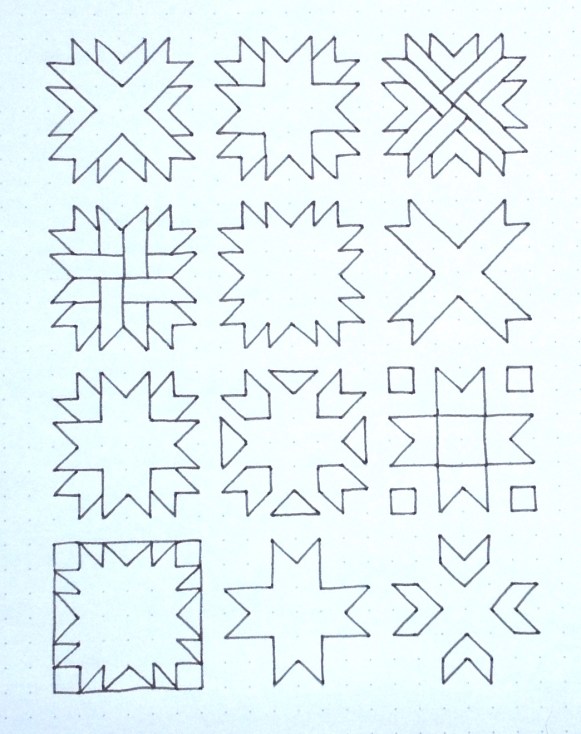
This week, starting with just one block led to a series of blocks that echo its original outline…

geometriquilt_ss27

I love this block outline. I’m very tempted to make a quilt sampler of these blocks in a limited colour palette. (For an example of how stunning this effect can be, check out Sofie Nix’s (@augenbeere) Summer Sampler quilt blocks on Instagram.)

Since we’re starting a new year, here are some of my resolutions for 2017:

  • stop lazily taking photos with my iPhone, and start taking better pics with our Canon instead
  • learn Photoshop, so I can start fixing all the dodgy colour balance I get when taking photos in a house with poor natural lighting
  • more sketching!

Happy New Year.

Sunday sketch #26

If you’re celebrating Christmas today, Merry Christmas to you and yours!

This week’s design explores a theme I’ve been thinking about for a while: a regular unit that ‘deteriorates’ from one side of the page to the other, creating an entirely new pattern.

geometriquilt_ss26

The pattern’s a bit MC Escher-like, a bit like Islamic geometric designs. (If you want to see some amazing Islamic geometric designs, check out Eric Broug‘s book on this topic, conveniently entitled Islamic Geometric Design. His School of Islamic Geometric Design website also has a ton of information and resources, including step-by-step instructions on how to produce your own designs.)

I think I need to work on the transition from top left to bottom right a bit more, to even out both sides of the pattern. I’m not sure how this would work with fabric; I like the idea of retaining the lines to define the units, but that would probably require careful thought (and even more careful paper piecing).