
Category: Sunday sketch
Sunday sketch #209
Regular readers know that I’m a sucker for block designs that create secondary shapes when they’re put together. This week’s design features corner curves that combine to create whole circles, plus flying geese that combine to create squares…. all around a standard sawtooth star.
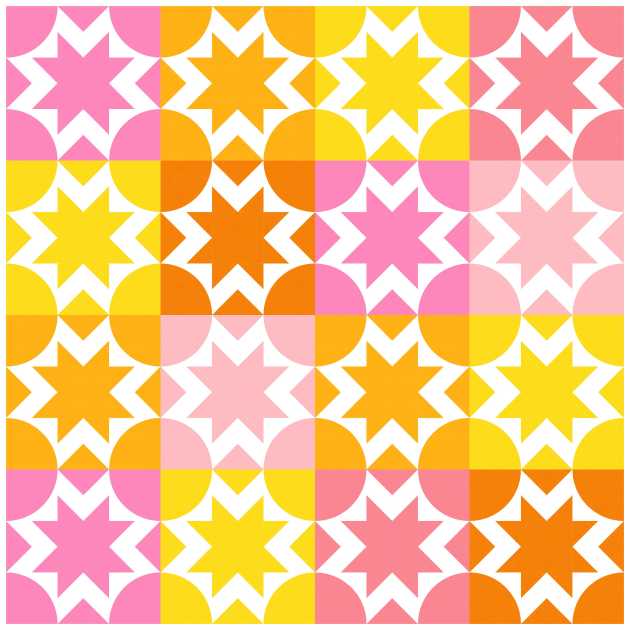
There are really three main elements to this block design: the star, the star surround, and the background. That gives lots of opportunity for different colour combinations (part of me really wants to do the math to see how many, but I won’t 🙂 ). Here’s just the star surround on its own in colour, with the other two elements (star and background) in white:
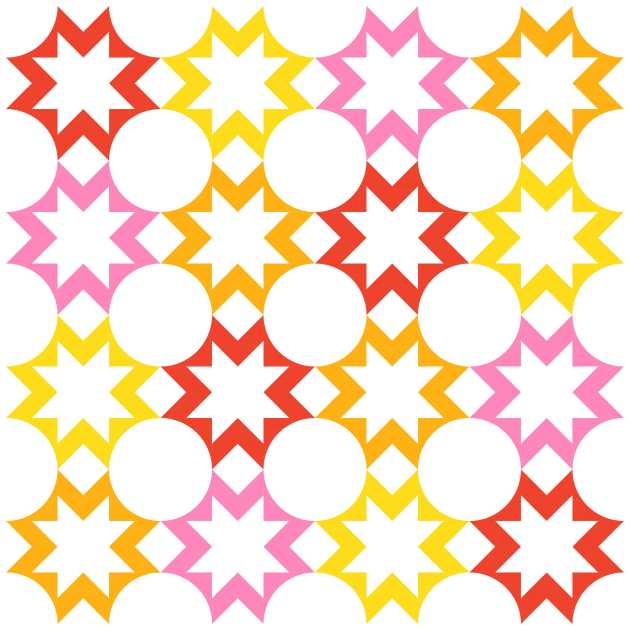
Or both the star and the star surround in a mixed palette:

I feel like the circles are more prominent when they’re in white – what do you think? I love how the secondary shapes in any design can be brought forward or pushed back, depending on how they’re coloured (alone and in relation to other elements).
I realised recently that I could sorta recreate the look/feel of a scrappy, low-volume background in EQ8 by using some really pale Kona colours. (I always use Kona colours in my EQ8 designs, mostly because Robert Kaufman has the most colours and they’re the easiest fabrics for me to find/buy.)
This next version of the design combines bright, saturated colours for the stars with white surrounds and scrappy, low-volume backgrounds. Maybe this one’s my favourite?!
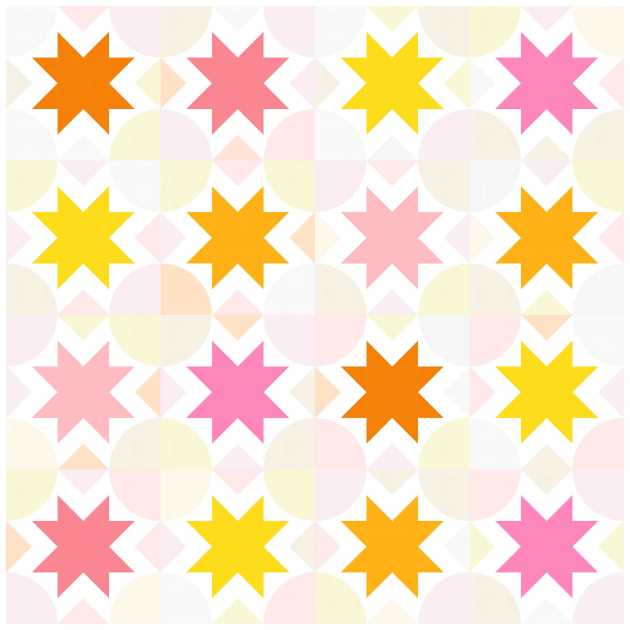
This design is made from drunkard’s path units, flying geese and squares. That’s it!
Sunday sketch #208
This week’s sketch uses the same motif as last week’s, but with an added row of blocks and a different colour scheme.

For some reason, I prefer this design arranged vertically rather than horizontally, but of course it would work either way. And it can be coloured in a million different ways. Here are just a few examples….
These first two versions highlight the vertical lines between blocks.
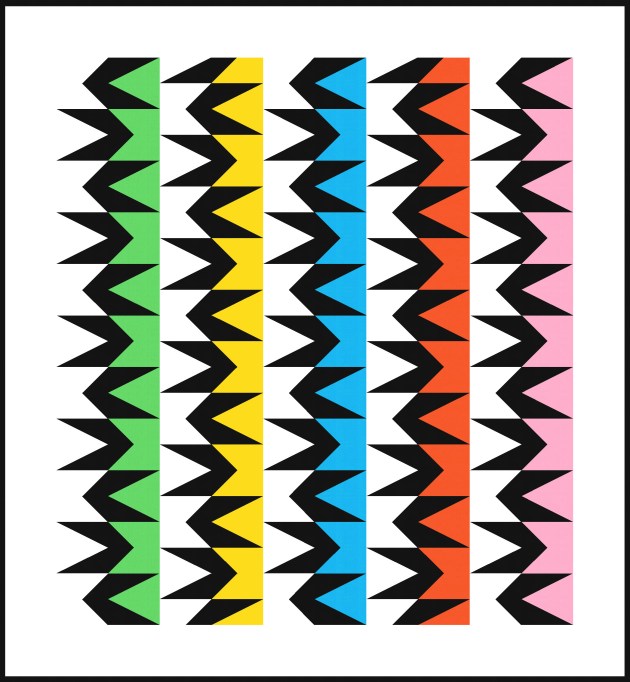

That can be taken a step further by iterating through a few different colour pairings for each column of blocks. This one’s one of my favourites. I feel like the big vertical zig-zags are much more obvious in the second and fourth columns than in the others. Can you see what I mean?
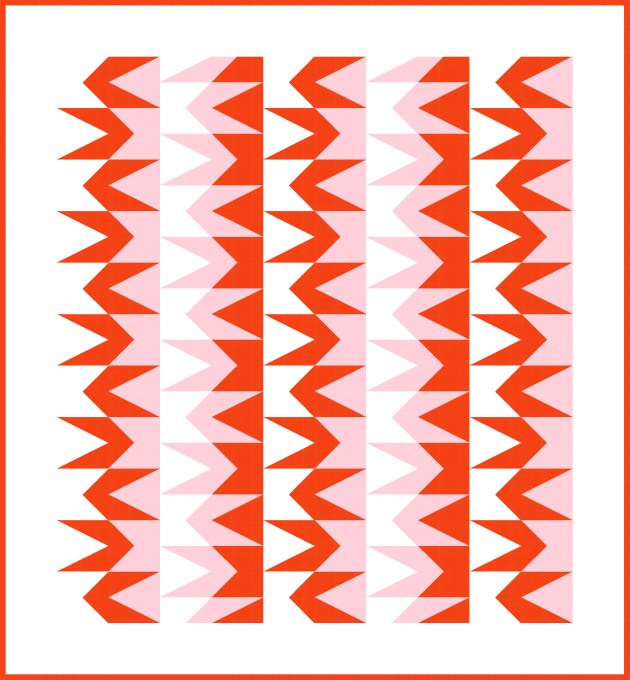
Or we can use colour to ignore the delineation between the columns:

In hindsight, I think all of these designs would’ve worked better if I’d extended the blocks to the top and bottom of the quilt top, rather than having a white border all the way around. An easy fix, but not one I could be bothered going back to correct right now 🙂
And, finally, a horizontal layout just to show you what it looks like.

That design cycles through three colours from top to bottom – green, black, white – and I used six rows of shapes to ensure that the top and bottom of the quilt top both ended up being green. It’s a fairly busy, energetic design as a result! Not necessarily one of my favourites, but I still liked it enough to post.
Like last week’s design, this one’s all flying geese units and half-rectangle triangles (or triangle-in-a-square units).
Sunday sketch #207
How about a slightly spicy design to follow last week’s palate cleanser?
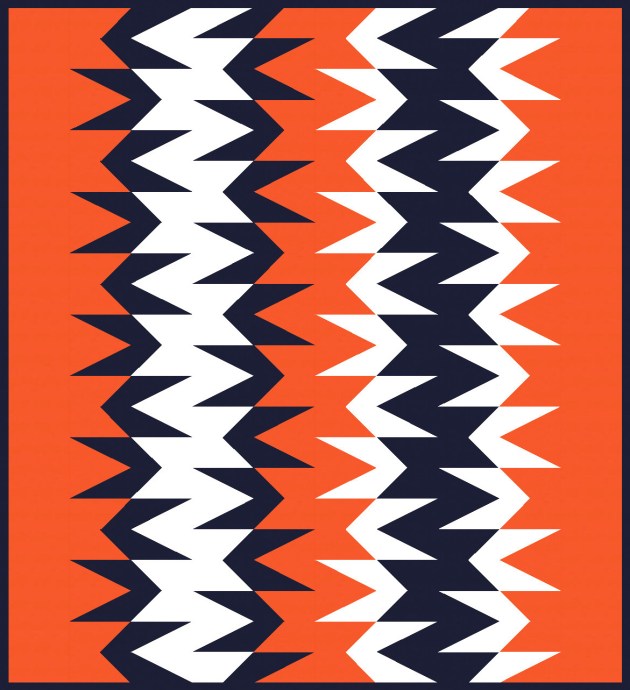
This started out as a hand-drawn sketch on my Rhodia dot pad, as a mix between flying-geese triangles and half-rectangle triangles (I’ve said it before and I’ll say it again: triangles are so versatile!). I wanted the lines from each flying geese block to lead into the adjacent flying geese blocks, creating a large zig-zag. And at the same time, the straight lines from the half-rectangle triangles would connect to the facing block.
I recreated the design in EQ8 so that I could play with colour. There are quite a few ways to combine just three colours in this design, each of which give it a slightly different feel.

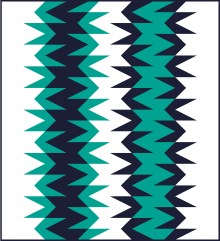
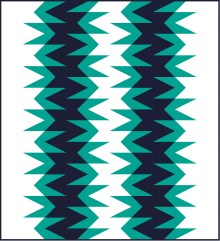
And, of course, my usual favourite combo of red, pink and white.
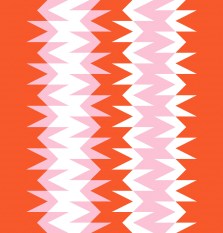

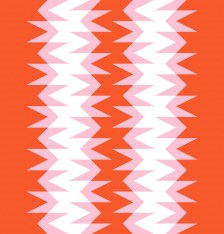
I feel like the light pink against the red gives a bit of a transparency feel, and helps to make those large zig-zags – which carve a path down the page – a little clearer.
The design doesn’t necessarily have to flow vertically down the page; it would work just as well horizontally.
These designs could be made into quilts using just two blocks: a flying geese block and a triangle in a square block (or two half-rectangle triangles instead). Pretty straightforward, but with striking results.
