
Tagged: square in a square
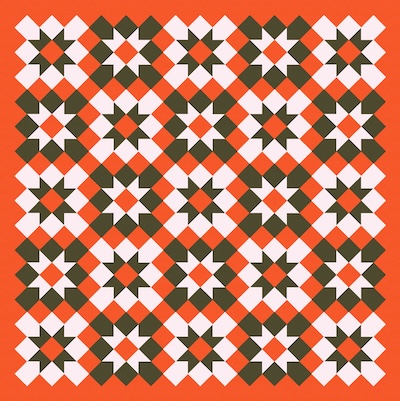
Sunday sketch #440
I realised quite soon after designing this week’s sketch that I’d just recreated a traditional block: the Kansas star block. When I’m designing with basic shapes like squares and half-square triangles, it’s not hard to stumble across something that’s been done before. Often I’ll just shelve those ideas, but occasionally I’ll post them, particularly if they’re a little different (in appearance or construction) from what I’ve seen elsewhere. In this case, I haven’t managed to find a version of this block where the outer squares are all one colour, like I’ve shown here.
Continue reading
Sunday sketch #384
If you’ve followed my Sunday sketches for awhile, you’ll know that I love playing with colour palette and placement to make multiple versions of the same block. This week’s design uses two blocks, but that just creates more opportunities!
In the first version I’m showing you, which is the last iteration of the underlying design, I’ve just used colour to hide parts of the block (by blending them into the background). This particular colour placement suggests that the blocks have two layers, each of which can be peeled back to reveal the other one on its own. (This is my attempt at ‘modernising’ what’s otherwise a relatively traditional design.)

The designs that led to that first one are a bit different, though. I started by alternating two block types in a standard layout (even though the diagonal lines in the next few versions might suggest an on-point layout). Even with two relatively simple block designs, there are loads of ways to use colour placement to achieve a different look. Sometimes that means colouring some shapes the same as the background, effectively removing them from the design.


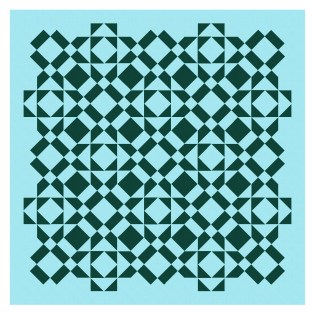

After playing with those versions for awhile, I switched to an on-point layout, which changes all those diagonals to vertical or horizontal lines. The same two block types are in there, but it almost looks like a design you could achieve using just one block type and some creative sashing.

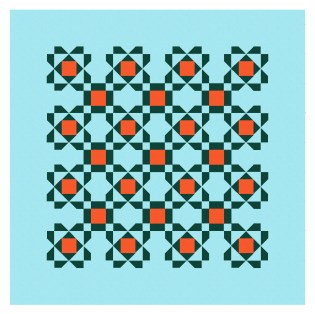

I often like to colour only some of the outer blocks to create interesting edges to my designs. (I really like the movement in the first design below, which I think might be easier to see when there’s no red to distract the eye.)

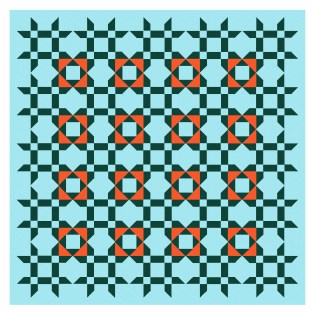
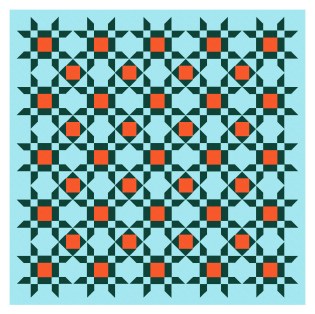

Of course, I kept iterating these designs and adding or subtracting new shapes (which were always there, just not always coloured in). This next version, the penultimate one, is the first version where I coloured in those smaller red squares (which are actually the four corners of that particular block; the other block doesn’t have any red in it).
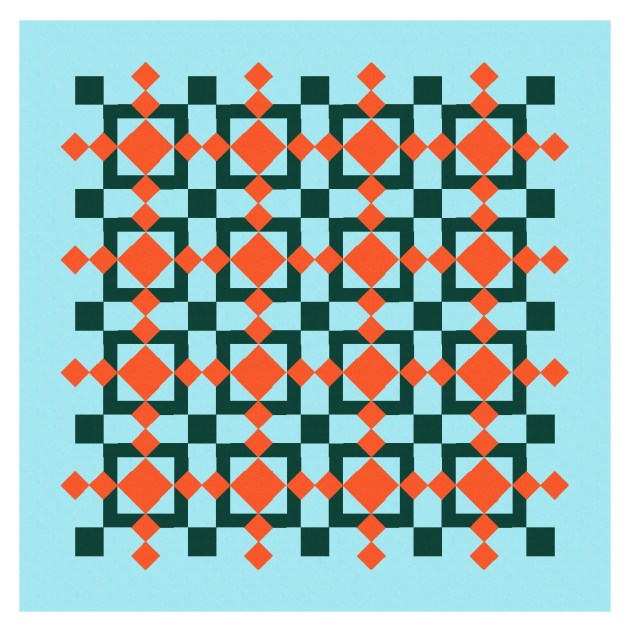
This colour placement suggests two discrete layers: a lacework of red squares overlaying the black ones. I liked the idea of paring back both layers in different areas, to reveal each one on its own (at least for a few blocks). That’s a concept I’d like to explore more in future.
Anyway, so the first and last sketches in this week’s post feel a bit different from the rest of the designs – I probably could’ve stretched them out to fill two blog posts! – but at least you can see how they’re all connected.
This week’s designs could be made into quilts using squares, square-within-a-square units, flying geese, rectangles and half-square triangles.
Sunday sketch #308
I was so excited when I created this week’s sketch, I set it aside thinking I might actually make it into a quilt… I even bought fabric! But I’ve since been distracted by many other designs and ideas… and even used some of the fabric for something else. That happens more often than I’d like to admit…!

You can probably see how this sketch evolved from last week’s. I wasn’t going to post that one last week – I much prefer this design, and I didn’t think it was really necessary to show the precursor – but I ended up sharing it so I could talk about how easily different people can come up with similar designs.
But back to this week’s design. This version chops the ends off those chevron-y bits, and instead turns them inward, creating what look like squares that are on point and overlapping. The flying geese units topping each square are still there, and there’s still the opportunity to play with foreground and background colours (and negative space). Instead of there being a vertical straight line between blocks, there are now columns of smaller squares.
A more restricted palette helps to play on the repetition in the design and introduce some more movement, I think. Those internal background squares help to join diagonally adjacent shapes of the same colour, so your eye zig-zags back and forth across the design.

Those smaller flying geese can go uncoloured (or take the background colour), which changes the main shape into something with a cut-out rather than an extension.

It’s pretty much just another excuse for my usual palette of rose pink and bright orange.

There are a few different ways that this design could be made into a quilt. I’d probably make columns of flying geese and alternate them with columns of quarter-square triangle units or square-in-a-square units. My default is always to imagine designs in solid fabrics, but I think this could work with the right prints.
