
Tagged: quarter-square triangles

Sunday sketch #471
I’ve been hopping back and forth between a few related designs lately, and while this week’s sketch didn’t evolve directly from a previous idea, it was inspired by Sunday sketch #468.
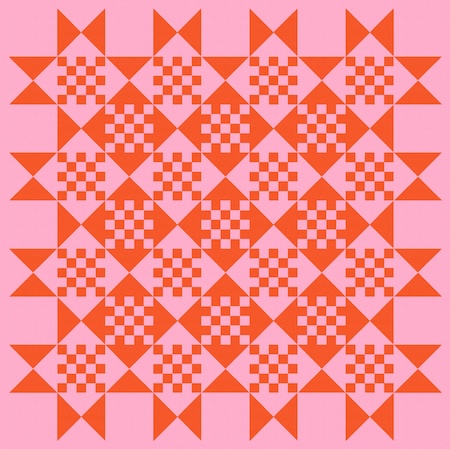
Sunday sketch #468
After a few weeks of mega-colour, I’m back to a two-colour palette this week. There are probably ways that this design could accommodate extra colours, but sometimes less is more!
Sunday sketch #377
This week’s sketch features rail-fence-like blocks with square-in-a-square units as the main element. The middle row or column of each block (depending on its orientation) is differentiated from the adjacent columns/rows by switching the colouring of the squares and background. This creates floating rectangular shapes within the design.
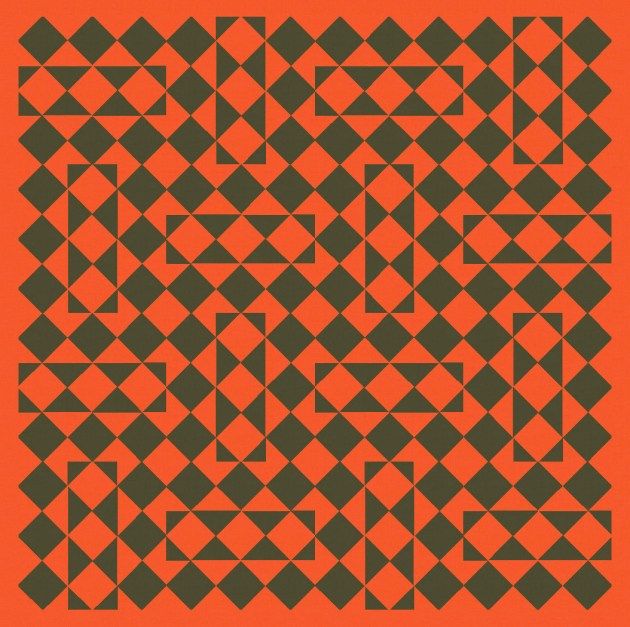
Here it is in red and white and in the reverse colourway.


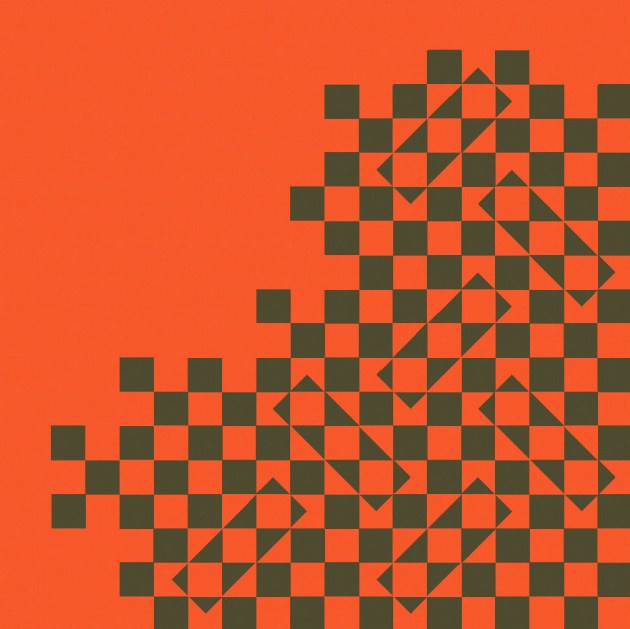
I often like trying a design with a different block layout; in this case, setting the blocks on point. Now instead of running horizontally and vertically, those floating rectangles are sitting diagonally. And the background (or foreground?) grid is now a checkerboard.

Rather than having some of the floating rectangles only half-appearing (on the edges of the design), I’ve removed those ones so that the design has only complete rectangles.
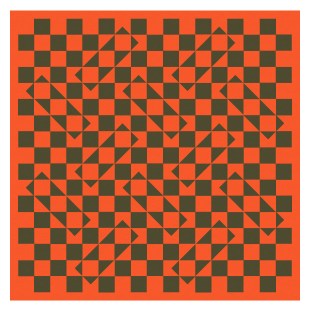

I think from afar, this design can look like a bit of a jumble, until you look more closely and see that there’s some regularity to those floating shapes.
Removing some of the rectangles gives the eye a (little) bit of room to rest, and makes the remaining rectangles more of a feature. This might be something I’d do if I were submitting this design to a modern quilt show.
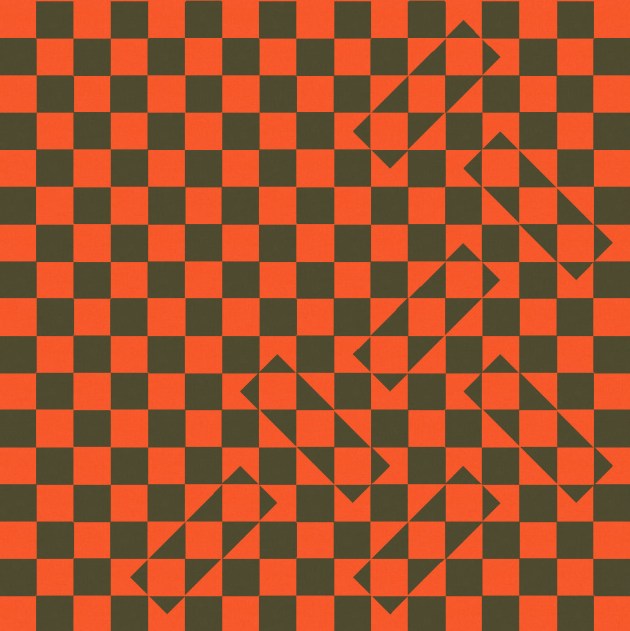
As the background (or foreground?) checkerboard pattern can be a bit overwhelming, I also tried removing some of it. This gives the eye much more room to rest. Ahhhhh.
This week’s sketch(es) could be made using squares, half-square triangles and quarter-square triangles. Despite describing the main block as including square-in-a-square units, I wouldn’t actually use those units to create this design; simple squares and HSTs/QSTs would be enough.
