
Tagged: quarter-circle
Sunday sketch #362
This week’s block is the same as last week’s, so I’m cheating a little bit by making a new Sunday sketch rather than rolling these designs into last week’s post. But hey, it’s my blog, and I can do what I want! 🙂

I’ve rotated the block to create these new shapes. They’re admittedly kinda odd, but I like them.
Rotating again creates these shapes – don’t they remind you of moose antlers?

Here’s the same design shifted over, so the four antler conglomerations appear in full.

I tried different palettes, too, but I think I prefer the first one.
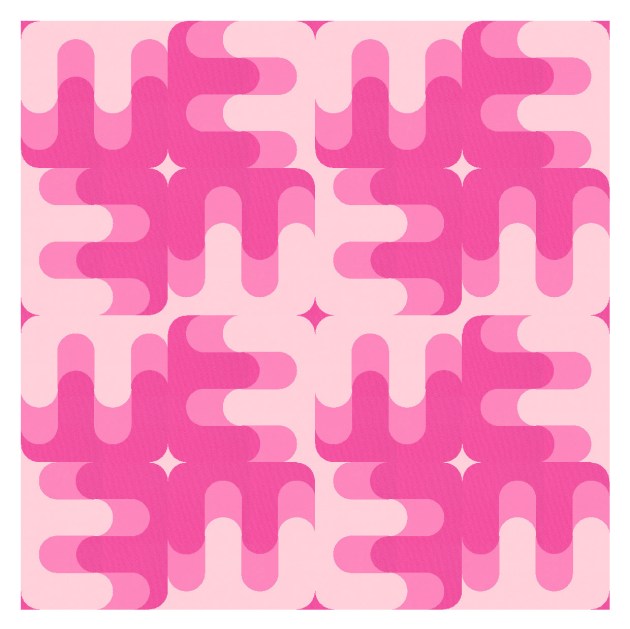
And there’s the antler design without the interstitial stars. I kinda like them too though. They add just that little bit of visual interest to keep things fun.
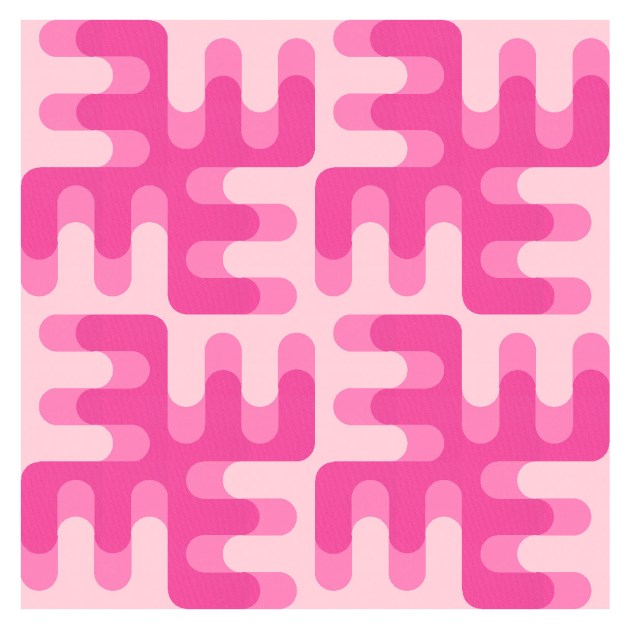
Like last week’s designs, this week’s sketch could be made into a quilt using quarter-circles (or drunkard’s path units), half-circles (or 2 × drunkard’s path units), squares and rectangles.
I probably won’t make this one. At small-scale and from afar, the design looks a bit too much like it includes a motif that I always try to avoid. I only really noticed after I drafted this blog post and then looked at the thumbnail image on the list of upcoming posts. Oops. Let’s not go there.
Sunday sketch #349
A quick, cute design this week, and an excuse to talk about colour placement.

This design is set on point, and just features squares and quarter-circles (or drunkard’s path units). In the version above, the squares are coloured the same as the background, and the curves are in white, yellow, orange (light, medium or dark) or pink.
Even though each row features squares of background colour, they look like they’re two zig-zagging lines twisting round each other – like a double coil of white plus another colour. I’m not sure what optical illusion is at play here; it’s not really a transparency effect, because white plus any of these colours wouldn’t produce that background colour. But somehow the brain just seems to imagine that those squares are connecting the curves on either side to create a long, winding coil.
The design works horizontally too.

And in a more limited palette.
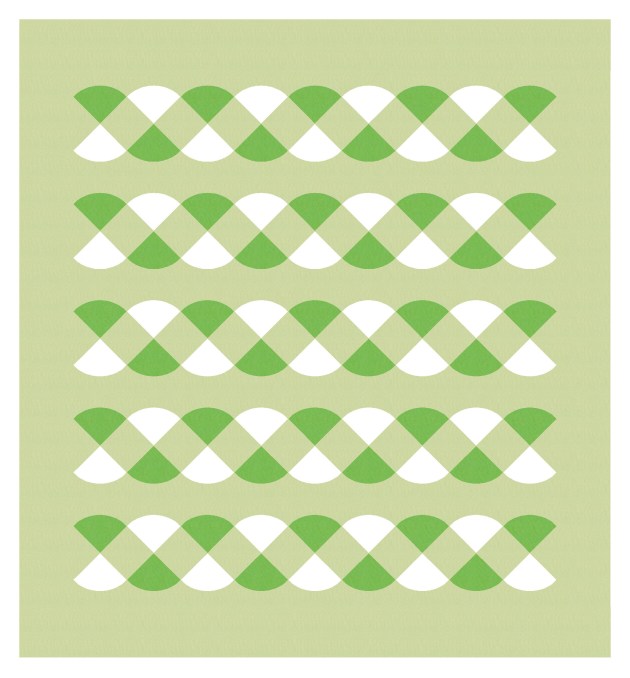
The design doesn’t have the same effect with a different colour placement though. Below I’ve used different placement in each row, and you can see how it changes the whole effect – in some places, the transparency is there but less effective; in other cases, it’s gone completely, leaving quite a clunky design in its wake.
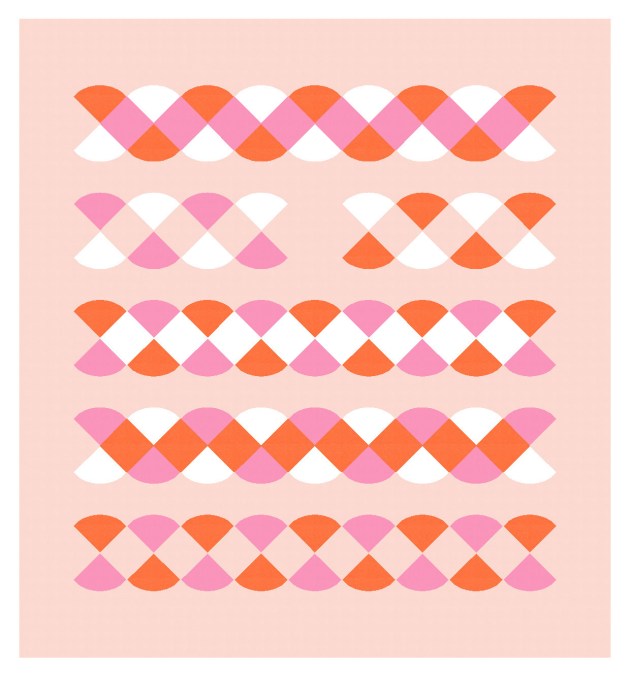
The first row above features a transparency effect: the white and red zig-zags overlap in pink squares, which makes sense. I feel like it’s a bit ‘heavier’ than the second row. The third and fifth rows lose that effect completely, and feel very clunky (and boring) to me. The fourth row retains the zig-saggy feel (for the most part), but using red to colour in the squares where the white and pink ‘overlap’ doesn’t quite work, so feels a bit wrong.
So anyway, if a pattern featured a design like this, I think it would be important to tell people how the overall effect might change with different fabric placement. Something that looks great on paper might end up looking very dodgy in fabric if you weren’t careful.
Of course, the same design can be coloured completely differently, to avoid any of these problems 🙂
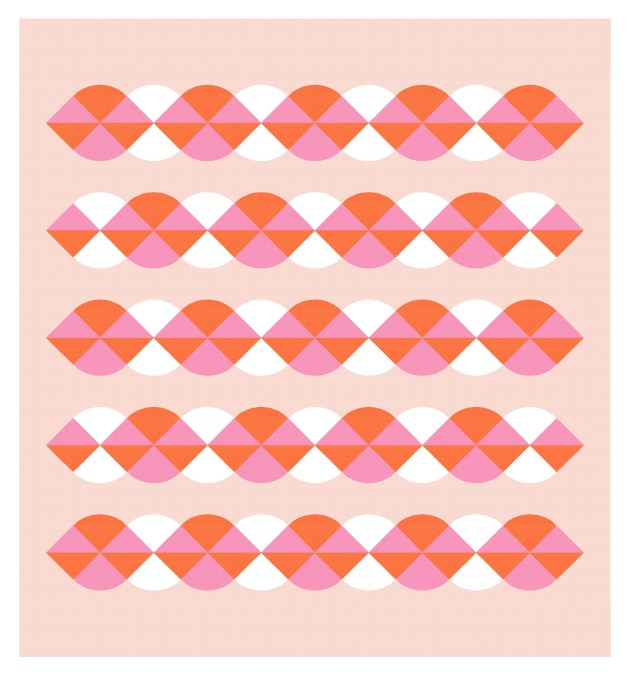
These designs could be made into quilts by arranging squares and quarter-circles (or drunkard’s path units) on point. The last version uses half-square triangles instead of squares. All fairly straightforward!
Sunday sketch #330
I made one more addition to last week’s block. There’s now a curve running diagonally through it; the two quadrants of the block with the half-circles now have a larger quarter-circle too, which connect to create a curve that extends across the block. And makes the whole design very groovy.
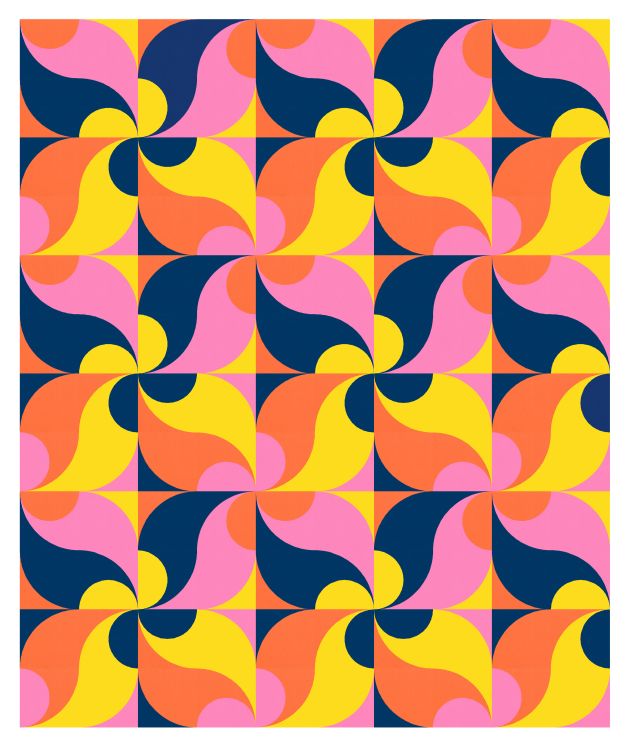
These designs remind me of those swirly endpapers that you sometimes see in old books. Or the designs you can make with water marbling. They might be a bit over the top for a quilt, but I couldn’t resist playing anyway.
Here’s the same block, just rotated.
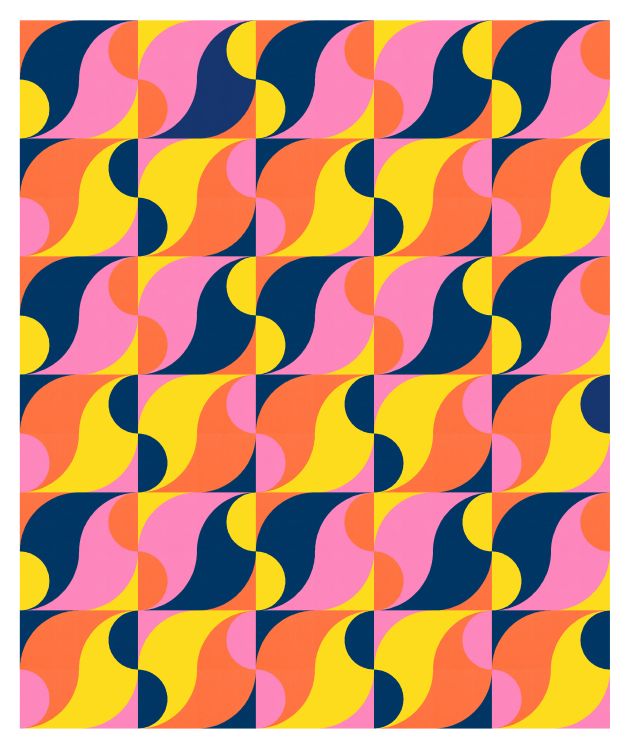
I used these colours because I recently finished making a quilt with a similar palette (but a less psychedelic design). I think they work here though! Very in-your-face, but in a good way.
These designs could be made into quilts using curves, curves and more curves. Some smaller, some larger. I always use templates for cutting/piecing curves; my favourites are Jenny Haynes’ (which you get find here), because her cutting templates are oversized. That means any dodgy sewing doesn’t really matter (like my complete inability to match up the beginnings and ends of the convex and concave pieces), because I can just trim the units down to the perfect size later using her squaring template. Game-changer!
Anyway, this week’s Sunday sketch is the last in a series of four related sketches that all use blocks featuring those small, diagonally placed semi-circles (or half-circles) and another element (or two). It’s fun to see how little tweaks can have such a big effect!
