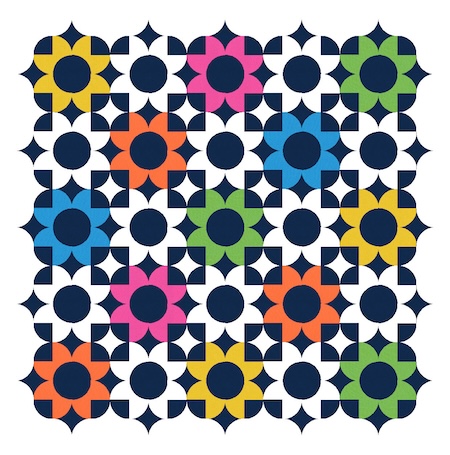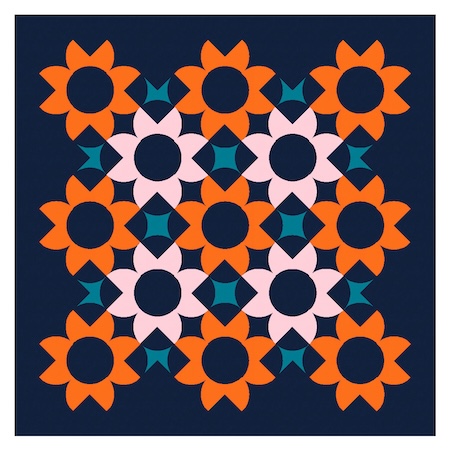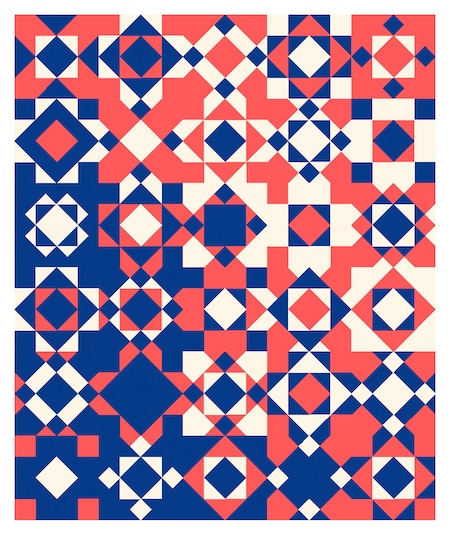
Sunday sketch #377

This week’s sketch features rail-fence-like blocks with square-in-a-square units as the main element. The middle row or column of each block (depending on its orientation) is differentiated from the adjacent columns/rows by switching the colouring of the squares and background. This creates floating rectangular shapes within the design.

Here it is in red and white and in the reverse colourway.

I often like trying a design with a different block layout; in this case, setting the blocks on point. Now instead of running horizontally and vertically, those floating rectangles are sitting diagonally. And the background (or foreground?) grid is now a checkerboard.

Rather than having some of the floating rectangles only half-appearing (on the edges of the design), I’ve removed those ones so that the design has only complete rectangles.

I think from afar, this design can look like a bit of a jumble, until you look more closely and see that there’s some regularity to those floating shapes.

Removing some of the rectangles gives the eye a (little) bit of room to rest, and makes the remaining rectangles more of a feature. This might be something I’d do if I were submitting this design to a modern quilt show.

As the background (or foreground?) checkerboard pattern can be a bit overwhelming, I also tried removing some of it. This gives the eye much more room to rest. Ahhhhh.

This week’s sketch(es) could be made using squares, half-square triangles and quarter-square triangles. Despite describing the main block as including square-in-a-square units, I wouldn’t actually use those units to create this design; simple squares and HSTs/QSTs would be enough.

Sunday sketch #376

I’m still using the same block as the past two Sunday sketches, but I’ve removed some parts this week. (This is easy to do when designing; I just make bits ‘disappear’ by colouring them the same as the background. Obviously if I were making these blocks, I’d revise the design so there were fewer pieces in the block to begin with.)

So how did I get here from there?

Last week, I ended on a layout in which the blocks were set on point. Both the rounded and the squared corners in each block were coloured the same as the background, and the block had a leaf shape (also in the same background colour) in the middle. I didn’t love those versions.So this week, I’ve removed that internal leaf shape and replaced it with the square that was there originally. I left the curved corners coloured in, but the squared corners are still gone (coloured as background). And then I mixed up the colouring to highlight a different set of shapes within the design. I really liked these retro Xs, with their arms separated by the sashing in between blocks.

The four ‘arms’ of each X come from four adjacent blocks; each block has two arms in two different colours.

It’s quite a busy design when it’s multicoloured, so I tried a two-colour, alternating layout instead.

I liked that one, but I felt that the retro nature of those Xs really cried out for a standard layout.

And then I added some more space just to let the shapes breathe a bit. This layout’s reminiscent of Sunday sketch #373, too – two grids of 3 × 3 overlapping.

As always, I kept iterating this design, although that first version is my favourite. I tried colouring the sashing between the blocks, which ends up creating a plaid-ish effect.

That added colour removes the retro feel and gives this a more traditional feel. I still like it though!

Like the past few weeks’ designs, this week’s sketch could be made using squares, rectangles and quarter-circles (or drunkard’s path units). The curves would need to be pretty small – something I still struggle to do well – but the rest of the piecing would be pretty straightforward.


Sunday sketch #375

The last version of last week’s sketch introduced curves to two of the four corners in each block, but I felt like the centre of the block was a bit empty. So I added a new black shape: it’s square at the ends, to match the 90-degree angles of the black shapes in two corners, and rounded on the sides, to match the curves of the other two corners.

Colouring the background the same as one of the block colours ends up leaving the black shapes from those blocks just floating within the design, which I really like.

I switched yellow to black in EQ8, which made those ’empty’ blocks disappear into the background.

Here’s the full design again. I like how the blocks now seem reversed, with the key shapes being those in colour rather than those in black. Those leaf shapes in the centre of the blocks are now balanced with the circles and squares that are formed by 4 adjacent blocks.

I tried rotating all the blocks, and quite liked this version in which all the leaf shapes are parallel….

…and then decided I wanted to see what those leaf shapes looked like running vertically rather than diagonally. Setting the blocks on point changes the feel not just of the design but also of the blocks themselves, I think – possibly because I’ve used more in this version, and made them smaller.

Here’s another vertical layout.

I can’t decide which is my favourite! I think maybe the version with the yellow background – I like the interplay of the black shapes and the few ’empty’ blocks where the wrapped-lolly shape in the centre becomes more obvious.

This week’s sketches could be made using quarter-circles (or drunkard’s path units), squares, rectangles, and sashing.