
Category: Sunday sketch
Sunday sketch #103
Following on from last week, another sketch that incorporates a design element and its reverse colourway.

Black on white, or white on black? I like the fact that your eye settles on one before realising that the other’s there too.
I took this design a little further, extending those chevron-limbed arms out in both directions.
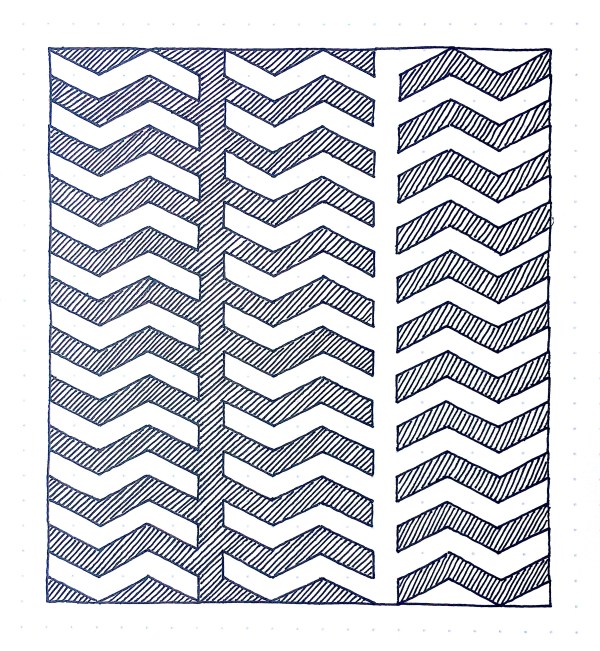
Because of the overall colour placement, the left side of this design seems to be the ‘opposite’ of the right side – but really, they’re both the same, just offset by one row. I just love this effect.
Like last week‘s design, this one could be made using half-rectangle triangles and long vertical sashing, or columns of angled strips. It would work well in solids (of course), but could also be a great way to feature one or two bold prints.
Sunday sketch #102
I think of my sketches as being two-colour, even thought it might be more accurate to call them monochromatic – I usually use one pen (black, more often than not) and then rely on the paper itself to act as the second ‘colour’.* Apart from making my life a bit simpler, two-colour sketches help me to focus on the design itself rather than get distracted by colour.
Another benefit of two-colour designs is that they’re great for playing with reverse colourways. It’s much easier to create a design and then incorporate its opposite.

This design reminds me of zippers or tire treads. Depending on how you look at it, it could be white on black or black on white. Even though it looks like the top and bottom parts of this sketch are in reverse colourways, they’re not; only the direction of the ‘zips’ is different.
This design could be made into a quilt pattern using half-rectangle triangles and vertical sashing, or long columns of angled strips.
* I know, I know: black and white aren’t colours. But you know what I mean.
Sunday sketch #101
The repeating shape in this week’s sketch reminds me a little of a churn dash block: it’s got a square in the centre, half-squares around the outside, and lots of sharp points poking out in all four directions… but it’s also quite different.
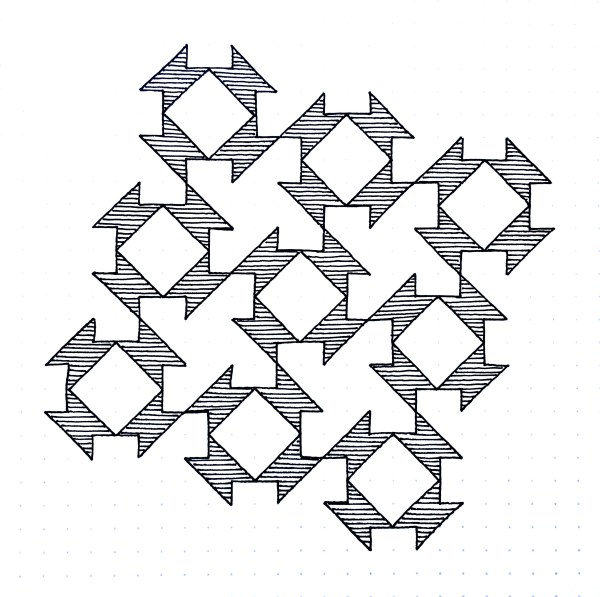
The repetition of the units also creates fantastic secondary shapes inside. So much movement! I wanted to see how else I could use the same block, so I tiled it normally.

Depending on which way the blocks were made, the repetitive unit could be an X or an (angular) O block. Alternating colours help to differentiate the blocks:

But isn’t it interesting how the block design disappears behind those small squares at the junction between 4 blocks? Those secondary shapes really come to the foreground and push the coloured pieces to the background. It looks less like the sides of each block are a really interesting shape, and more like they’re just straight rectangles overlaid with small squares. What started out as an edgy, quirky block in the top design now isn’t so eye-catching!
These blocks could be made easily using rectangles and triangles. Since a lot of the cutting might be on the bias, you could paper-piece for accuracy.
