
Tagged: flying geese
Sunday sketch #159
I had an idea for a block this week. Two pairs of diagonal strips with angled ends, overlapping in the middle to create an ‘X’ shape. Don’t ask me where the idea came from – I must’ve seen an ‘X’ somewhere and wondered if I could do something with it.
One of the things I love most about quilt designing is the fact that a single block can create a million quilt patterns, just by rotating or colouring it differently. Case in point…
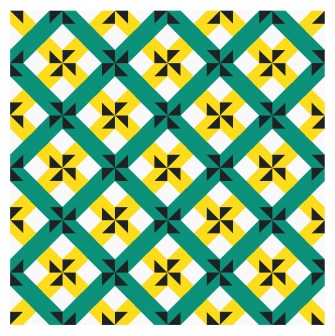
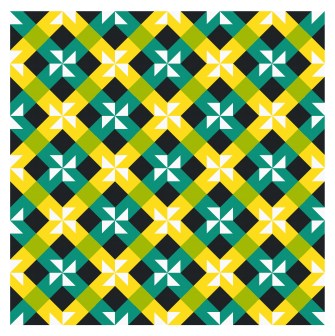


OK, that’s 4 (well, 2 colourways of 2 designs). I made more, but I just liked these 4 together. They’re all a 6 × 6 layout of the same block, using only 4 colours (I know, I know – black and white aren’t colours). Some use transparency; some don’t.
I actually love the idea of creating a single quilt with all 4 of those designs, with the same colour palette to pull them together. Wouldn’t that be cool?
The best thing about this design might be how basic the actual block is.

Given its symmetry and structure, I bet it’s a traditional block that’s been used before – it’s probably even got a name. It’s like a variation on a sawtooth star. Obviously, with different colouring, this block could be used to create completely different designs that don’t look anything like the ones above.
Making these designs into actual quilts would be pretty easy. You’d just need 4 flying geese blocks, 4 half-square triangles, and one square-in-a-square for the centre for each block.
Sunday sketch #155
Recently I created a bunch of related designs that I figured I’d just post together, since they’re so similar. They’re all based on triangles – mostly half-square triangles, but also some flying geese and some elongated diamond shapes (rhombi!).
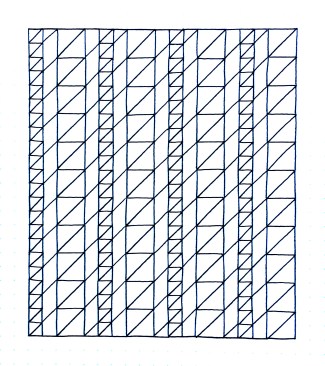
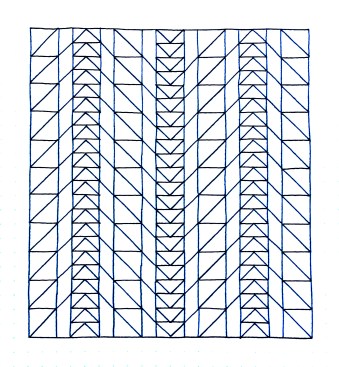
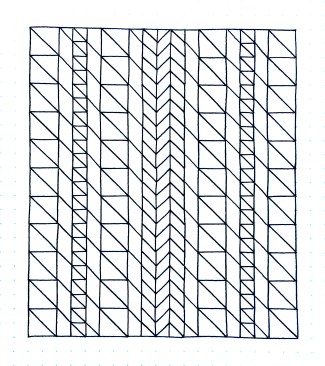

I wanted to recreate the feel of my Heartbreaker quilt pattern – those long diagonal lines created by adjacent half-square triangles – and ended up sketching one design after another on my Rhodia dot pad. There really are no limits to how you can use those shapes in that way.
I love the energy and movement in these designs, and the way they evoke electricity pylons, or maybe cranes, or building scaffolding.
I plan to keep sketching more along this theme. I’d love to try making one of these designs into an actual quilt. I’d prefer to use piecing, although I think you could also make these designs using appliquéd bias strips (if you had a very steady hand or a long straight edge!).
Sunday sketch #143
I like playing with squares and triangles. They’re such basic shapes, but they’re so versatile. The design possibilities always seem endless to me. I was recently sewing up some blocks based on Sunday sketch #84, and decided to explore the idea of triangles around a central square.
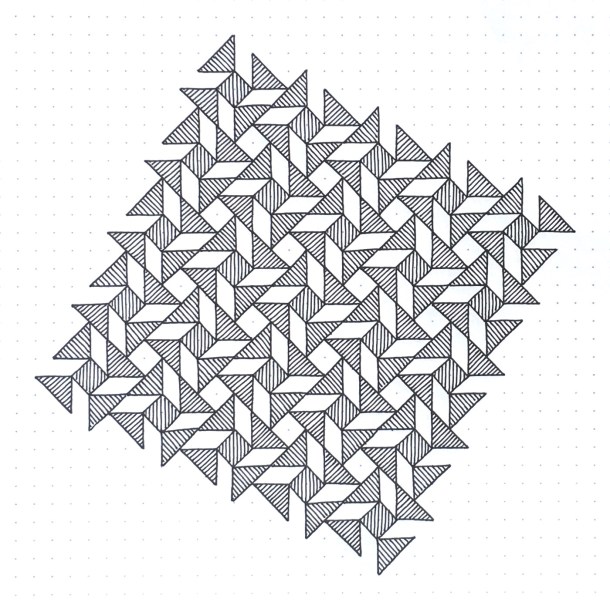
(My favourite part of handsketching is those repetitive black lines. I just find them so calming – both to draw and to look at.)
This version is less busy than my original attempt, which squeezed three smaller triangles into each one you can see there. Sometimes less is more 🙂
Because the blocks in this design are offset – shifted one square over instead of directly above or below (or to the left or the right) – the design kinda migrates across the page instead of forming a neat shape with straight edges (like you’d want in a quilt). If you tilt the page a little, you can get a better idea of what a ‘square’ quilt would look like.
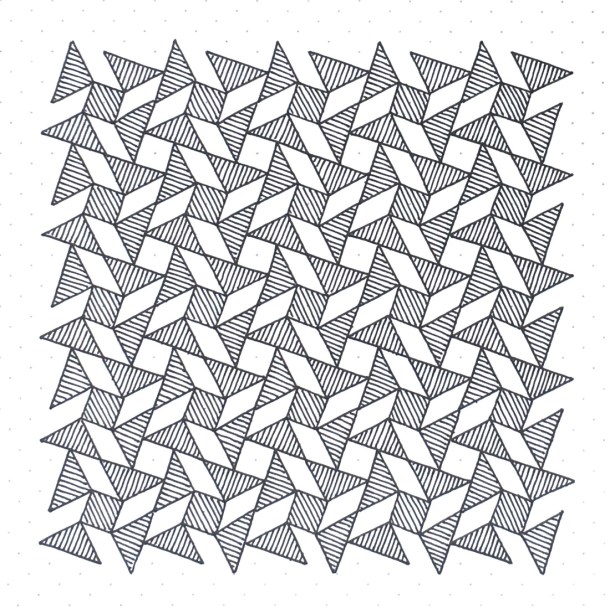
Of course, you could keep the orientation in the first image and just crop blocks to get straight edges, but I don’t think that’s as nice.
Because of the offset blocks, this design would be easier to make into a quilt pattern by piecing lots of little units rather than creating whole blocks first. The units themselves are just squares and half-square triangles. You could save a bit of time by using flying geese in some spots.
