Sunday sketch #380

Recently I created a bunch of designs in response to a specific brief: design a quilt using only circles, squares and rectangles. This week’s sketch is not one of the designs I submitted in response to the brief (for a project that I’ll be able to talk about more soon), but it’s one that I like so I’m sharing it here.
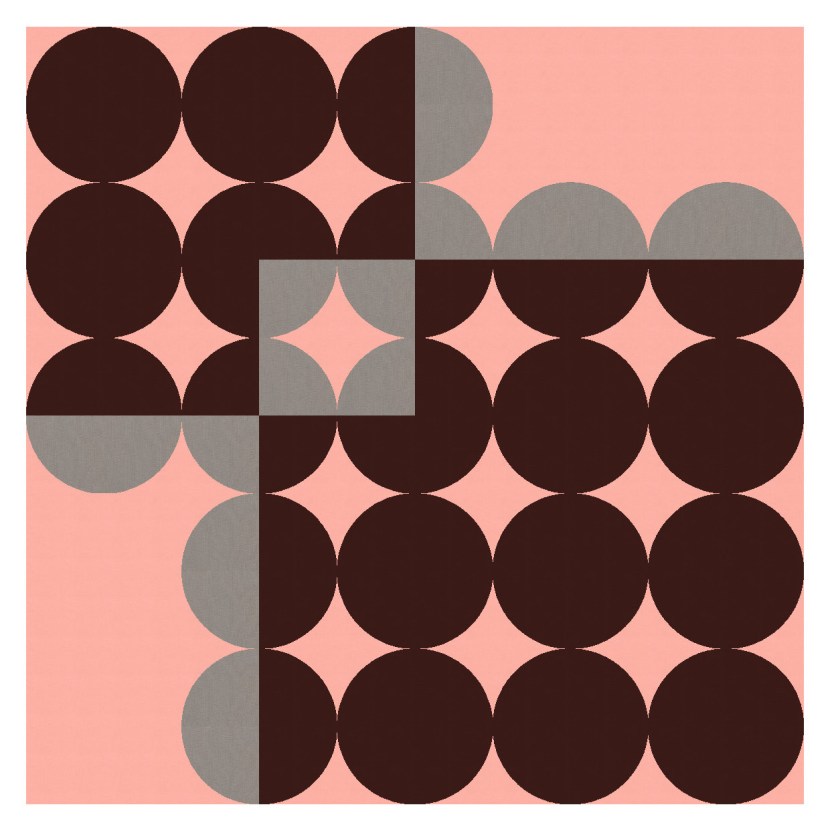
This approach of bisecting circles to create new shapes is one that I’ve used before: see Sunday sketches #224 and #275 (and, kinda related, #288).
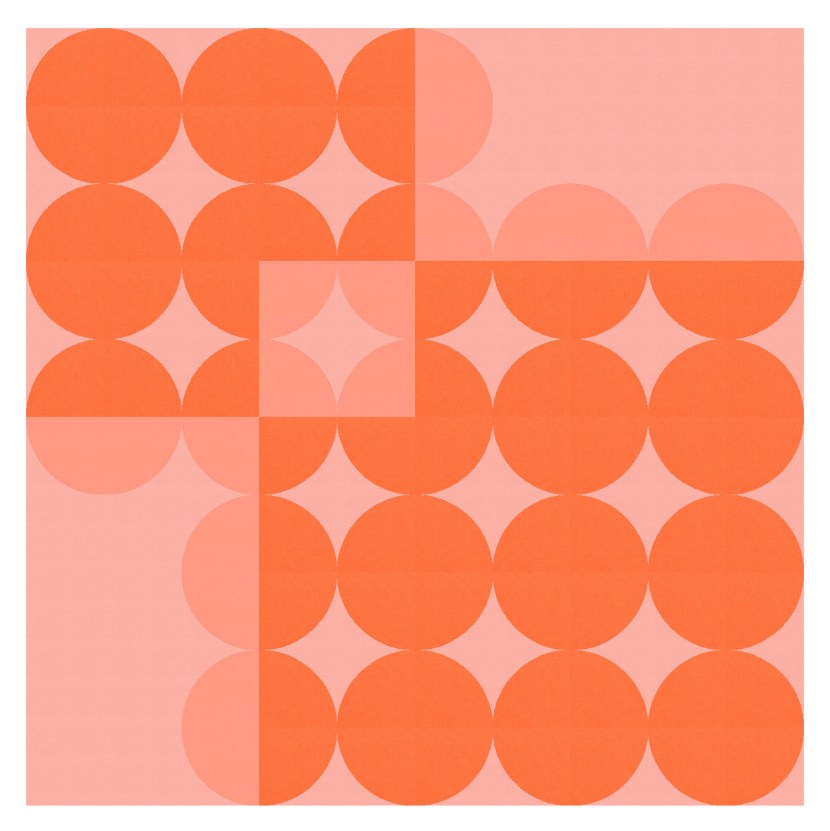
This kind of design lends itself to transparency effects. You can also play with the colour palette and placement to emphasise different parts of the design. In the second version below I’ve filled in those empty spaces at the top right and bottom left, although I don’t love this version – it feels too crowded.

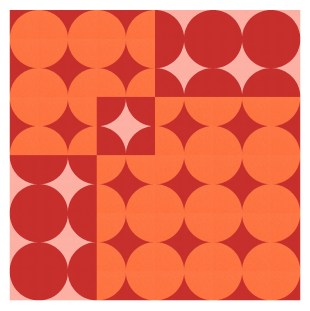
Back to a bit of negative space. Just changing one area of the design alters how you perceive those overlaid shapes… on the left, my first impression is of two lighter rectangles and one smaller square laid over those green circles. But on the right, I see two green squares overlapping over white circles.

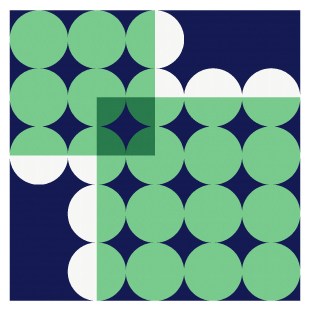
These designs could be made into a quilt using lots of quarter-circles, half-circles and full circles. I’d probably just make a million quarter-circles rather than trying to wrangle half-circles or full circles, but that’s only because I’ve never made a half-circle or full circle. I know there are ways to do them, but I’ve just never tried them.

I was fortunate enough to have 2 designs selected for this project, which means I need to make 2 quilts by mid-November. Both of which feature lots and lots of circles (which means even more quarter-circles!). One of the designs also plays with transparency using the supplied colour palette, so it will be interesting to see if my design looks as good in fabric as it did on screen.

Sunday sketch #379

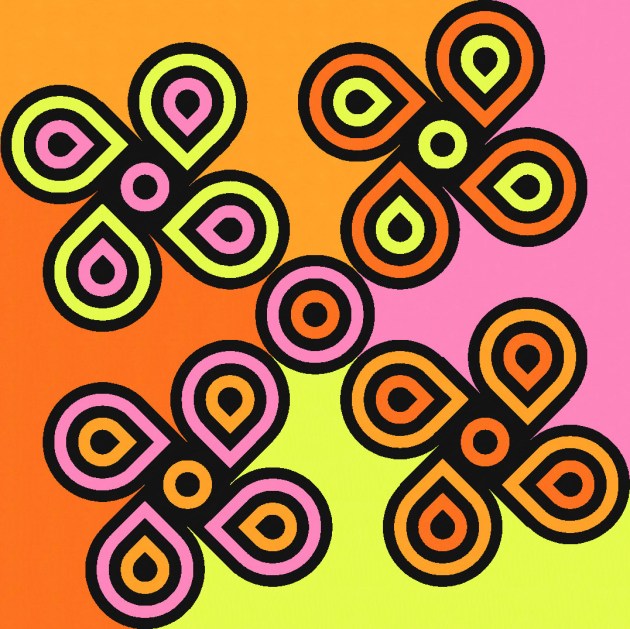
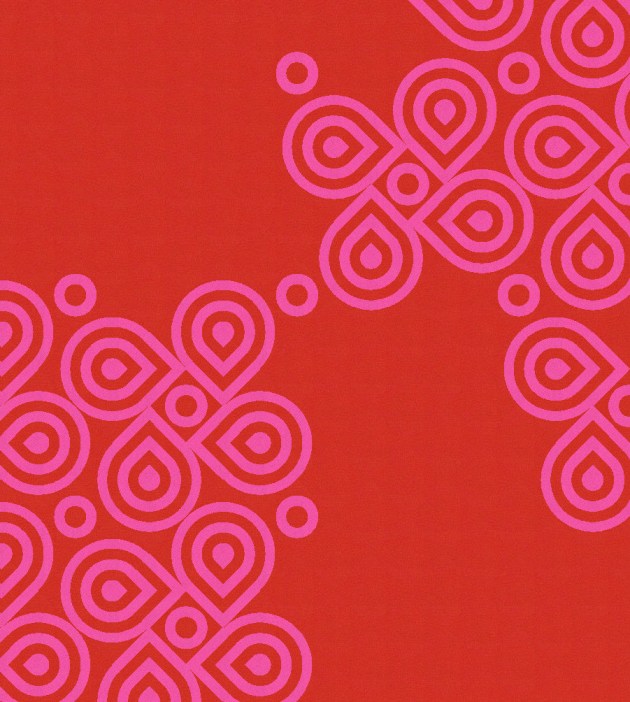
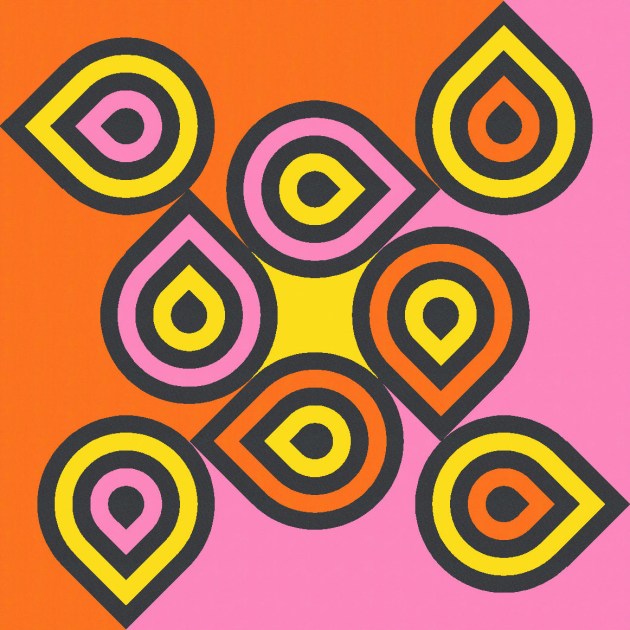
I can’t remember what prompted this week’s sketch, but I probably just wanted to explore this teardrop shape – which I’ve loved ever since designing Sunday sketch #107 (which I later made into Quattro).

As always, the final version is a loooong way from the first design I came up with. I started about here, with blocks arranged on point and a very vivid colour scheme.

That layout felt a bit too like Sunday sketch #107, so I expanded the overall size and added more blocks (and more vivid colours). Hmm. I like the shapes and symmetry (of course)…

…but I felt like something wasn’t working. Maybe the palette? Let’s pare it back.

Ahhh, that feels better. I decided a much simpler palette was needed to let the shapes themselves take centre stage. Now it’s less about those colours and all about those lines. I also started adding and subtracting more, too.


Once I’m fairly happy with a design concept, I can start mixing things up more. I’ll often try an asymmetrical version to see how I feel…and I decided I liked this one.

But maybe I could take it further?

And if I make the blocks smaller, I can fit more in!

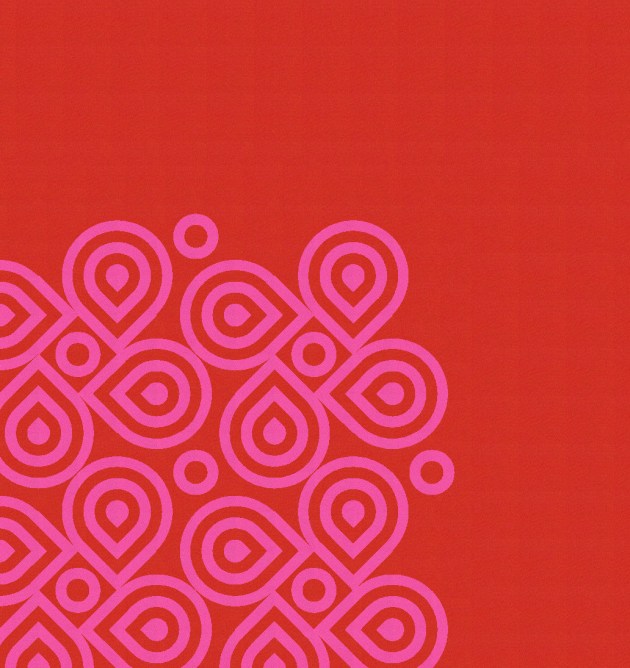
There are three different block types in this sketch, and they are set on point in all versions apart from the first one and the next two. The main reason I decided to use a standard layout rather than setting blocks on point is that it makes it easier to deal with edge blocks (which can be included in full rather than cut off in seemingly weird places). The on-point layouts have the advantage of those diagonal lines drawing your eye up and across the design… but I decided I could live without that.

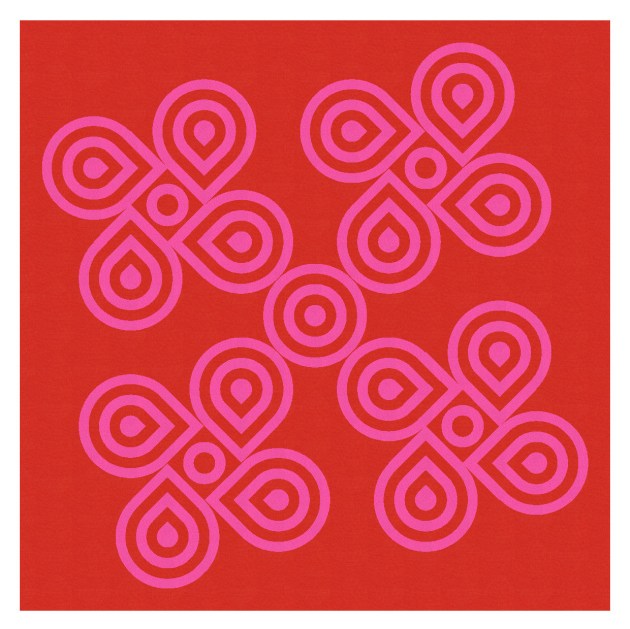
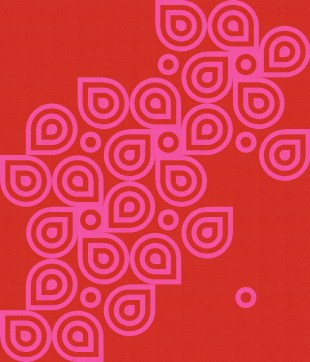
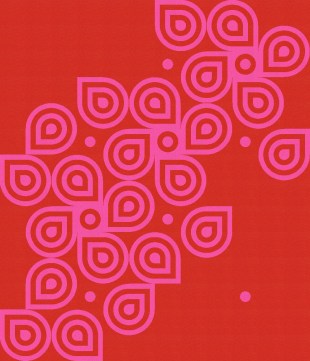
One of the three blocks in the design is just a ‘donut’ block: a central circle (or dot) surrounded by another one (which looks like a donut). In the first version below, these blocks are coloured as a pink donut on a red background or a red donut on a pink background. In the second version, all of the pink donuts on a red background have been changed to pink dots instead. The latter adds a smidge of negative space and a bit of visual interest.


Each teardrop shape is made up of 4 blocks: 3 blocks featuring 5 nested/concentric curves, and one block that’s like the corner of a log cabin. I know a few quilters who sell templates for nested curves: Jenny Haynes of Papper, Sax, Sten has one with 6 curves (with extra curves if you need them), and Daisy Aschehoug of Warmfolk has one with 7 curves. I think either of them could be repurposed for use with this design, or you could make your own templates for your desired block size.

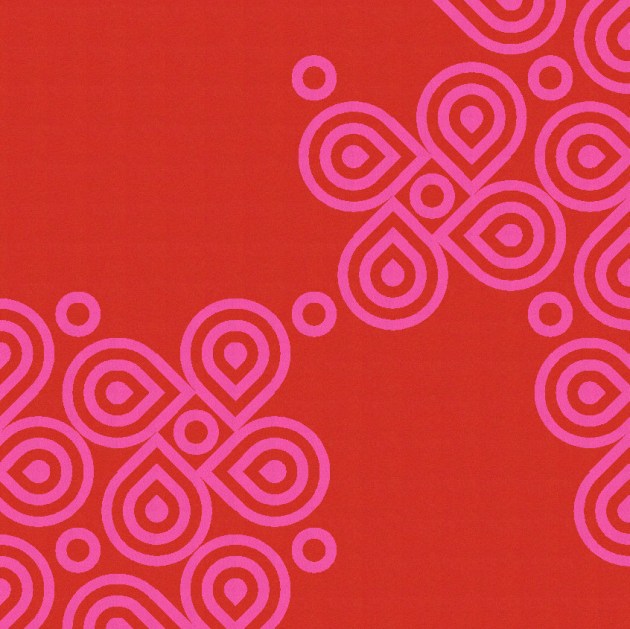
This is one of those designs that I really like, and have seriously considered making, but… I can’t decide which layout I prefer. Usually the first image in a Sunday sketch post is my favourite, but this week I couldn’t decide (and still can’t!) if I prefer the first or the last image. Something about that floating dot in the bottom right corner of the last image really appeals to me!

Sunday sketch #378

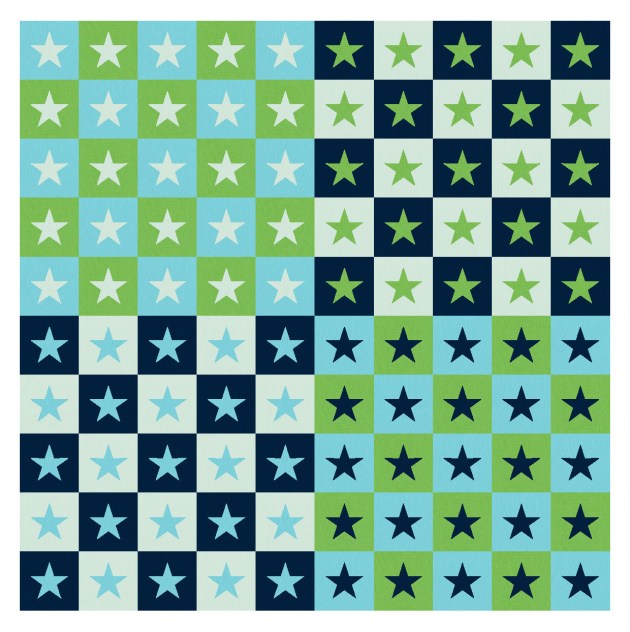
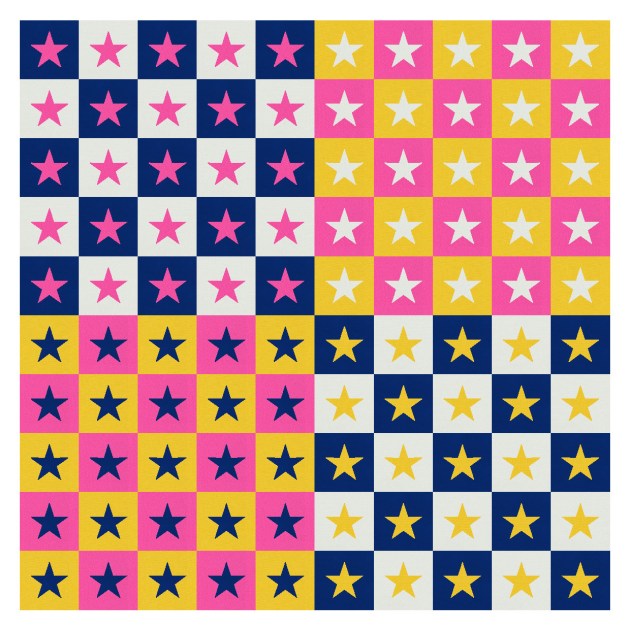
This week’s sketch is an iteration (of sorts) of Sunday sketch #369. Instead of 8-pointed stars, I’m using 5-pointed stars, and instead of a 2-colour palette, I’m using a 4-colour palette.

I’ve followed similar rules for colour placement though. Each quadrant features 3 of the 4 colours: the stars are one colour, and the background is a checkerboard of 2 other colours. That creates 8 of the 12 possible star blocks across the whole design (4 x 3 = 12; it’s not 4 x 4 because I didn’t want the star and background to be the same colour in any block).

(I snuck in a ninth block in the design above; see if you can spot it.)

Here are a few more colourways.

There aren’t the same connections between quadrants as there were in Sunday sketch #369: none of the star or background colours extend across or down the design. I think that would be possible, but I didn’t try it.

If I’d wanted to include the remaining 4 possible block colourways, I’d have to add 2 more of those 5 × 5 ‘quadrants’ (although they wouldn’t be quadrants anymore if I added 2 more!). That kinda messes with the proportions, I think – the whole design becomes a bit too narrow and long. But it does mean there are 4 more choices for block colourways if you didn’t like some of these 8!

This week’s sketch would require a paper-piecing template for the 5-pointed star, I think. I’ve seen a few around, although I’ve never made one. Have you? Do you know of a good tutorial or paper-piecing template? I feel like I should try making one, one of these days. And then I might design more with this shape.