
Category: Sunday sketch
Sunday sketch #338
I was telling someone recently that I’d never designed with an orange peel shape, cos I’ve also never sewn an orange peel shape, and the next time I sat down to sketch something, guess what shape came up?
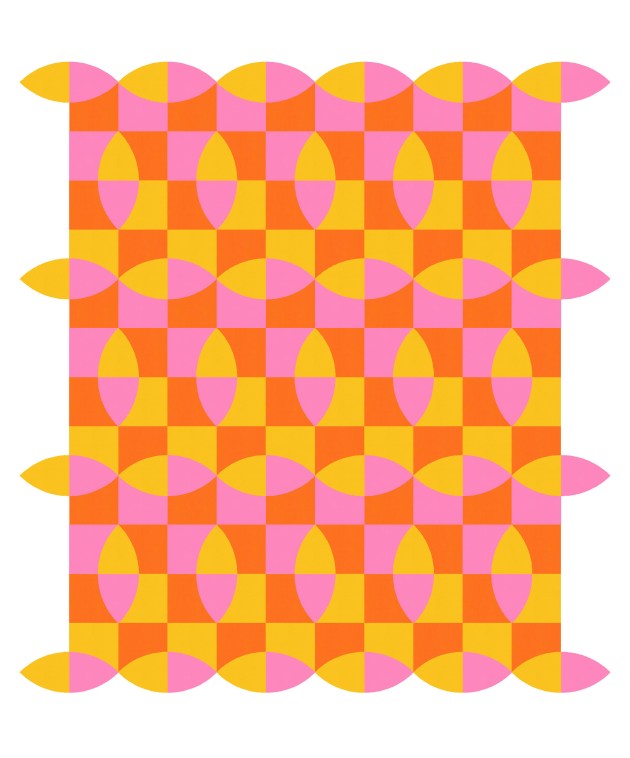
It’s maybe not being used in the way that you’d normally expect to see an orange peel, but I think it works. It’s certainly fun in this colour palette (one of my all-time favourites). The checkerboard colouring helps to keep it fun too.
The main block in these designs has the orange peel in the middle, bisected by a straight line that also cuts the square block into two rectangles. But colouring some of the block in the same colour as the background lets the orange peels hang off the edge in some cases, or give a nice curvy edge at the top and bottom.
Here’s a simpler version (same design but less ‘busy’ colouring) – this one might be my favourite.

It works in the other direction too. I feel like those orange peels in the middle are giving me the side-eye 🙂

Here’s a more regular layout, where you might be able to see the basic block more clearly. Placing blocks in the middle of the design and then using one of the block colours as the background helps to ‘float’ the shapes a bit.
I also like colouring the edge blocks so that there are no hard vertical lines showing the outside borders of the block – just the curves of the orange peels undulating down the page.

On looking at the blocks now, I can see hourglass shapes too. I should’ve tried a design that echoed that shape. Here’s one with just a large diagonal instead.

These designs could be made into a quilt using templates of some sort (I’d probably just make my own). Once you got the hang of sewing these curvy shapes (and when I say “you”, I mean “I” 🙂 ), I think the quilt would come together pretty quickly.
I’m going to use these shapes in more designs, so keep an eye out for related sketches next week.
Sunday sketch #337
I don’t have too many designs up my sleeve at the moment, and when I sat down recently to draw something new, I ended up rehashing an old sketch.
This week’s design is a reworking of Sunday sketch #318, which I posted in July. I introduced some curves, which actually make the whole design simpler to construct as a quilt.

The shapes kinda remind me of Christmas crackers too: long rectangles (or cyclinders) capped by triangles at both ends.

Like the original sketch, this one illustrates the Bezold effect – an optical illusion where a colour (in this case, orange) looks slightly different depending on which colours are next to it. I didn’t know there was a name for this until Carolina Oneto mentioned it in a comment on my Instagram post for Sunday sketch #324 (obviously it’s an effect I use a fair bit!).
Anyway, this sketch could be made into a quilt using flying geese, half circles (or quarter-circles or drunkard’s paths units) and squares. I think it’d be much easier to make than the original sketch on which it’s based!
Sunday sketch #336
I don’t normally do improv or random, but this week’s Sunday sketch ended up that way (in appearance, if not in design).
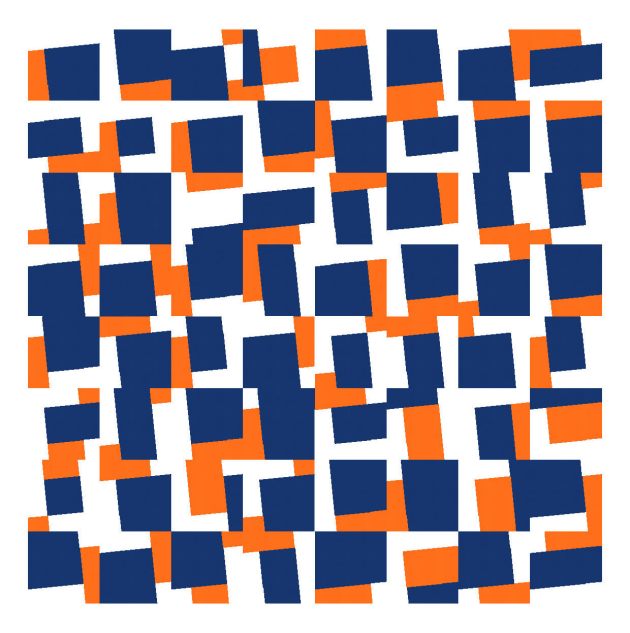
This is actually a block-based design, but with multiple elements of each block coloured in a way that kinda hides the repetition.
It started as a much more recognisable design – a wonky nine-patch. Here it is in a standard layout, with 5 colours per block: the dark blue centre, and then 4 colours each for one of the long sides and small corner pieces. Then rotating the blocks creates some fun movement.
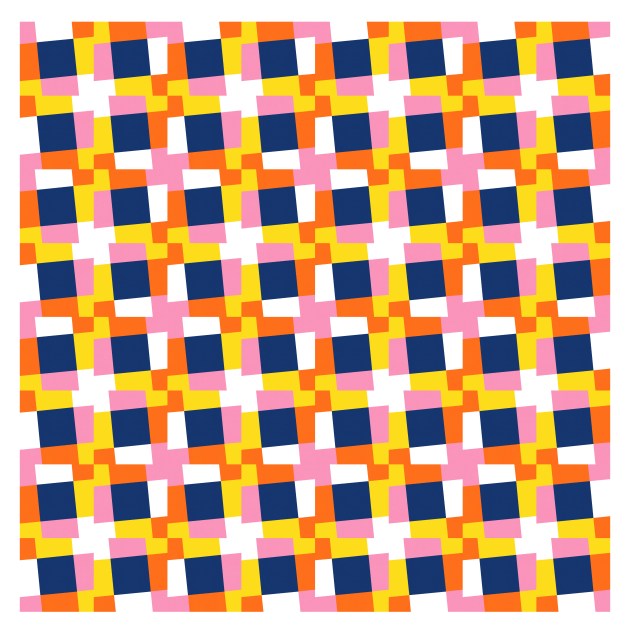
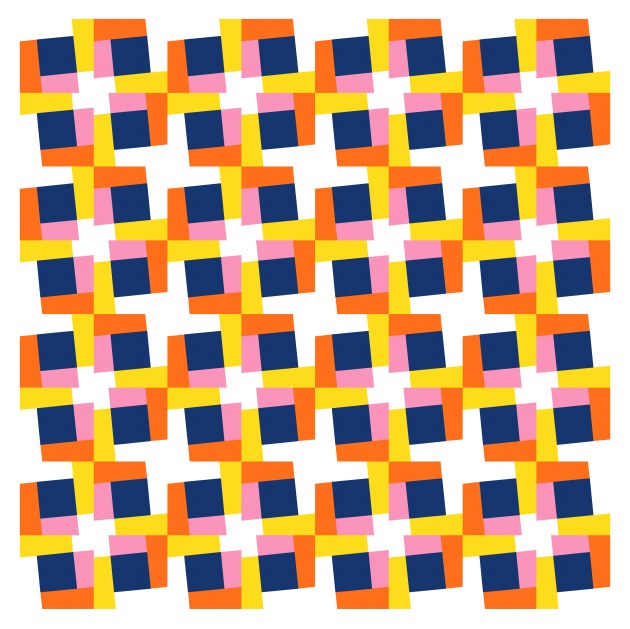
But after starting with the standard layout, I played around with the block placement and colouring. I kinda like how a fairly traditional block can feel more modern just with a few tweaks. I’ve seen some quilty conversations lately around the definition of ‘modern quilting’, and examples like this design make me question what counts as ‘modern’. I’m not sure I know.
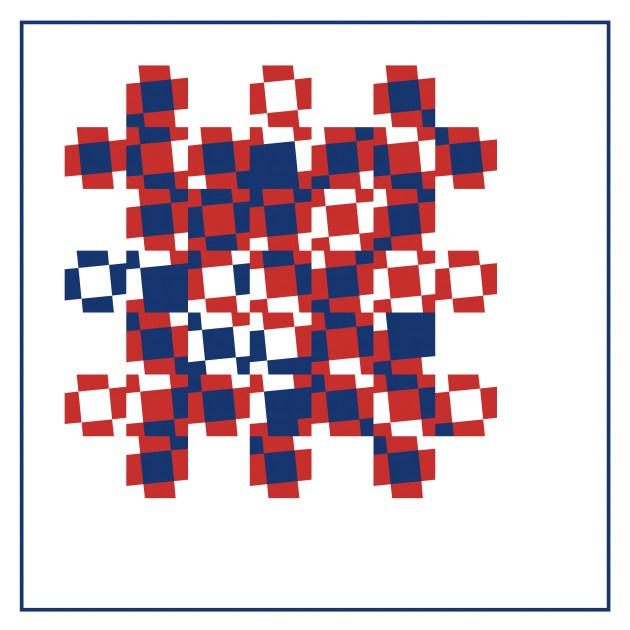
Anyway, I like how far the first version of this design feels from the others. I can see the origin when I look at it, but I’m not sure it’d be completely obvious to others.
if I was going to make it, I’d probably rework it further to try and obscure as many of those vertical and horizontal lines as possible – they make it a bit too obvious where the edges of the blocks are. There are some areas where the colouring of the pieces makes those borders less clear, and I’d aim to achieve that more consistently across the whole design. I’ll keep playing with it.
I’m not sure if I’d piece a normal nine-patch and trim it down to the wonky version, or if I’d just use templates to cut the wonky shapes and then piece them together. The former would probably be more accurate, but the latter might be less wasteful.
