
Tagged: triangle in a square
Sunday sketch #310
I ended last week’s post by promising to show some iterations of Sunday sketch #309 that are more traditional. But first, here’s a more modern-ish version.

To get more modern-ish versions, I find it easier to start with a full design and then take things away, rather than starting with a blank design and adding things randomly. Why is that…?
Anyway, on to some iterations that feel decidedly more ‘traditional’ to me.
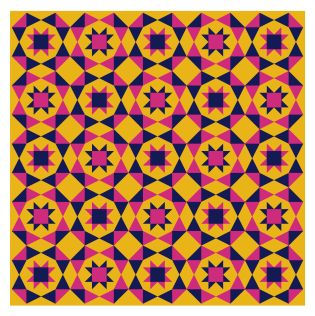
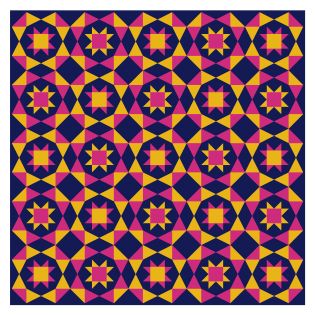

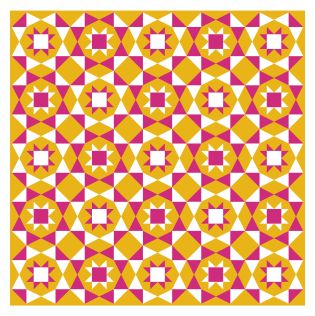
This is essentially the same design as last week, but with the individual shapes coloured differently to emphasise each one. Actually, these variations still aren’t showing every single shape; for example, the vertical and horizontal diamonds in the next version are actually made up of four pieces (the side pieces of four triangle-in-a-square units). I’ve just coloured them in a single shade, otherwise my brain would go crazy from the bitty-ness of it all.

And of course, so many pieces means soooo many colour combinations, permutations and variations. This next one feels very Parc Güell to me – a bit mosiac-y.

If so many pieces are too many pieces for you, it’s possible to pare this design back to even fewer pieces than I used last week. This creates a layout of 8-pointed stars, separated at their corners by large squares.


And I can pare it back even further, allowing some of those inner octagons to stand on their own. I like how their edges still align with those of their neighbouring stars. This might be one of my favourite versions!
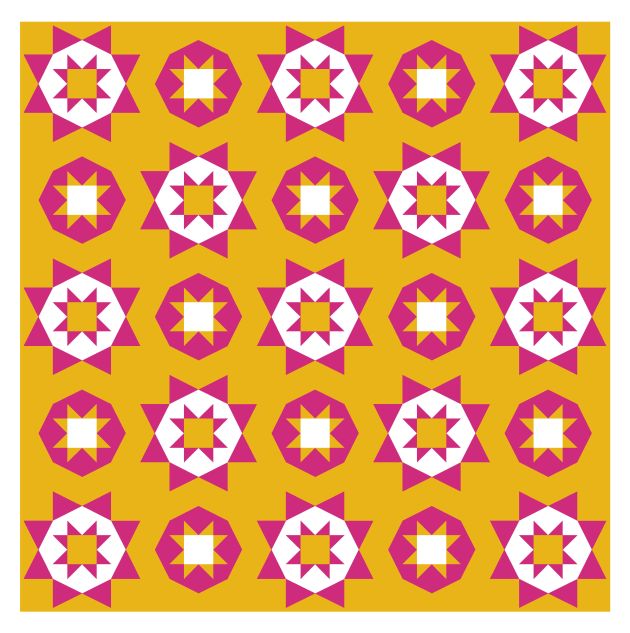
Finally, like last week, I can shift alternating rows of blocks across by one half-block, and the tips of the stars will still touch. This creates some new secondary shapes and some new movement in the design – instead of vertical columns of blocks, I now have angled stacks. This lends itself to new design variations too.

I stuck with the sawtooth star as the centre unit of these blocks because I wanted the link to last week’s designs to be clear. But you could replace it with any square-based unit… a nine-patch, a different kind of star, a circle even.
I love how a single block can look so different depending on how its components are coloured. I’ve always thought if I ever sold patterns, I could market the same one to two completely different target markets, just by changing up the fabric and colour placement!
Sunday sketch #309
Australia got a new prime minister this week, so it feels like the perfect time for a bright and happy multicoloured design.
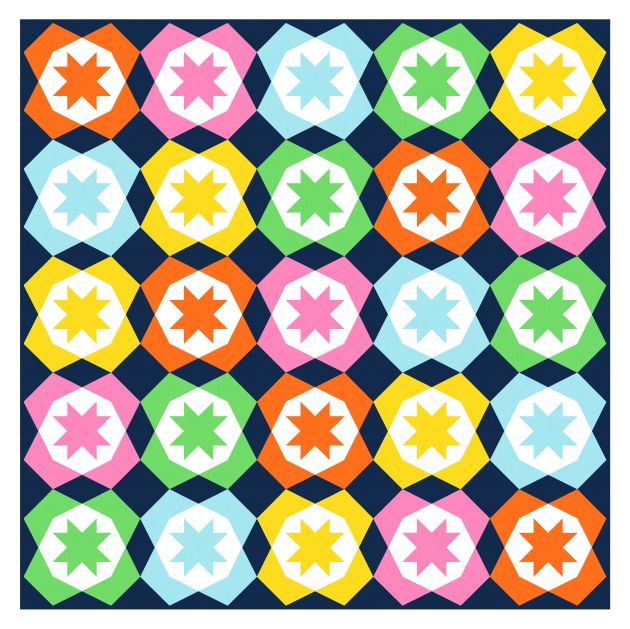
This design is a single block on repeat. Although the block is made up of a few different elements – which I’ll talk about later – I’ve stuck with only a few colours per block. I wanted to emphasise certain shapes, and not let the whole design get over-busy. One way to reduce busy-ness is to use the same colour in certain parts of all blocks – in this case, using white for that internal octagon in each block.
Here’s an even sparser colourway that matches the internal octagon to the background colour (white):
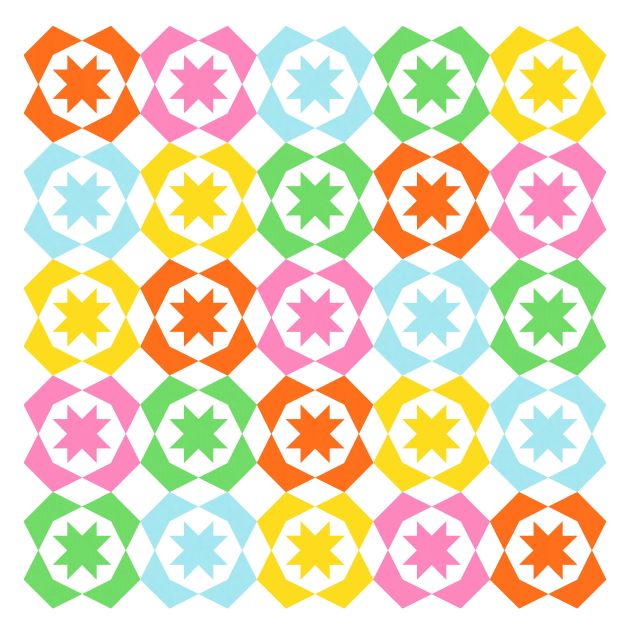
The centre of each block is a square that could fit just about any other type of block, but here I’ve used the sawtooth star – one of my favourites, and a traditional block that I come back to again and again. Sawtooth stars have several elements (the internal square and the outer half-square triangles), and they too can be coloured differently to create another variation of this design.
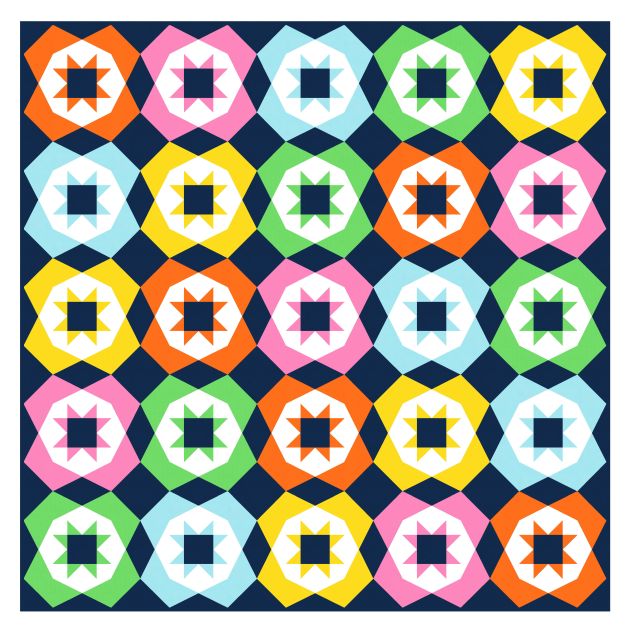
These blocks remind me a little of storm-at-sea blocks, as all the lines around the central square in each block meet the lines in adjacent blocks, creating movement that draws your eye round and round.
I added even more movement by colouring some of the shapes that emerge between adjacent blocks. (And added a border so your eye has somewhere to rest.)
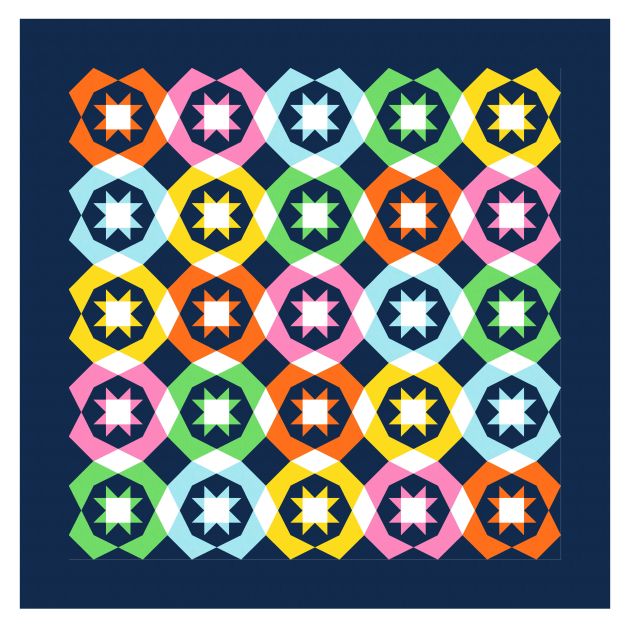
The outer points of the blocks are positioned in such a way that shifting blocks along a bit still lets them touch by their tips. So I can stack them in tilting instead of vertical columns. Some of the movement from the earlier versions is gone, replaced by movement in new directions.
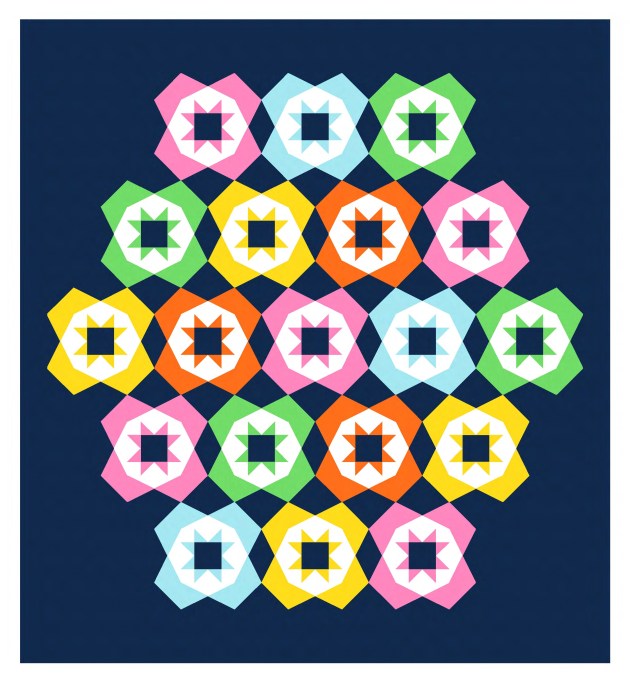
And the blocks in each row can be connected again, as before.
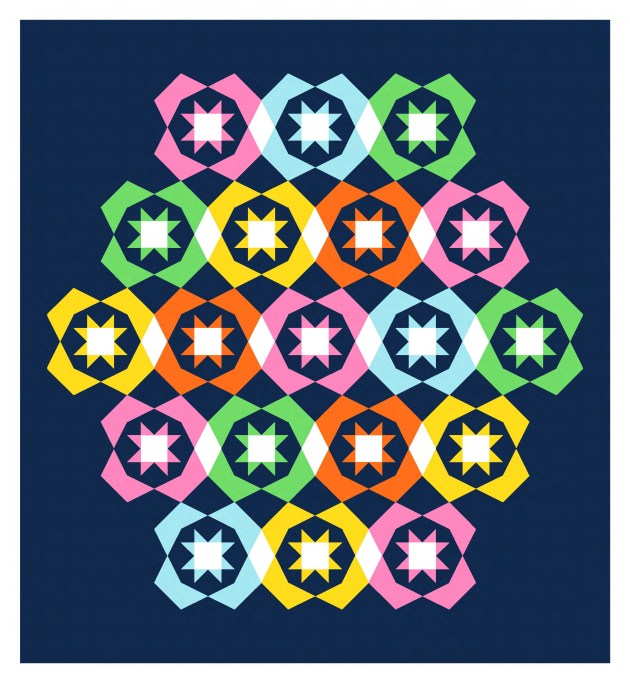
These blocks are created using a bunch of basic units. Each block is a 16-patch, with the central 4 patches merged to create a larger square that fits the sawtooth star. The 4 corner patches are half-square triangles, and the 4 sides (comprising 2 patches each) are triangle-in-a-square blocks (facing each other with their points touching).
Pretty much any block could be squeezed into that inner square – even a mini version of the same block. I like sawtooth stars cos they’re simple and easy to make, but also just cos I love the way they look.
I could’ve kept iterating this design to try and create one with a bit more negative space, but then you’d lose a lot of that movement, I think. And not every design needs to be ‘modern’ in that way… this one feels a bit more ‘contemporary’ than ‘modern’ (although don’t get me started on how to differentiate between the two…). It definitely has traditional leanings, and next week I’ll share variations that take the design even more in that direction.
Sunday sketch #254
Recognise the pinwheel flags from last week? Here’s where they started.
I’ve been playing with elongated curves lately. I was prompted by the oval drunkard’s path templates from Jenny Haynes / Papper, Sax, Sten, which I got awhile back. They’re 2:1 curves, so twice as high as they are wide (standard drunkard’s path blocks are 1:1 – the same width and height).
I wasn’t sure how to make 2:1 curves in Electric Quilt, but I figured out that you can draw a standard curve, then select it and drag it the box around it to create new dimensions. I’m not sure I got the dimensions quite right in this design, but I got sidetracked by the concept of using curves in this way. It’s a concept I’ve tried a few times recently – you might’ve seen Sunday sketch #251, and I’ll post some other designs like this in the future.
Anyway – alternating blocks help to introduce a bit of negative space, so the whole design doesn’t feel too crowded.
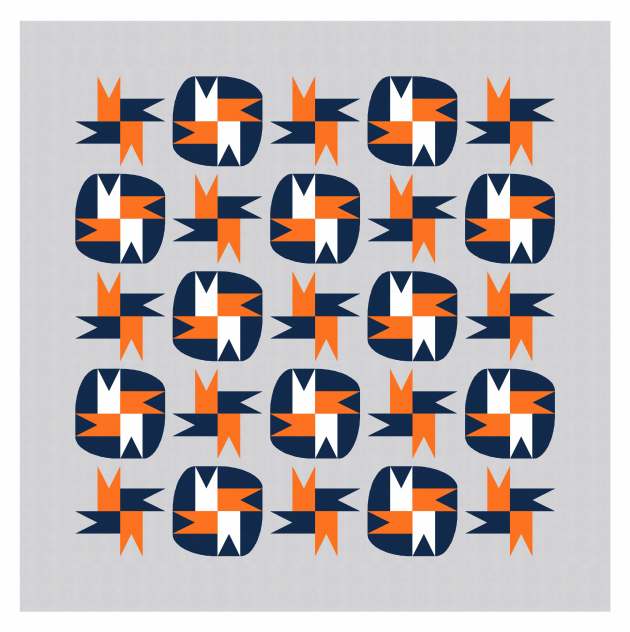
The great thing about a four-colour palette is how many combinations are possible. Here are a few.


It gives a slightly different feel to the design if you switch the order of the alternating blocks, so that the curved blocks are in the corners.
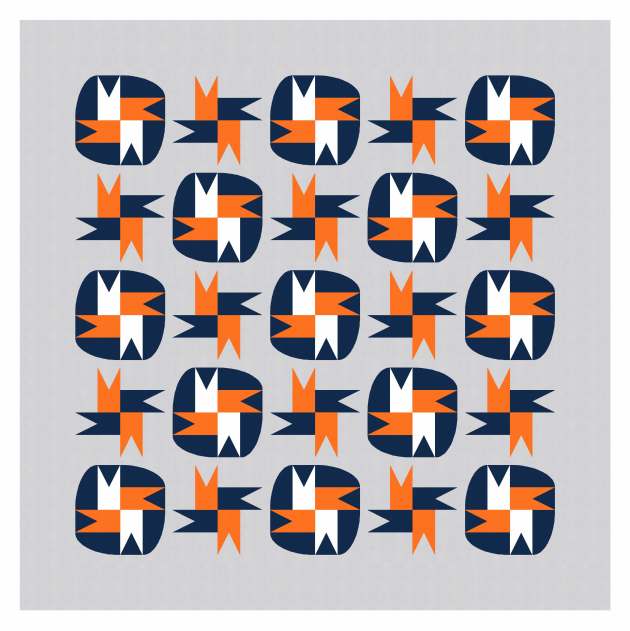
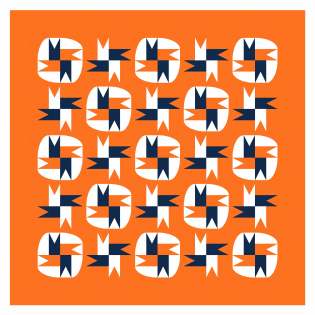
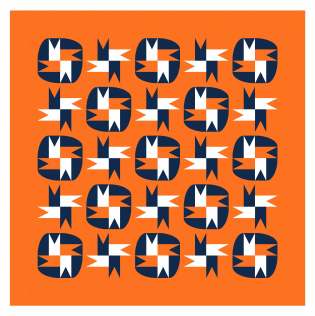
I used sashing between the blocks, so it’s possible to use all curved blocks throughout the design without making it feel too crowded…


…but I still prefer the alternating arrangement of curved and non-curved blocks.
I love the oval drunkard’s path shape! It lends a bit of wonkiness and an informal feel to the overall design. I’m looking forward to trying out the Papper, Sax, Sten templates and coming up with more curvy designs. This one could be made using the templates, triangle-in-a-square units, and squares.
