
Tagged: triangle in a square

Finished quilt: Starbound
Another finish from last year that’s hanging in this year’s QuiltCon is Starbound. Here’s how it came about.
Sunday sketch #369
More eight-pointed stars this week! These are the ones that the Encyclopedia of Pieced Quilt Patterns by Barbara Brackman calls the ‘sun ray’s quilt’ block. And all the blocks called ‘eight-pointed stars’ in the book (and there are many!) look completely different to this one (and to each other…). But I’m sticking with ‘eight-pointed star’.

This is one of those apparently simple designs that I feel is a bit more complex on closer inspection. Each of the two blocks in each quadrant extend into the two adjacent quadrants. For example, at the top left, the orange squares continue on into the top-right quadrant, while the light stars against an orange background continue down to the bottom-left quadrant. At the top right, the orange stars against a light background continue down the design, while the orange squares continue across. It’s the same for each quadrant; they’re all connected.
I’ve used just two colours, as a larger palette would disrupt that connectivity. I’m really stuck on this dark green / light blue palette recently.

I’ve talked before about how I need to consciously ‘modernise’ a quilt design by taking elements away, introducing asymmetry, etc. So here’s my attempt at a ‘modern’ version of this one. It’s perhaps still a bit too balanced. I should’ve tried making the placement of blocks in each quadrant a bit more random.

I’ll never get tired of the bright orange and hot pink palette.

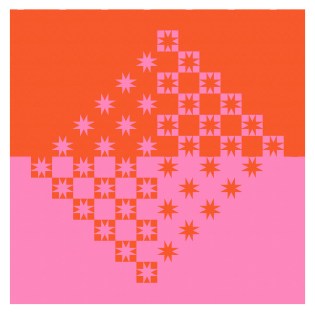
In EQ8, there’s a ‘Randomize’ feature where you can just click on a design and it’ll serve you up different colour palettes. Over and over and over again. It does seem pretty random; more often than not, they’re not very nice! But occasionally something interesting pops up. Here are a few I tried myself or stumbled upon by randomising.
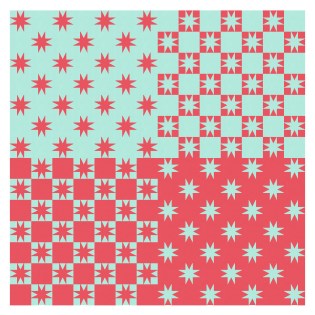
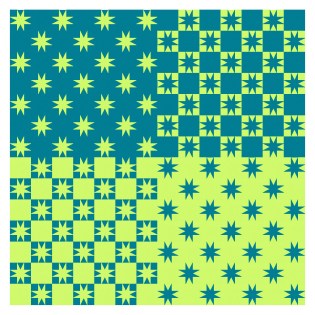
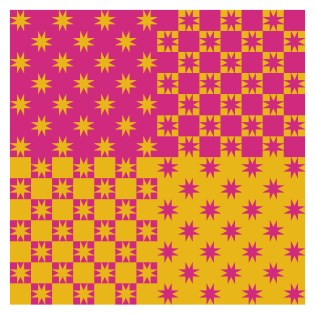

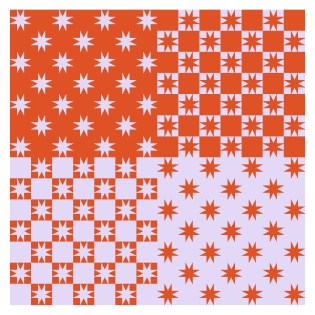


I tried a few more iterations of this design too, by mixing up the placement of the stars and their backgrounds. I liked this checkerboard variation.

This week’s sketches could be made into quilts using eight-pointed stars (which require either half-rectangle triangles or a triangle-in-a-square block, plus a square) and solid squares. I mentioned last week that I wasn’t sure how small I could make an eight-pointed square and be happy with the precision; I have a feeling that the seams could feel kinda bulky in a very small star? I’ll have to try it and see.
Sunday sketch #347
Here are the diamonds I mentioned last week. I’ve simplified the inside of the block by removing the half-square triangles (they’re just coloured as squares now), which also removes the internal octagon. (This is all compared to the past few week’s sketches; if you’ve no idea what I’m on about, start with Sunday sketch #344 and go from there!)

This first version feels like overlapping lace to me… that circular movement, and all the dark blocks overlaid on a white background.
Making the internal stars white instead of dark blue helps to lighten the whole design, although I feel like the overlapping effect isn’t as prominent. As usual, I can’t decide which one I prefer.
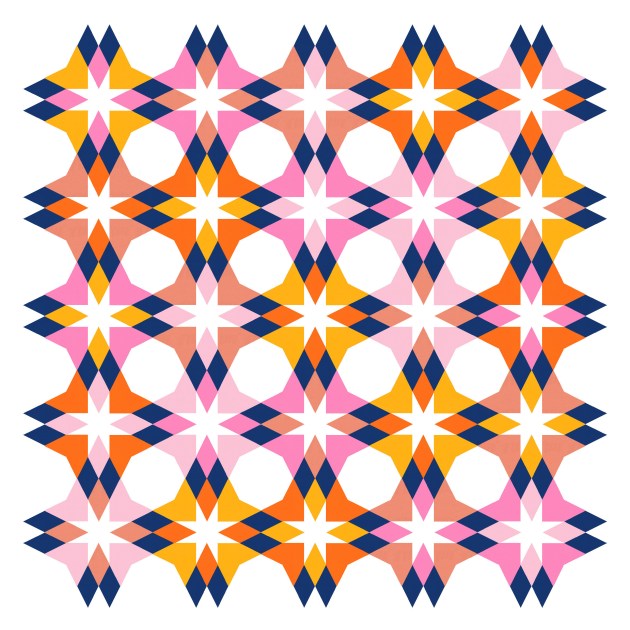
And here’s a throwback to last week’s design, with the internal octagon shape back again and the diamonds coloured in the opposite way to the background.

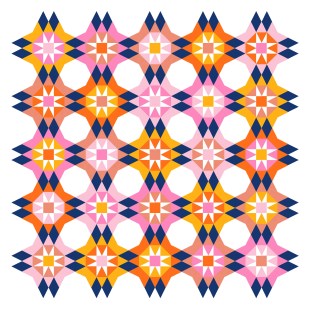
I like how an element that wasn’t even really obvious in previous versions of this block is now the most prominent. It just goes to show the difference that colour (and colour placement) can make in a design.
I’m sure I could go for another few weeks, tweaking this design to create new sketches, but you get the idea. If a block has enough elements, you can add and subtract small components to make a big difference to the overall design. And then one design sparks another, which sparks another… ad infinitum.
I’d love to see some of these designs as actual quilts. They’d be easy to construct – they’re just half-rectangle triangles, half-square triangles and triangle-in-a-square units – and they’re all block-based, so you could batch-sew similar components and/or pieces of the same colour. (I love planning how I’ll approach a new project 🙂 )
