
Tagged: stars
Sunday sketch #369
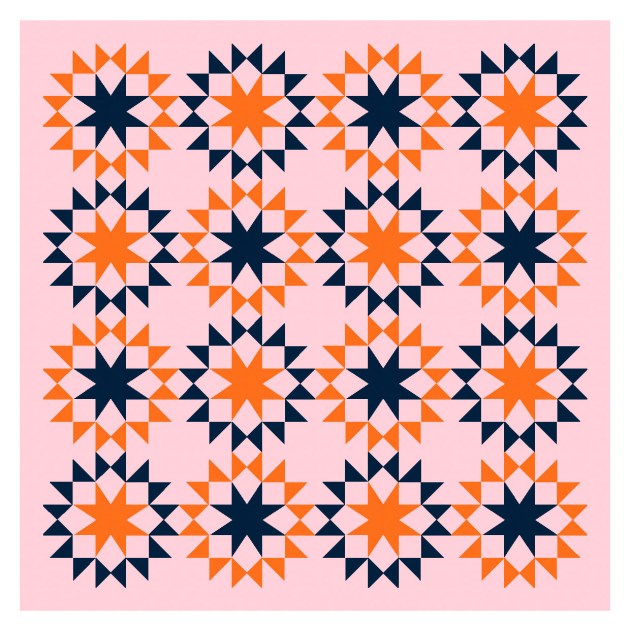
More eight-pointed stars this week! These are the ones that the Encyclopedia of Pieced Quilt Patterns by Barbara Brackman calls the ‘sun ray’s quilt’ block. And all the blocks called ‘eight-pointed stars’ in the book (and there are many!) look completely different to this one (and to each other…). But I’m sticking with ‘eight-pointed star’.

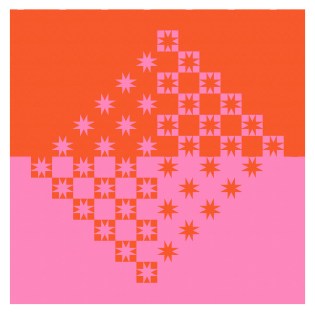
This is one of those apparently simple designs that I feel is a bit more complex on closer inspection. Each of the two blocks in each quadrant extend into the two adjacent quadrants. For example, at the top left, the orange squares continue on into the top-right quadrant, while the light stars against an orange background continue down to the bottom-left quadrant. At the top right, the orange stars against a light background continue down the design, while the orange squares continue across. It’s the same for each quadrant; they’re all connected.
I’ve used just two colours, as a larger palette would disrupt that connectivity. I’m really stuck on this dark green / light blue palette recently.

I’ve talked before about how I need to consciously ‘modernise’ a quilt design by taking elements away, introducing asymmetry, etc. So here’s my attempt at a ‘modern’ version of this one. It’s perhaps still a bit too balanced. I should’ve tried making the placement of blocks in each quadrant a bit more random.

I’ll never get tired of the bright orange and hot pink palette.

In EQ8, there’s a ‘Randomize’ feature where you can just click on a design and it’ll serve you up different colour palettes. Over and over and over again. It does seem pretty random; more often than not, they’re not very nice! But occasionally something interesting pops up. Here are a few I tried myself or stumbled upon by randomising.
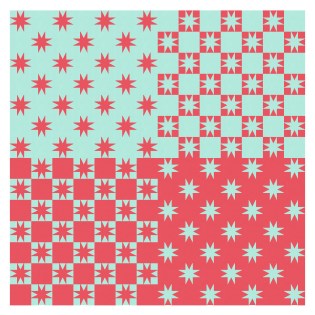
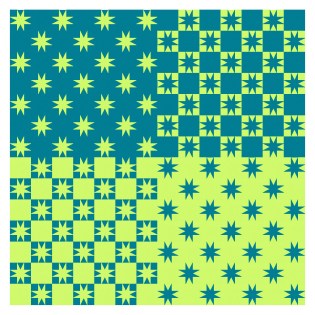
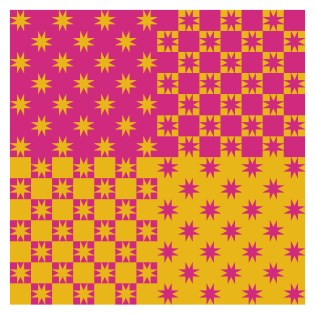

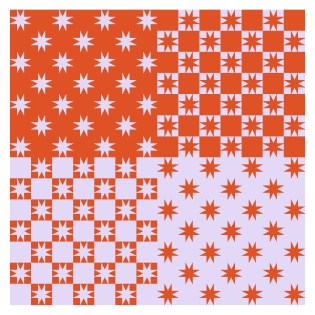


I tried a few more iterations of this design too, by mixing up the placement of the stars and their backgrounds. I liked this checkerboard variation.

This week’s sketches could be made into quilts using eight-pointed stars (which require either half-rectangle triangles or a triangle-in-a-square block, plus a square) and solid squares. I mentioned last week that I wasn’t sure how small I could make an eight-pointed square and be happy with the precision; I have a feeling that the seams could feel kinda bulky in a very small star? I’ll have to try it and see.
Sunday sketch #367
I don’t have a favourite quilt block (I don’t really do favourites), but I do love a good eight-pointed star. (Basically a nine-patch where each pair of pointy bits fits into one square; contrast that with a sawtooth star, which is essentially a 16-patch where each pair of pointy bits takes up two squares). Here I’ve shortened the pointy bits so they’re half-way between a sawtooth star and an eight-pointed star.
That’s so it fits into the centre of another block, which the Encyclopedia of Pieced Quilt Patterns by Barbara Brackman calls the ‘rising sun’, wheel of luck’ or ‘wheel of fortune’ block. I’ve tiled the new block (which doesn’t have a name I can find, but I’m sure it has one) in a 4 × 4 layout and coloured each one differently.
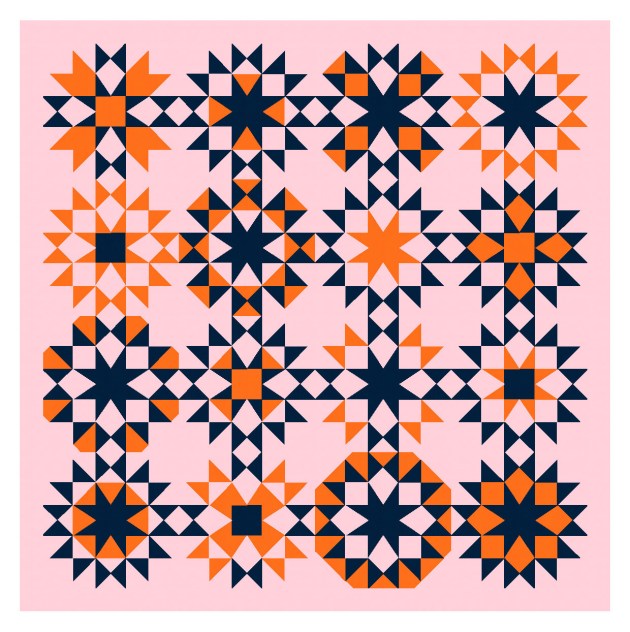
If I add sashing, you can see each block a bit more clearly (but I prefer the layout without sashing).
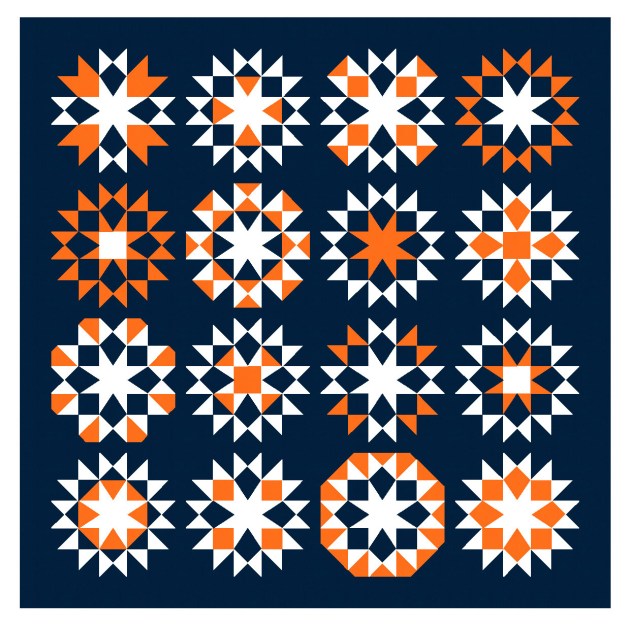
There are enough elements in this block to mean that a simple palette of only three colours can still produce 16 unique colourings (at least!). Obviously with a larger palette, you’d have even more colouring options.
Here’s an alternating layout of the two versions I like the most.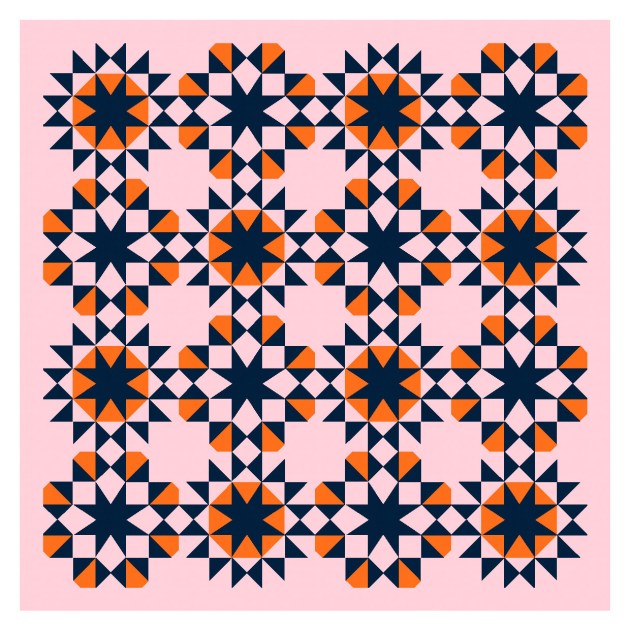
And a layout of the two versions that probably have the simplest colouring. I like the big squares that are created in the spaces between the blocks.
I love how much designs can change through simple tweaks to colour placement or colour choice. And I particularly love how a single block can look so different depending on how you colour each element. I played with that concept in Sunday sketch #310, and it’s something that I’ll keep exploring.
This approach (and this week’s sketch) is not necessarily ‘modern’ (although if I tweaked the grid work and introduced some negative space, it probably could be), but I find it very useful (and fun) as a design exercise. You should try it!
Sunday sketch #363
I’m not sure if the main shape in this week’s sketch has a name – I’ve seen it called a leaf shape or a half-squircle. It’s basically a square with two opposite corners rounded off. Set on point with the curves to the side, it gives a kinda Christmas ornament vibe. But it also has lots of space in the middle for another block or shape. I’ve stuck a star in there.
I’ve used a three-colour palette here, but probably any number of colours would work. Especially as the middles of the stars can be coloured differently too.


Here’s my usual warm palette. I can’t resist!
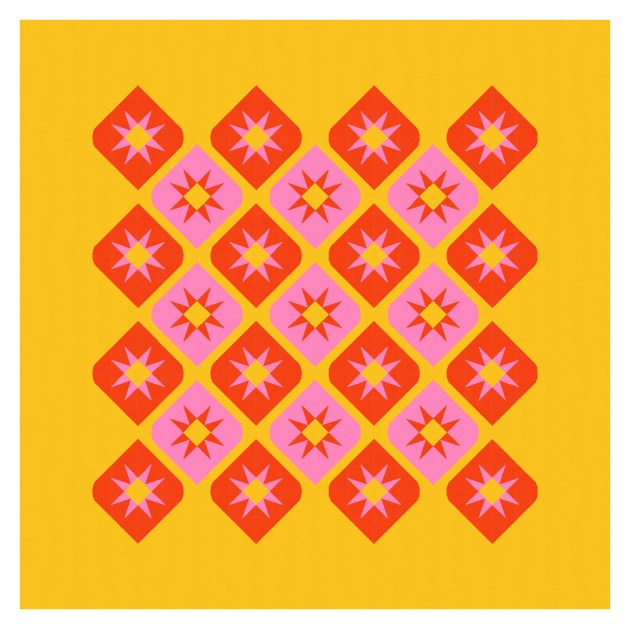
And back with the more basic colour placement.
It works in a busier colourway too.


I also like the sideways version – it looks less Christmas-y and more wavy.
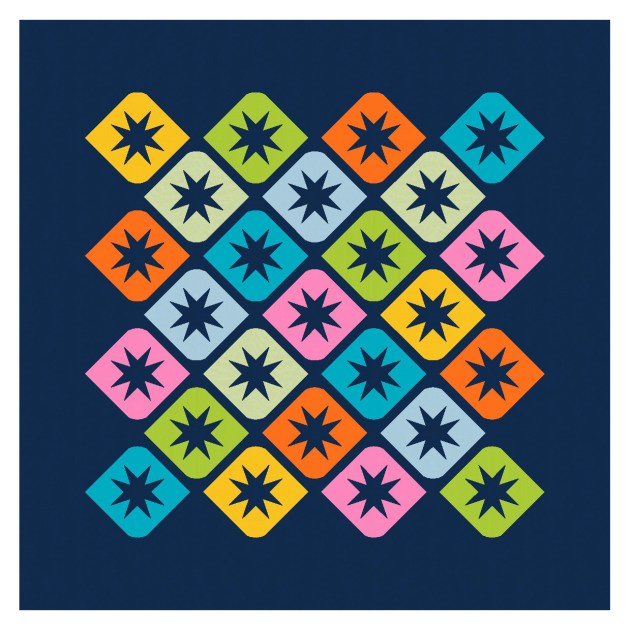
I’ll probably play more with the half-squircle – I think it’s a good shape for incorporating other smaller blocks or shapes. The best construction method would depend on the smaller shape/block. Here, I’d probably make the inner star block then create a template to round off the two corners and make a curved sashing.
What other shapes should I try putting in the middle of these half-squircles?
