
Category: Sunday sketch
Sunday sketch #388
This week’s design came to me in a dream – well, a daydream. That’s not such a big deal, because I spend quite a bit of time daydreaming about quilts and quilt designs 🙂
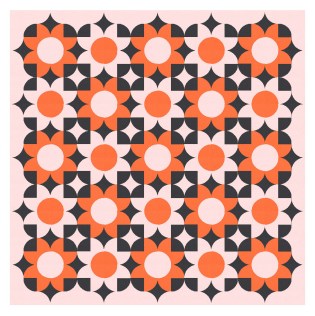
I’ve been designing a lot with curves lately, and I’ve been trying some block-based designs featuring two alternating blocks. I like there to be some connection between the different blocks, like a common shape or colour (or both). This week, I imagined half-circles in both blocks, but concave in one and convex in the other.
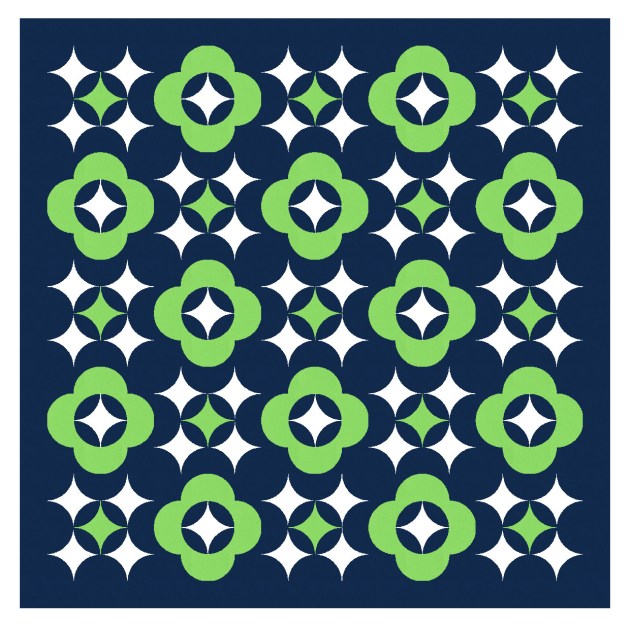
The convex ones are in the flower blocks, and the concave ones are in the star blocks. The two block types also share a central circle within a curvy star inside it. Although that’s not where I started… at first, the two blocks just had circles in the middle.
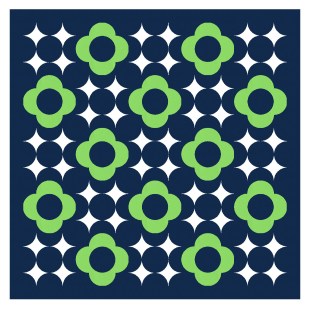
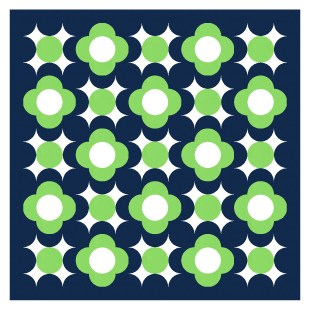
I didn’t mind that design, but the blocks felt a little empty. The simplest thing to put in those middle circles was another curvy star – repeating some of the existing shapes so the design doesn’t feel too busy or chaotic.

This makes three ‘areas’ per block for colouring in different ways (not counting the background)… the main flower or star shapes, the middle circle, and the centre star. In the previous version, I’ve used the same three colours per block but mixed them around a bit. In the first and last versions I’ve shown here, I’ve coloured one shape consistently across all blocks, for a more cohesive look: in the first version I’ve posted, the middle circles are all in the background colour. In the last version, it’s the centre stars.

I really like the movement in this design, and how the flowers seem to be nestled by the curves in the adjacent blocks. I think the negative space does a lot of work here in creating connections between the blocks.
This week’s sketches are all curves – quarter-circles or half-circles (or lots of drunkard’s path units). If the blocks were 12″ (finished), the curves would be 3″ (finished), which is about the smallest size I can manage well (smaller than that, and my curves get less curvy and more messy!). So the layouts shown here would be ~60″ plus whatever size border you wanted to add. Of course, the advantage of block-based quilts is that they’re usually pretty easy to size up or down.
Some of the shapes in this week’s sketch prompted me to take this design in a different direction, so watch this space for the next few weeks for a few related designs.
Sunday sketch #387
I’m posting only one version of this week’s Sunday sketch, which I know is unusual. I did come up with some other versions of this one, but the iterations are so minor (at the level of single pieces in just one block), you’d have a hard time spotting them.
This is my latest attempt to create a design using one block on repeat but colouring the blocks such that each one appears unique. So even though the block is repeated, there are no repeats. (Does that make sense?!)

In this week’s version, I’ve used an alternating layout of two different blocks (which means I’m already breaking my own rule…). The two blocks are very similar though; they have many common elements and could probably be considered one block if I just combined some of their components.
I’m pretty sure no two blocks in this design are identical, but let me know if you spot any copies! I tried to colour each block in a proper/symmetrical way (in other words, all similar pieces in a block are in the same colour), but in some cases I’ve introduced a piece or two in the ‘wrong’ colour to carry across a secondary shape from an adjacent block. I didn’t want to interrupt an interesting shape by insisting on strict colour rules.
I first tried this approach (kinda…) in Sunday sketch #310, although it doesn’t take an eagle eye to see that there are several identical blocks in that design. I’ve tried reworking that one, but haven’t yet found a version I’m happy with. I can’t quite get the balance right with all the different block variations.
This week’s sketch uses three colours instead of two, and two blocks instead of one. That means a much bigger number of unique block colourings! So I had more to play with in this design. But even still, I’m not 100% happy with this week’s sketch. I haven’t quite figured out what it needs – maybe a bit more negative space? A greater focus on the secondary shapes that form between the blocks? Only one block type instead of two?
I’ve had this idea in the back of my head for a looong time (I posted Sunday sketch #310 in the middle of 2022!), so I’ll just keep chipping away at it. I’m sure I’ll work it out eventually!
Sunday sketch #386
It took me ages to decide which version to show you first today, and I’m still second-guessing myself. I love all of this week’s sketches!

The fundamental design of this week’s sketch is the same as last week’s, but the blocks are set in a standard layout instead of on point. And I’ve changed the colouring to emphasise a different shape – the dark blue shapes that combine to form a lovely curvy four-pointed background to each flower (which in turn combine to create a lovely scalloped edge to the whole design). Can you see them? (In the bottom right image, below, they’re in white instead of dark blue.)
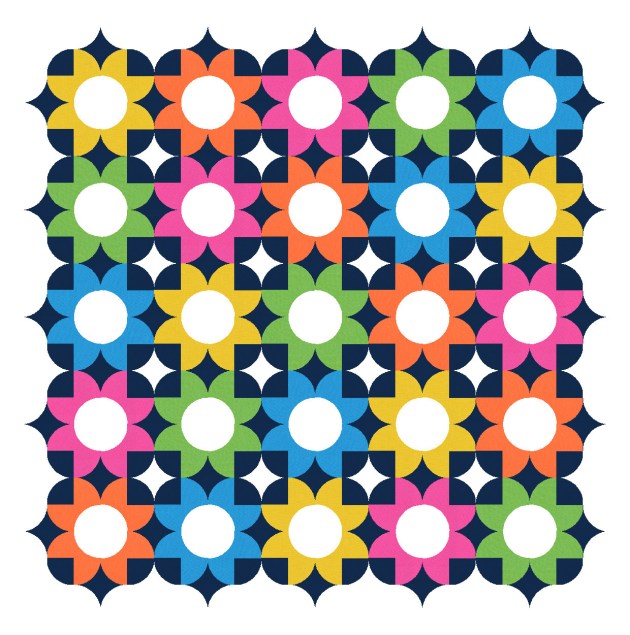
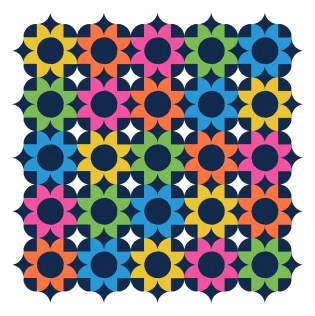
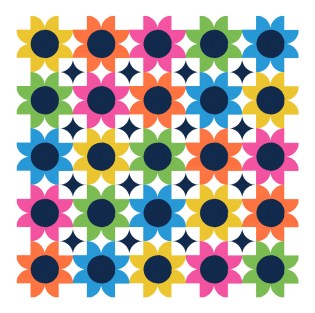
I like this multicolour palette – so bright and happy! – but I prefer the alternating colour/white flowers of the first version, which let your eye rest a bit while maintaining the repetition of the flower blocks.
Different parts of the design can be coloured to move the emphasis around – in the next version, I’ve added another layer of squares to the edges of the design, which I think helps bring them to the foreground.
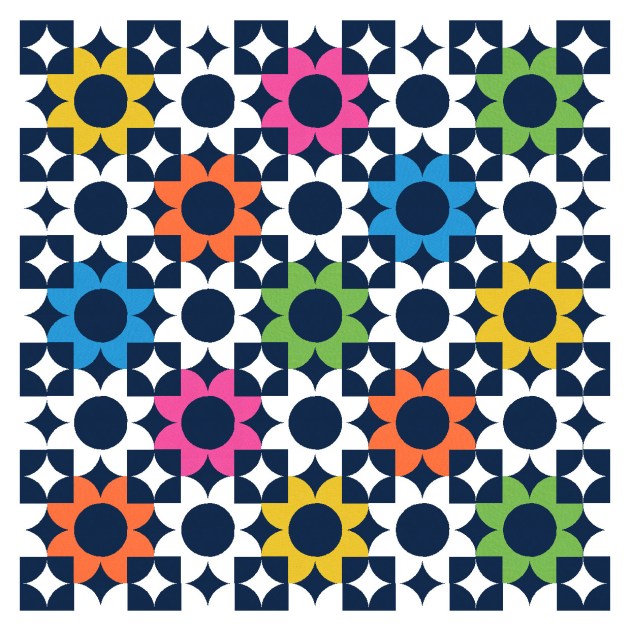
Similarly, removing other elements helps to emphasise those curvy shapes. Here are a few versions where I’ve eliminated more and more bits.

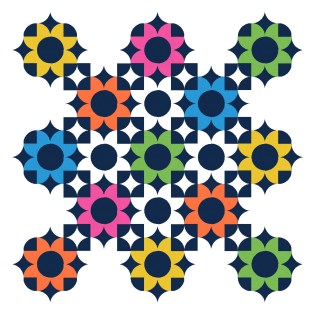

The design also works with a simpler palette. In both versions below, I’ve used a lighter colour for the background and a darker colour for the squares and diamonds, but I think the reverse would work just as well.

This week’s sketch could be made into a quilt using mostly quarter-circle (or drunkard’s path) units. Some of the versions shown here would also require a small number of squares and/or rectangles.
