
QuiltCon 2026: Quilts, categories and countries
Every year in February, modern quilters around the world get a little bit excited about QuiltCon – the Modern Quilt Guild’s annual quilt show. Loads of MQG members submit their work for consideration, and hundreds of quilts are accepted for display at the show – which is taking place in Raleigh, NC, USA, this year.
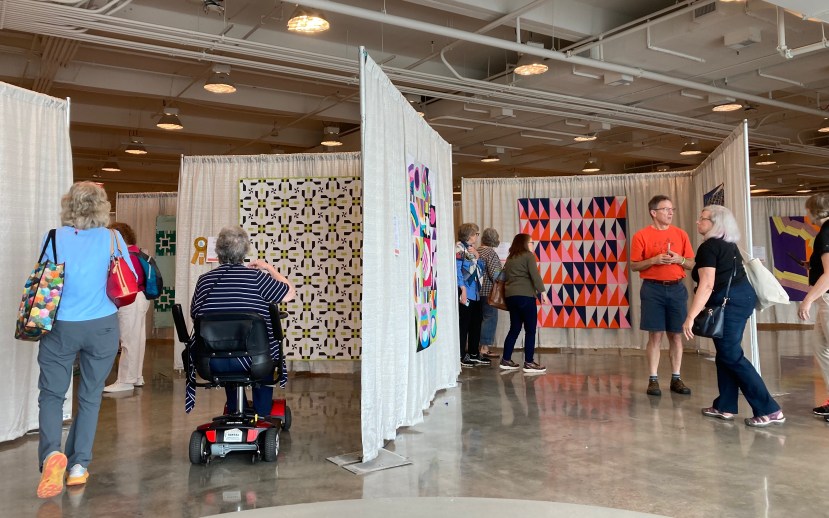
Quilts on the show floor at QuiltCon 2023 in Atlanta, the only one I’ve visited in person.
For the past few years, I’ve collected data on the show for my own interest. Through various conversations, I’ve realised other people might find it useful too, so I figured I would share it more broadly here. You might want to grab a cuppa!
Summary of QuiltCon 2026
- 470 quilts were juried into the show.
- 23% of submitted quilts were accepted into the show.
- At least 315 makers from 11 countries have quilts hanging in the show.
A note about the data
Most of the data provided here is a mix of numbers I’ve obtained from publicly available sources (e.g. QuiltCon website, app and catalogue, and other quilters). The 2026 data was provided by the MQG. Note that almost all of the numbers I talk about in this post relate to quilts that were juried in (or accepted) to the show, not that were submitted to the show.
Just to be clear, before we get started: Numbers don’t tell the whole story. The figures I’m providing here will give you a sense of what’s happened/happening at QuiltCon, but not necessarily the ‘who’, ‘why’ or ‘how’ of it all. Every single data point is underpinned by a slew of factors – some of which I can guess at, and doubtless a ton more that I’ve never considered. So please take care when drawing any conclusions from the data presented here 🙂
Submitted quilts
A total of 2041 quilts were submitted and 470 quilts were juried in to the 2026 show, which means the acceptance rate was 23%.
For the 2025 show, 2269 quilts were submitted, and the acceptance rate was 20%. I don’t have submission numbers for previous years, but Kelly Spell provided rounded numbers on her blog for 2013 to 2024. Combining our data gives you a general picture for the show since its beginning.
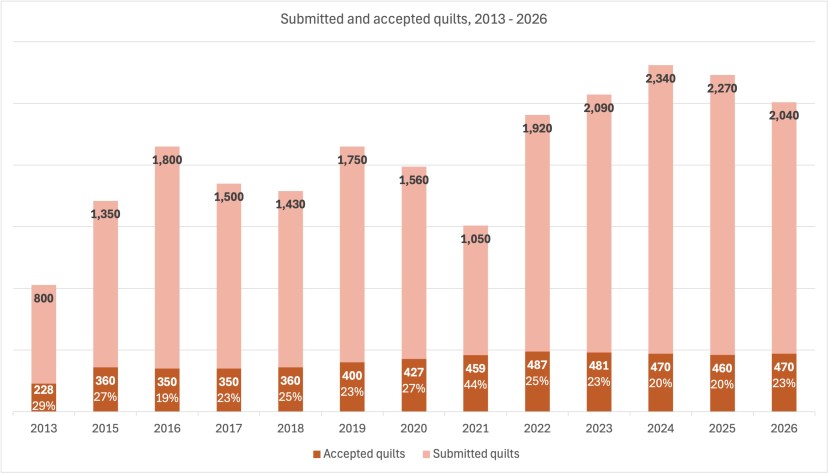
(Note that the first QuiltCon was in 2013, and there was no show in 2014. The pandemic affected the show in 2021.)
There was a 10% drop in submissions this year compared to last year, but that’s not the first time submissions have fluctuated that much year-on-year. (Submissions tend to be open from around August/September to October/November for the following year’s show in February, so data for each year’s show reflects submission behaviour in the previous year.) I thought perhaps the US tariffs had something to do with the drop this year (since many countries were still figuring out how to handle tariffs in the period when QuiltCon submissions were open in 2025), but there are probably other factors at play too. More shows welcoming modern quilts? A decrease in discretional spending? People making fewer quilts? General global uncertainty?
Quilts at the show
A total of 470 quilts were juried (or accepted) into QuiltCon 2026. (For a clear explanation of the jurying process, see the QuiltCon Jurying Policy.)
The number of accepted quilts this year is around the same as in recent years. Since 2021 (when QuiltCon went entirely online due to the pandemic), the number of accepted quilts has hovered between 460 and 481.
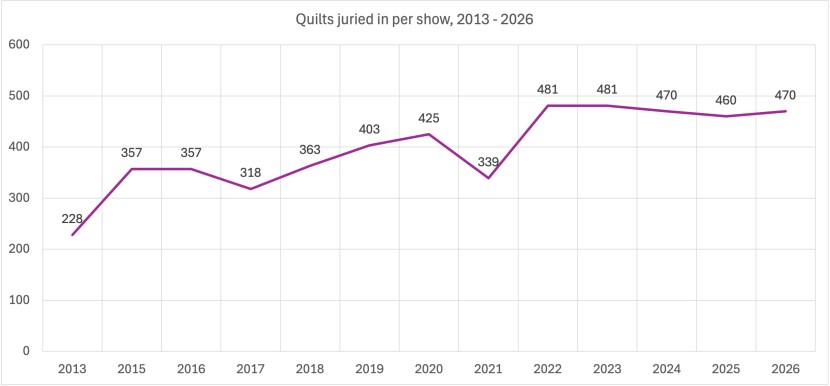
(There may be slight discrepancies in numbers shown here and those found elsewhere – just another fun thing about collecting data!)
Obviously, the number of accepted quilts depends on many factors, such as the number and standard of submitted quilts, the number of submissions in each category, and the amount of available floor space at the show venue.
It’s also worth noting that more quilts require more space, which means a bigger venue, which means fewer locations where QuiltCon can be held (keeping in mind that cities in more southern US locations are also favoured, as February weather is less likely to affect travel there).
Quilts per category
There are currently 12 categories at QuiltCon:
- Applique
- American Patchwork & Quilting Challenge
- Group & Bee Quilts
- Handwork
- Improvisation
- Minimalist Design
- Modern Traditionalism
- Piecing
- Small Quilts
- Use of Negative Space
- Windham Fabric Challenge
In recent years, there has also been an extra category that forms the MQG special exhibit (which is the ‘2016 Resource Pattern Exhibit’ this year); quilts in this category are not subject to judging.
The percentage of quilts in each category has varied widely since the show started. No category is consistently the smallest or largest, but some tend to be smaller (e.g. Applique, Handwork, Group & Bee Quilts) or larger (e.g. Improvisation, Modern Traditionalism, Piecing).
Here’s how it’s looked since 2015. (I’ve omitted 2013, because the categories were a little different that year.)
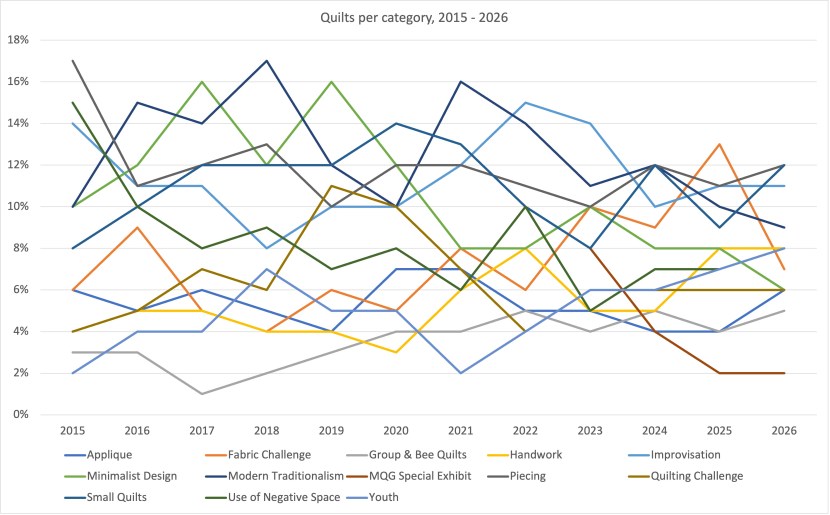
What a jumble! Suffice to say, things change every year.
And here’s how it looks this year:
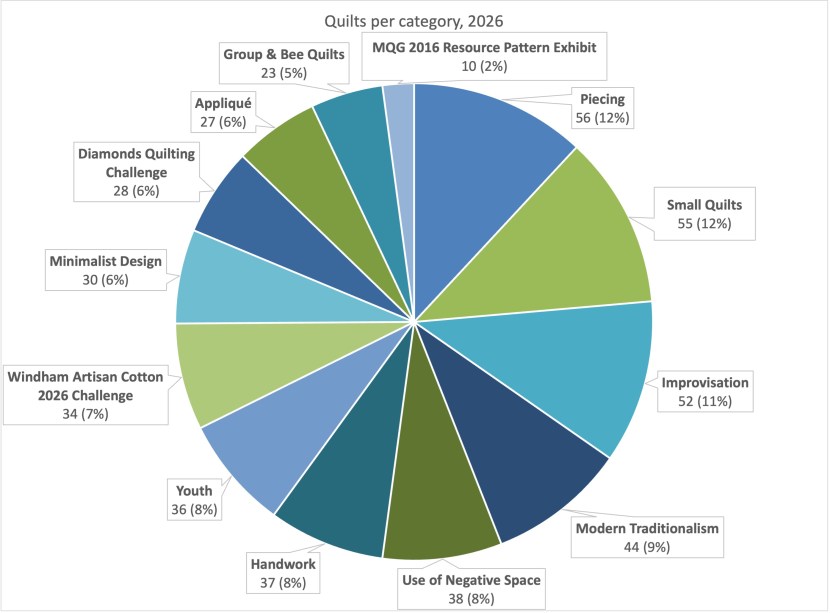
The smallest categories this year were the 2016 Resource Pattern Exhibit (10 quilts), Group & Bee Quilts (23), and Applique (27). The largest categories were Piecing (56 quilts), Small Quilts (55 quilts), and Improvisation (52).
Quilts per person
The 470 quilts in this year’s show were submitted by 315 people. I can’t be entirely sure how many unique makers that represents, because that number includes quilts made by groups or bees, whose makers aren’t all included in the data. It also includes people (usually parents or guardians) who submitted quilts on behalf of their makers for the Youth category (which has 36 quilts this year).
For example, if one person submitted 1 Youth quilt, I know it represents 1 maker. But if 1 person submitted 2 Youth quilts, I don’t know if that represents 1 or 2 makers. So, let’s just discount the Youth category for now (sorry, kids!).
That leaves me with 434 non-Youth quilts from 294 makers for the 2026 show.
The maximum number of quilts that any person can have juried into the show is currently 4. It used to be 5; it dropped to 4 for the 2023 show and has stayed at that number since.
You can submit as many quilts as you like, but you cannot have any more than 4 accepted in to the show. My understanding is that in cases where a person has 5 or more quilts that meet the jury’s criteria for hanging in the show, the jury is alerted to the fact that those 5+ quilts have been made by the same person (but not who the person is), and the jury decides which 4 they will accept. It’s important to note that the jury does not see the maker’s identity when they are considering the submissions.
There are often rumblings on social media each year (usually around the time that acceptance emails go out in early December) when people question why the maximum number of quilts per person is 4, and how many more makers could be included in QuiltCon if each person was limited to 3, 2, or even 1 quilt. I’m not going to engage on that topic here – it’s a decision for the MQG to make based on the organisation’s aims and business interests. (There would be many factors at play in such a decision, not least of which would be the financial implications for the MQG of reducing submissions.)
But here are some numbers to give you an idea of the spread of (non-Youth) quilts per maker over the past 4 shows (i.e. shows with a max. 4 quilts per person). Note that I didn’t exclude the Youth quilts from the 2023 data – doh! – so take those numbers with a grain of salt.
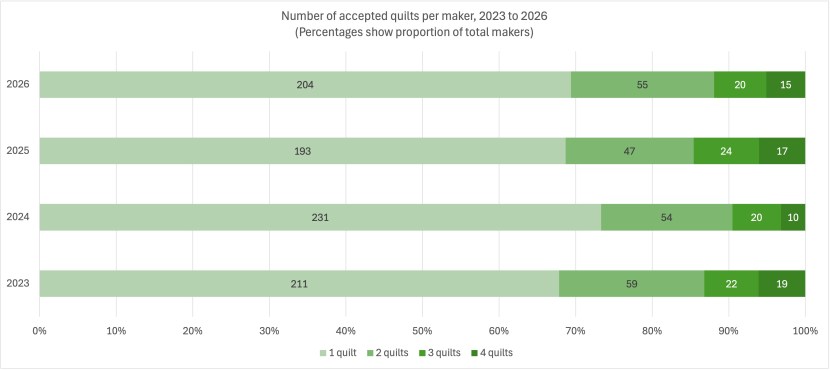
So each year for the past 4 years, around 70% of the makers represented at QuiltCon had 1 quilt in the show. Just under 20% of makers had 2 quilts in the show. (I’m rounding here; you can see from the figure that the numbers aren’t quite that precise.) Under 10% of makers had 3 quilts in the show. And the remaining ~5% of makers had the maximum 4 quilts in the show.
But when you look at the quilts rather than the makers, a slightly different picture emerges.
For the 2026 show, for example:
- 204 makers have 1 quilt each = 204 quilts (47% of the quilts in the show)
- 55 makers have 2 quilts each = 110 quilts (25% of the quilts in the show)
- 20 makers have 3 quilts each = 60 quilts (14% of the quilts in the show)
- 15 makers have 4 quilts each = 60 quilts (14% of the quilts in the show)
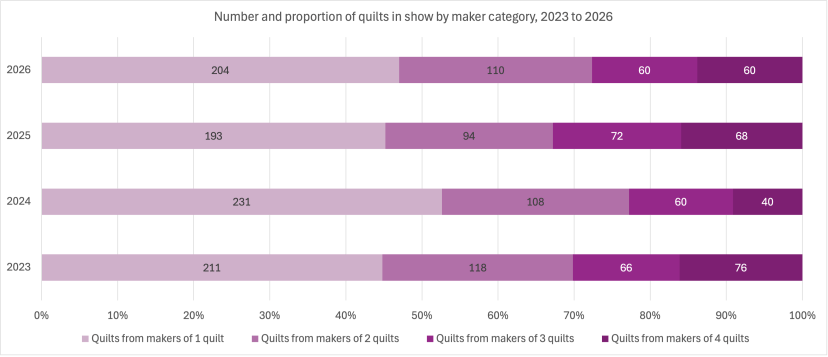
In 3 of the past 4 years, the quilts from makers of only 1 quilt have made up less than half of the show (and only slightly more than half in 2024). In other words, more than half of the quilts are from makers with at least 2 quilts in the show.
It’s difficult to predict if/how things would change if the maximum number of quilts were dropped, say from 4 to 3. For 2026, for example, such a decision could’ve made space for 15 more makers with 1 quilt each or 5 more makers with 3 quilts each – or somewhere in between. Or maybe the total number of makers would’ve stayed the same, with only the number of accepted quilts per maker changing.
I have no strong feelings either way about what the MQG sets as the maximum number. Full disclosure: I’ve been submitting my work to QuiltCon since the 2019 show, and in that time I’ve submitted the maximum number 4 times and had the maximum number juried in once. I’ve never submitted more than the maximum number. [Edited to add: I wasn’t very clear in this paragraph… when I say ‘maximum number’, I mean the maximum number that any person can have accepted into the show – so 5 up until the 2022 show and 4 since then.]
Anyway, I’m sure this will continue to be an ongoing conversation in the modern quilting community. If you’re an MQG member and you feel strongly about it, I’d encourage you to contact your regional representative directly with your thoughts.
Countries
One thing I love doing each year is seeing where quilts at QuiltCon have come from. QuiltCon is very much a North American show; the vast majority of accepted quilts are submitted by makers in the USA and Canada. But guess which country is pretty consistently third on the list? Australia!!
I couldn’t figure out an easy way to show you the spread over all 13 QuiltsCons, so you’ll just have to take my word for it that Australia has been third in 10 of those years. In two years, we were fourth or joint fourth, and in the other year we joint second with Canada.
(Remember that I’m talking about accepted quilts here, not submitted quilts. I don’t have data on where submissions are coming from. I wish I did, because I’d love to know more about why certain countries (particularly big ones!) aren’t represented at QuiltCon. Do they make modern quilts? Do they have members in the MQG? Do they face barriers to submission? Are they submitting their work elsewhere? Anyway, I digress….)
Check out the geographical spread of accepted quilts this year.
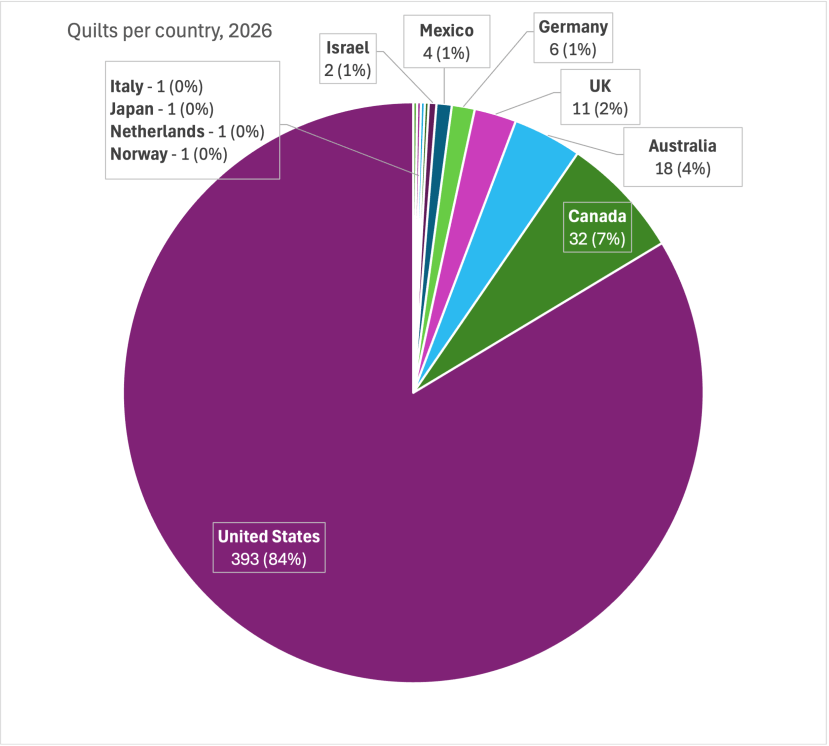
Over the years, people from 30 countries – from Argentina to Zimbabwe! – have submitted their work to QuiltCon. This year, 11 countries are represented, which is the lowest it’s been since the 2019 show. (Again, maybe because of tariffs?)
The vast majority of accepted quilts are from makers in the USA, which makes sense. The MQG was founded in the USA, and I imagine the majority of its 18,000+ members are based there too. And Canada (population ~40 million) is not that far away, so it’s not too surprising that they’re second on the list. But why is Australia third?
It doesn’t make sense from a size perspective. Our population is around 27 million; compare that with countries like Germany (84 million), France (70 million) and the UK (70 million). But Europe has large quilt shows that include some modern quilts (like Festival of Quilts in the UK and the European Patchwork Meeting in France), so perhaps European makers prefer those shows over QuiltCon? And maybe people in Japan (and elsewhere in Asia) are submitting to the World Quilt Festival in Yokohama? (Unfortunately the Tokyo International Quilt Festival is no longer running.)
Maybe it makes sense from a cost perspective? Making and submitting quilts to shows is an expensive endeavour, and often (usually?) more expensive outside the USA. Products tend to cost more, international shipping is usually higher than domestic shipping, and now we have to contend with the cost of tariffs (yes, even on quilts that will be returned to us after a show). That could explain why such a small percentage of show quilts are from outside North America, but not why Australia is so disproportionately represented.
A chat with Tara Glastonbury (@stitchandyarn) – a huge champion of modern quilting in Australia – helped me to think about this a bit more. Tara pointed out that it’s likely a combination of Australia being an English-speaking country, with a history of quilting, and with limited local shows featuring modern quilts. So in most years, our closest relevant show might be QuiltCon.
Anyway, whatever the reasons, Aussies consistently punch above their weight when it comes to QuiltCon, and I’m always delighted to see it. I love that we have a vibrant and engaged community of modern quilters here who are keen to share their work internationally. Long may it continue!
Conclusions
If, like me, you’re interested in QuiltCon, I hope you find these numbers interesting, or insightful, or thought-provoking.
But I don’t want this data, or this blog post, to contribute to any suggestion that QuiltCon = modern quilting, and modern quilting = QuiltCon. The two are not one and the same. Yes, QuiltCon is a fantastic annual display of modern quilts and a wonderful opportunity for modern quilters to get together (in person and online) to celebrate modern quilting. But there are plenty of other shows around the world that welcome modern quilts (see lists from Kelly Spell and Carolina Oneto, for example).
And guess what? They’ll get bigger and better when they receive more submissions. So, if you have the means to do so, I strongly encourage you to submit your work to a relevant show, whether it’s local, regional, national or international. (You can often opt out of judging, if you don’t like that part!)
And, of course, there is a world of modern quilting beyond shows. If you already share your work online – thank you. If you don’t, I hope you’ll consider it. I’m constantly encouraged, motivated, inspired and delighted by modern quilts I see online. There are a lot of people – both amateur and professional – doing incredible work. (Carolina Oneto and Jenny Haynes of Papper, Sax, Sten regularly share others’ work in their posts and stories on Instagram.)
In the meantime, enjoy QuiltCon – from afar or in Raleigh – and keep quilting!
Discover more from Geometriquilt
Subscribe to get the latest posts sent to your email.

Thank you so much for the article, I’ve read it with great interest. I love statitics and numbers))
I would add my opinion about Russian-speaking quilters. I started teaching online improvisational piecing in 2018 and modern patchwork in 2021. Since that time I can see that modern and improv quilting became popular in Russia and Europe among the Russian-speaking quilters. In 2022 there were our 10 quilts (among them 4 were from Russia and 1 was from Belorussia) in Quiltcon. After the war started it became mostly impossible for Russian citizens to partecipate Quiltcon and European Festivals, as their banking cards are not accepted in the world. This year there is just 1 quilt from Russia in Quiltcon. DHL asks 1200$ for delivery from Russia to USA, no one is willing and able to pay such amount. I spent years trying to convience my Russian students to partecipate in European and American festivals. But when the war started, all my work turned to ashes. It’s a pity I would like that Russian quilters could show that they can sew interesting modern quilts too.
About Europe. I live in Italy and travell to various europeans quilt festivals., I can say that art quilts are more popular here – works with machine raw edge applique and that demonstrate real images, not abstraction as it’s often used in modern quilts. Modern and improvisational patchwork is less popular here as I see. That’s why we observe the statitics shown in your diagrams. And patchwork is not as widespread in Europe as in the USA. I live in the South of Italy, there are a few people who know the word “patchwork” here ))
Thank you for sharing your perspective, Yuliya – that’s really interesting (and also depressing) and helps explain some of the realities behind the numbers. (And congrats on being juried in to the show – and selling your quilt!)
Thank you so much Caroline!
Brilliant read! Thanks for putting this together
Thanks for reading!
I’m confused about your comment that you’ve submitted the maximum number of quilts per year: “I’ve been submitting my work to QuiltCon since the 2019 show, and in that time I’ve submitted the maximum number 4 times and had the maximum number juried in once. I’ve never submitted more than the maximum number.”
There is no maximum cap in *submissions*, only on the number accepted (at least for the last few years). So I’m not sure what you mean when you say you’ve never submitted more than the maximum number.
Sorry, I wasn’t very clear there! I mean that I’ve never submitted more than the maximum that anyone can have accepted into the show. You’re right that there’s no cap on submissions. But when the max. number that anyone could have accepted was 5, I never submitted more than 5. Now it’s 4, and since that change, I haven’t submitted more than 4. If the number was dropped again, I’d likely limit myself to submitting that number. (Having said that, in most years I submit fewer than the maximum anyway!)
Thanks, I appreciate the clarification!
Thanks for pointing out that it wasn’t so clear! I appreciate it! 🙂