
Category: Sunday sketch
Sunday sketch #160
Just when you thought I’d moved on from chevrons…

I’m still playing with them. They’re so fun to overlap, and they create such interesting secondary shapes when they do.
I’m such a big fan of orange and hot pink together! I originally designed this with a white background, but then remembered how much I hate making quilts with white backgrounds (because it’s a pain to get rid of all the stray coloured threads from the underside of the quilt top before quilting…!)
This one would be easy to make into a quilt. I know I always say that! But in this case, it’s actually just a bunch of squares with stitch-and-flip corners. Tilt your head to the side and you’ll see what I mean.
I’m toying with the idea of actually making this one. If it worked out well, it might be suitable for submission to QuiltCon 2020… hmm, I wonder if I could manage to make it before the deadline in early December?!
Sunday sketch #159
I had an idea for a block this week. Two pairs of diagonal strips with angled ends, overlapping in the middle to create an ‘X’ shape. Don’t ask me where the idea came from – I must’ve seen an ‘X’ somewhere and wondered if I could do something with it.
One of the things I love most about quilt designing is the fact that a single block can create a million quilt patterns, just by rotating or colouring it differently. Case in point…
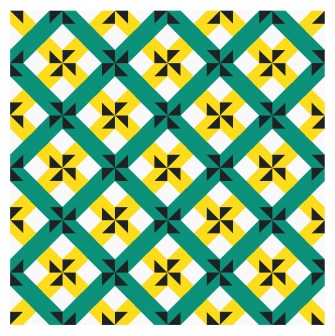
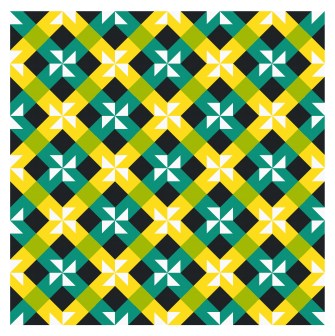


OK, that’s 4 (well, 2 colourways of 2 designs). I made more, but I just liked these 4 together. They’re all a 6 × 6 layout of the same block, using only 4 colours (I know, I know – black and white aren’t colours). Some use transparency; some don’t.
I actually love the idea of creating a single quilt with all 4 of those designs, with the same colour palette to pull them together. Wouldn’t that be cool?
The best thing about this design might be how basic the actual block is.

Given its symmetry and structure, I bet it’s a traditional block that’s been used before – it’s probably even got a name. It’s like a variation on a sawtooth star. Obviously, with different colouring, this block could be used to create completely different designs that don’t look anything like the ones above.
Making these designs into actual quilts would be pretty easy. You’d just need 4 flying geese blocks, 4 half-square triangles, and one square-in-a-square for the centre for each block.
Sunday sketch #158
If I could only ever design using one shape, I’d have to choose the half-square triangle. I just love it. Whenever I’m sketching aimlessly with no fixed idea in mind, I almost always start with some HSTs. They’re a bit edgy, but a bit tame; totally basic, yet versatile enough to lend themselves to some really sophisticated designs.
Recently, I sketched this idea…

It’s no great shakes, right? Not terribly interesting in black and white, but I decided to recreate it in Electric Quilt 8 to see if some colour would perk it up a bit. Well…

It’s funny what a pop of colour can do! I wasn’t overly inspired by this design on paper, but I really love it mocked up in a bright, fun colour palette.
It also works in monochrome, too… I cropped it slightly, so that it’s almost square and more symmetrical.
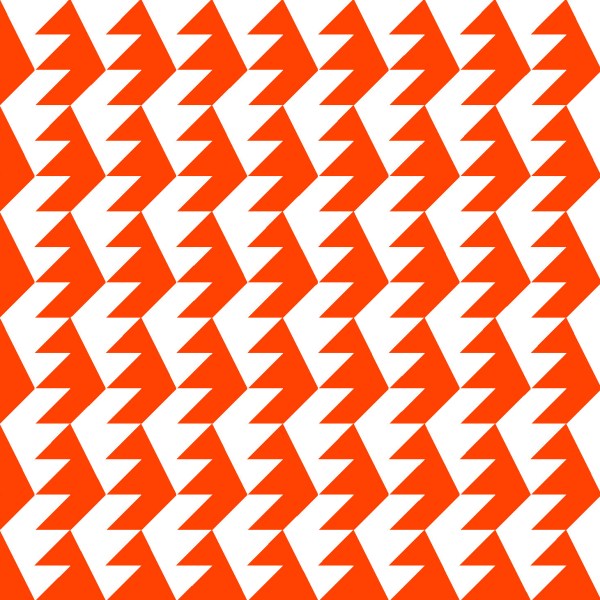
It’s not so clear, with the white background of the design against the white background of this page, but the half-kite shapes (made up of one HST and one half-rectangle triangle) on the sides balance each other out nicely. I reckon a contrasting binding (red against the white shapes; white against the red shapes) would look pretty cool on this one.
This design would be super-easy to make in monochrome, as each 2×3 block is made from 4 HSTs and 1 HRT. There’s an even number of blocks and half blocks, so you could use the 4-at-a-time HST method (or even 8-at-a-time!) and chain-piece your way to a finished quilt top in no time.
The multicoloured method would take a bit more planning, but nothing too difficult. Just a little bit of patience and a lot of coloured pencils 🙂
