
Sunday sketch #391
I am inordinately pleased with this week’s sketch. Sometimes I don’t love a Sunday sketch, or I’ll like it but not love it, and other times I’ll be absolutely smitten. This week’s sketch just pleases me in a way I can’t quite describe. It just feels ‘right’, if that makes any sense.

The funny thing is that this week’s sketch is almost identical to last week’s (which didn’t elicit the same response in me!). The only difference is that I’ve laid the blocks out on point – that is, in a diagonal rather than a standard layout.
OK, I’ve also coloured the blocks slightly differently. The larger circles and smaller inner circles are coloured as background, and the smaller circles formed along the edges of adjacent blocks are coloured in a dark blue. Those small dark circles and the adjoining curves remind me of links in a bike chain.
I also like the clover-like shapes that emerge from the background when some of the block shapes are removed.

Here’s where the design started – in a standard layout. Can you see the similarities with Sunday sketch #390?

Because those small dark circles form between adjacent blocks, they provide an opportunity for playing with colour and introducing transparency. Removing any dark circle (by replacing with the main block colour) where there isn’t an overlap helps to emphasise this effect.
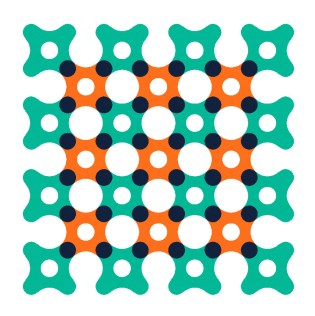

I can also stagger the different coloured shapes to show what each one looks like without overlapping parts. I’ve used this approach before to highlight how the same shape can be coloured a bit differently depending on where it is in the design: see Sunday sketches #246 and #373, for example.
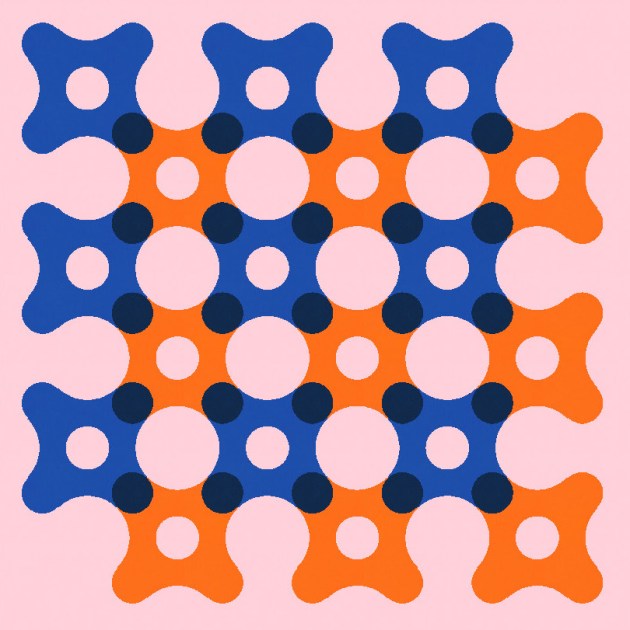
But my favourite is the first version, with all the colours (and the white background, which I keep telling myself I must stop using, cos making quilts with white backgrounds is just annoying!).
This week’s sketches could be made into quilts using the same shapes as the last few weeks’ sketches: quarter-circles (or drunkard’s paths), half-circles and full circles. As this design is laid out on point, you’d also need setting (also called set-in) triangles and corner triangles to finish it off.
I think this design could work with lots of different solids or prints, as long as you could find a suitable colour for the small circles that ties them all together.
Discover more from Geometriquilt
Subscribe to get the latest posts sent to your email.
