
Sunday sketch #397
The last few Sunday sketches have been two-colour designs in relatively bright shades – and that trend continues this week! I must be feeling a need to get back to basics.

This week’s sketch is block-based and uses a standard layout. You might be able to tell already what the block is, but I’ll show you a few designs before revealing it. Here’s my usual attempt to introduce some negative space by removing some blocks (or, in reality, colouring them the same as the background in Electric Quilt 8).


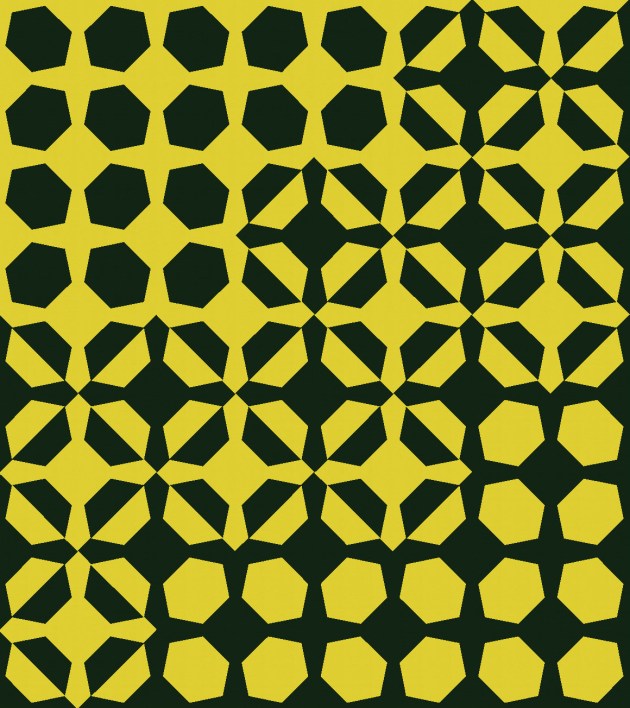
I’ve played before with the idea of starting with one design on one side of a sketch and morphing it into another (related) design on the other side of the sketch (see Sunday sketch #384 for another attempt). Here I’ve started with full hexagons in a dark colour that become half-hexagons that become full hexagons in the light colour.
OK, so here’s the actual building block, arranged in a completely different design. This shape kinda reminds me of a burger box – you know, the light cardboard packaging that you’d get a takeaway burger in.


The block can be arranged in a bunch of interesting ways. I like the centre of this next design – those split hexagons nest with each other nicely, a bit like teeth or cogs – but I’m not sure I love the bold stripes that result. I guess I could’ve extended the blocks to the edges of the design, but I wasn’t so enamoured with that.

Anyway, back to the basic design this week. The thing I like about this week’s sketch is that it’s not immediately clear which is the background colour and which is the foreground: are the dark shapes overlaid on the light, or the other way around?
I played with the ‘Randomize’ tool in EQ8 to explore some other two-colour palettes (since I always seem to use the same ones!). Here are some of the less offensive ones 🙂 …

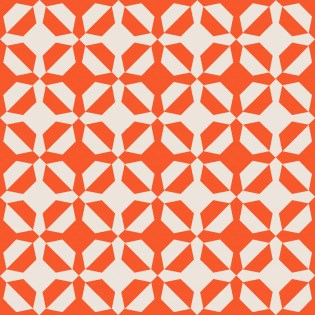


I created the hexagon block design fairly freely in EQ8; I wasn’t paying attention to angles or construction methods. So the easiest way to make this week’s sketches into quilts would be to make a (paper-piecing) template for each half of the block. It’s be pretty straightforward to make the two triangles and then join them. Each half-block triangle is just an isosceles trapezoid plus a small triangle and two side pieces.
Discover more from Geometriquilt
Subscribe to get the latest posts sent to your email.
