
Tagged: raw-edge appliqué
Finished quilt: Unblocked
Now that ‘In Conversation’ is open at Gallery 76 in Sydney, I can show you my quilt, Unblocked, and tell you more about it! (This ended up being quite a long post, so you might want to grab a cuppa first 🙂 )
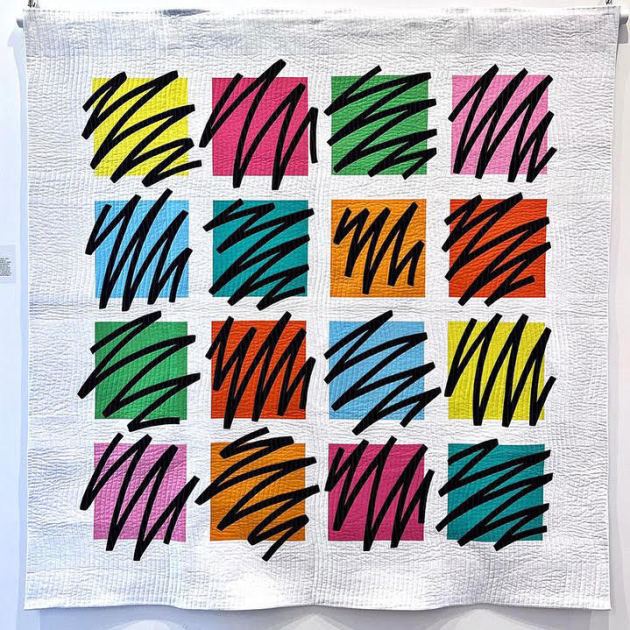
Image: Tara Glastonbury
After Tara Glastonbury (@stitchandyarn) invited me to be one of the Australian quilters in this exhibition, I approached Daisy Aschehoug (@warmfolk) to see if she’d be my ‘conversation’ partner. I’ve been a fan of Daisy’s work for a long time – back when I designing quilts for magazines, I’d admired her magazine patterns and the way she combined curves with other shapes. I liked the fact that our work has some overlaps (we both use solids and bold shapes) but also diverged in interesting ways (like Daisy’s use of handwork and, more recently, reclaimed textiles). Daisy and I had never met in person or interacted a whole lot online, but I had a feeling we’d get on.
I was a bit nervous, cos no one likes rejection, but thankfully Daisy responded almost immediately (actually 7 minutes later – I checked haha) with an enthusiastic YES. Yay! Over the next few months, we had a bunch of fantastic conversations over Zoom – Daisy from Norway, and then Switzerland, and me from Melbourne. We even managed an in-person catch-up in Atlanta at QuiltCon.
In our conversations, we talked really in-depth about our artistic practices and approaches. A recurring theme was how past constraints (like designing for magazine audiences) still influence our work today, and what our work might look like if we could learn to overcome these limitations. Daisy asked really insightful questions that made me think more deeply about my own practice and why I do what I do. I was fascinated by what came out of our conversations – both Daisy’s responses and my own!
One of the things I realised is that I’m really a ‘commercial’, contemporary designer at heart. I like block-based designs that use repetition and symmetry. But they’re not usually considered ‘modern‘. To make modern quilts, I invariably start with a ‘contemporary’ design and remove some elements (symmetry, repetition) while adding others (negative space, bold use of colour). If you follow along with my Sunday sketch series, you might have noticed that the quilts I make for modern shows are often different from the original sketches on which they’re based.
Like Sunday sketch #250, which led to Zester:
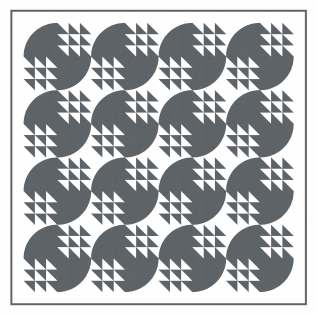

And Sunday sketch #302, which led to Magmatic:


For me, designing modern quilts is an iterative process of adding and taking away. I’m very much a ‘colouring inside the lines’ kind of person, so modern quilt designing requires me to purposefully break that habit.
But how to incorporate these insights into a quilt for the ‘In Conversation’ exhibition? (Tara didn’t require each pair of quilters to go this deep, but Daisy and I were keen to try!) I tried a few different designs in EQ8 that I didn’t love, exploring the concept of making an ‘ugly’ quilt – that is, one that wouldn’t necessarily satisfy an audience but would still fit the definition of a modern quilt. Something dissonant and dissatisfactory to look at, but nonetheless modern. But ultimately, I couldn’t get this concept to work for me. Maybe I’m still too tied to the idea of catering to an audience? Or maybe I just don’t want to look at an ugly quilt myself?
After one of my chats with Daisy, I quickly scribbled an idea on paper, trying to capture this feeling of having to fill in or scratch out ideas when designing quilts.

Although I really liked this concept, I knew that making it would require some complicated paper piecing or appliqué. I’ve done complicated paper piecing before, and it’s great for things requiring straight lines, but these hand-drawn lines are organic and fluid… they really called out for appliqué. Ugh.
I’d never tried appliqué before, raw-edge or otherwise. I don’t do hand-sewing (apart from attaching bindings and sleeves), and I don’t love the often-imperfect look of appliqué. When Daisy asked me what’s one thing I’d never do in a quilt, ‘appliqué’ was one of my answers. I just didn’t think I had the technical skill to achieve the level of precision that I prefer.
So I sat on that idea for a long time and tried to come up with another way to represent our conversations in a design. And then I went to QuiltCon in Atlanta, and saw some very interesting and impressive appliqué quilts. One of them stuck in my mind: As Yet Untitled by Andrew Love.
Andrew used a single piece of black fabric to trace wild, overlapping loops over a Mondrian-like palette of yellow, red and blue organic shapes. I was struck by his precision and craftsmanship as much as by the bold design. At the time, I didn’t look closely, and just assumed (so naively, I realise now) that he must’ve used needle-turn appliqué. The edges just seemed too sharp to me to be raw-edge (which I’d always thought would fray if you just looked at it). When I asked later on Instagram, he confirmed that it was raw-edge. Hmmmmmmmm. Interesting, I thought.
Fast-forward to another few conversations with Daisy, and she urged me again and again: DO THE APPLIQUE. A conversation with Tara about my plans resulted in the same advice: DO THE APPLIQUE. Arrrrghhhh.
So I picked the brains of friends in the Melbourne Modern Quilt Guild and did a bit of googling to find out more about raw-edge appliqué. I’m always amazed by the generosity of quilters in sharing their knowledge!
I figured I’d do a test run, so I bought some Vliesofix double-sided fusible interfacing and some black fabric. Normally I don’t do a lot of testing before I try something – due to a combination of impatience and not wanting to ‘waste’ fabric. But I knew I’d have to test this technique before committing to a whole quilt. Tara’s exhibition deadline was fast approaching, and I didn’t have time to pursue a technique that wasn’t going to work.
I used a bullet-tip marker to draw a scribble onto paper, cut it out, and overlaid it on a square that was the same size as the squares of colour on my quilt top, just to check that it was the size I wanted. Then I traced the scribble onto the fusible interfacing, taking care to trace it backwards, as it gets flipped when it’s adhered to the final fabric. Then I sat the final fused scribble over my pieced block to check if I was happy with it.


This little practice run showed me that the process worked, but I wasn’t happy with the scribble itself. I realised I wanted something heavier, with blunter ends and sharper back-and-forth transitions (where the marker stops when you change directions). So I ordered a wider chisel-tip marker, plus a pad of A2 recycled paper. (Who knew quilting could be such a good excuse to buy more art supplies??)
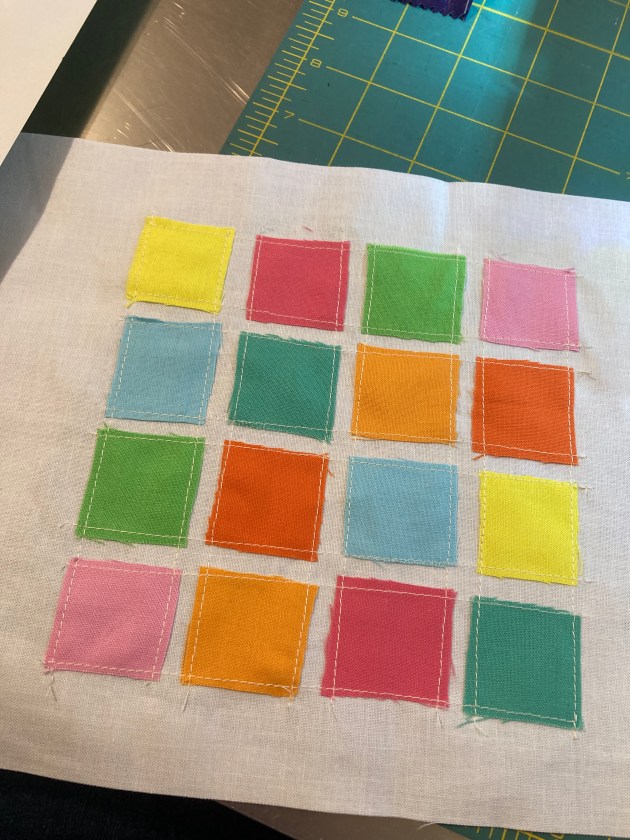
In the meantime, I pieced the quilt top using fabrics from my stash. Usually I agonise over colour selection and placement, but this time I purposefully avoided that habit by going with my first choice of 8 fabrics and my first layout. I did make a little practice piece to test if they looked OK (and to remind me of the placement later!).
When the paper and marker arrived, I sat outside (those markers smell!) and just scribbled. I chose 8 scribbles that were about the right size but sufficiently different. I carefully cut them out of the paper, then tested a few of them over my pieced top, just to make sure I was happy with the overall shape/scribbly-ness. I wanted the scribbles to extend beyond the lines of the squares, but I didn’t want them to touch each other.

Once I had my 8 scribbles, I traced each one on the back of the fusible interfacing (which has a paper side and an adhesive side, the latter of which only gets sticky when you iron it). I then pressed the interfacing onto black fabric, and cut out the traced-on shapes.

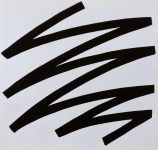
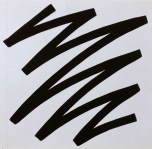
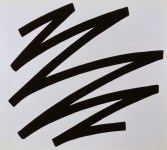
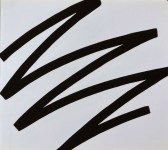
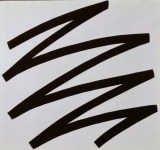
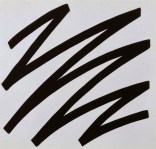
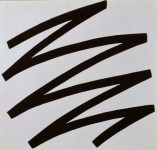
I needed 16 scribbles, so I reversed the 8 original paper scribbles, and traced them onto fusible interfacing once again.
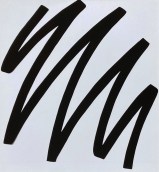
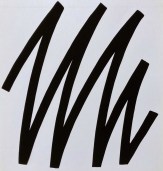


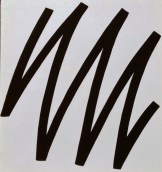


Originally I thought I’d have the scribbly lines running parallel, but then decided to alternate their direction. My hand-drawn sketch had the lines running in all directions, but I decided that was a little too chaotic for me.
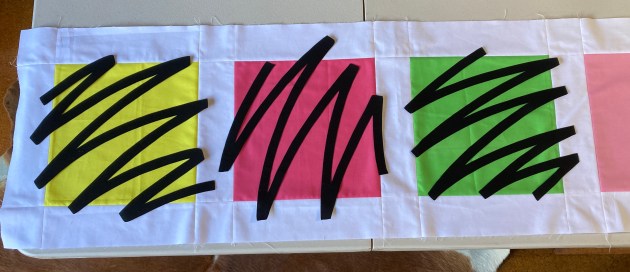
I was worried that over-handling the appliquéd scribbles would cause their edges to fray, so I had planned to work with one row at a time and then join them all together at the end. But then I realised that because the scribbles extend into the sashing between rows, that approach wouldn’t work. So I just worked methodically through each row, then added the next row, and tried not to move the scribbles around too much. I rolled up parts of the quilt top that I wasn’t working on, and tried not to squish it too much.
I fused each scribble onto the quilt top one by one by first peeling back the paper layer and then using my mini-iron on a woollen pressing mat. The instructions for the fusible interfacing say to press for 10 seconds using a damp cloth. I used a scrap piece of Kona White, which meant I could see through the damp fabric and make sure the scribble was in the right spot. As I pressed, the fabric dried out, so I could easily see what parts I’d already done and what parts remained. I have to say, this part of the process was deeply satisfying!
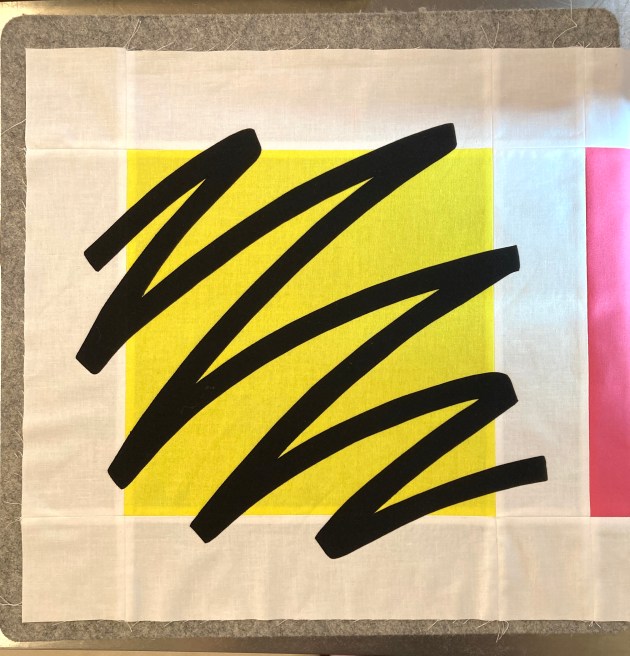
The appliquéd fabric felt very well adhered, and the edges seemed crisp (but not crispy – the quilt top still draped nicely and didn’t feel stiff).
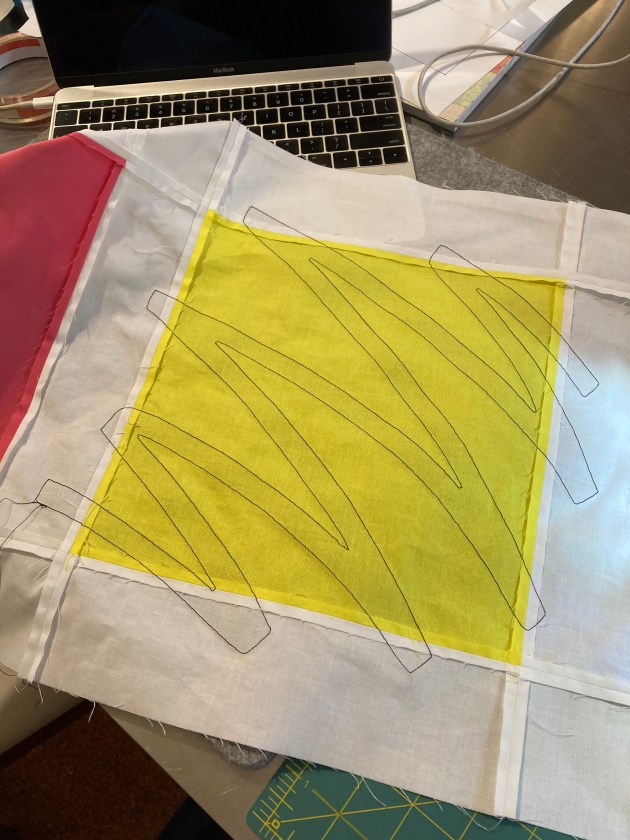
Then, using black thread (and lots of extra lighting!), I stitched around the perimeter of the scribble, as close to the edge as I could manage, using a short stitch length. You can almost see in the second image where I’ve already sewn along the left side of that line.


This part didn’t take nearly as long as I thought it would. Most of it is stitching in a (fairly) straight line, with only a few turns. Here’s the back! (Doesn’t that look good too?)
As I finished each row, I’d arrange the next row of scribbles to make sure none of them overlapped those in the previous row. I tried not to overthink it (a habit of mine).
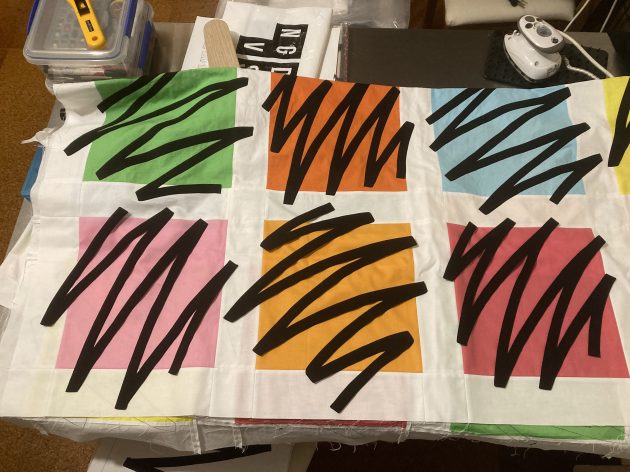
The scribbles probably took me a few days to draw, cut out, trace onto the fusible interfacing, and cut out of the black fabric. All the rest – piecing the quilt top, fusing the scribbles on, and sewing around the perimeters – took only a few evenings of sewing. For a process that I thought would be difficult and take ages, it was remarkably quick and easy.
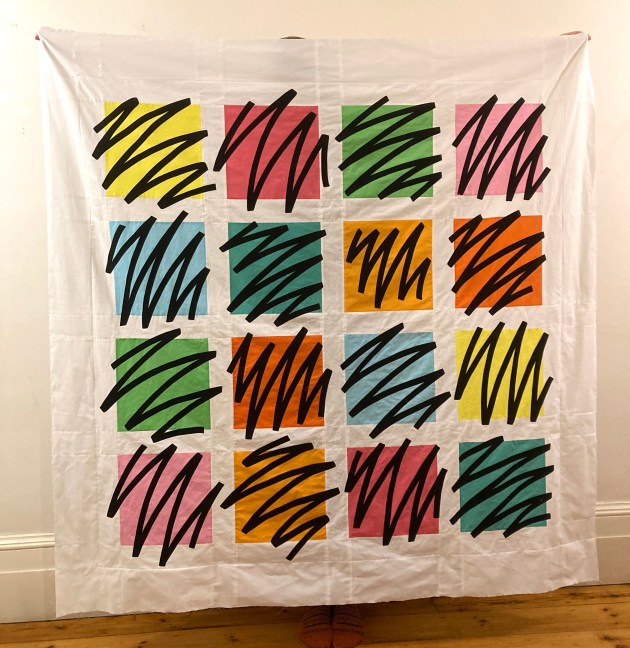
(My husband always gets roped in to quilt photography late at night, where there’s no decent place in our house for a well-lit picture!)
Can you see the one block where I didn’t colour outside the lines? There’s always a part of me that will adhere to the ‘rules’, no matter what 🙂
I sent the quilt top to Valerie Cooper of Sweet Gum Quilting, and we decided on a subtle wavy line (the Good Vibrations panto) that wouldn’t detract from the scribbles. I was worried that white thread over the black wouldn’t work, but it ended up looking great. You can’t really see the thread unless you’re up close anyway.

Image: Valerie Cooper
Most importantly, the edges of the scribbles are still really crisp, with no noticeable fraying. I’ll be interested to see how long they hold up (and how easy it is to trim any tiny stray threads).
The name Unblocked is a bit of a play on my tendency to make block-based designs and how I need to get over that (and other obstacles) to make modern quilts.
I’m grateful to Tara for inviting me to be part of ‘In Conversation’, and to Daisy for being an enthusiastic and committed conversation partner. This whole process has been so rewarding! The other work in the show is just as amazing. I find the similarities and differences between quilts within and between each Aussie/international pairing really interesting. Some pairs of quilters decided on specific quilt blocks and colour palettes to use, while others addressed the same concept or even shared materials. I love the diversity of approaches.
To find out more about the show and other goodies coming up, check out the supporter page. In Conversation’ is on from 27 May to 25 June at Gallery 76 in Sydney and will be in Melbourne later in the year.
